Less than four months after securing parliamentary approval for a record-breaking $1.558 trillion budget, the largest in Guyana’s history, the People’s Progressive Party/Civic (PPP/C) Government has returned to the National Assembly seeking an additional $54.9 billion in spending authority.
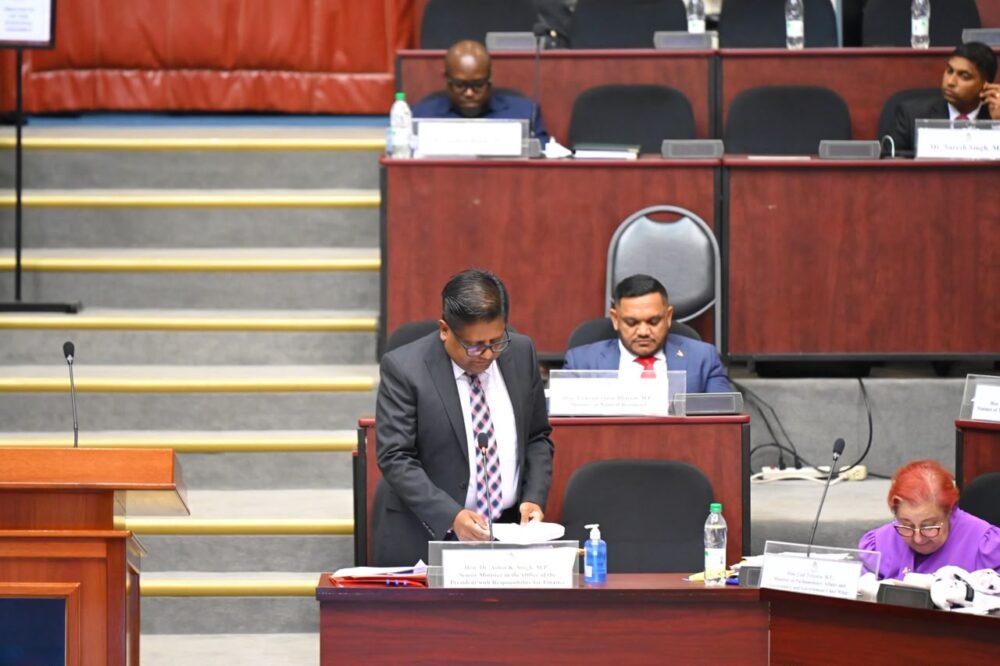
The request, contained in Supplementary Financial Paper Number 1 of 2026 and presented on Friday by Senior Minister in the Office of the President with Responsibility for Finance, Dr. Ashni Singh, is likely to raise fresh questions about budget planning and public accountability, particularly at a time when Parliament is not functioning in its traditional oversight role.
The supplementary request comes despite the Government’s assurances in February that the massive budget would finance its ambitious development agenda during its new term in office. Yet, before the fiscal year has reached its halfway point, billions more are being sought for projects and programmes that are largely ongoing and were known at the time Budget 2026 was prepared.
The issue is further compounded by the absence of robust parliamentary scrutiny. While the National Assembly remains constituted, key oversight mechanisms have yet to fully function following the September 2025 General and Regional Elections, limiting the Opposition’s ability to examine government spending and hold the executive accountable for the use of public funds.
According to the Ministry of Finance, the supplementary allocations are intended to support accelerated implementation of government projects and programmes across the country.
The largest request is $19.1 billion under the Office of the Prime Minister, including additional funding for the Gas-to-Energy Project, the flagship initiative that the Government says will eventually cut electricity costs by half.
Another $17.5 billion is being sought for the housing sector to support what the Government described as an accelerated work programme. The sector had already received $159.1 billion in the 2026 budget.
The Ministry of Public Works is requesting $8.5 billion, including $6 billion for miscellaneous roads and drainage works and $2.5 billion for hinterland roads.
An additional $8.3 billion is being sought under the Ministry of Agriculture, including $3 billion for the Guyana Sugar Corporation (GuySuCo), $4.5 billion for the National Drainage and Irrigation Authority (NDIA) and $807.5 million for the Guyana Rice Development Board.
The supplementary paper also seeks $600 million for maintenance of coastal airstrips and $496.3 million for water interventions under the Ministry of Public Utilities and Aviation, along with $60 million for the Customs Anti-Narcotics Unit (CANU).
In defending the request, the Ministry of Finance said the additional funds would support ongoing investments in infrastructure, agriculture, housing, healthcare, education, energy and public services.
“Government has, over the last five years and continuing in its new term, ramped up investments to strengthen, expand, and rehabilitate the country’s drainage and irrigation (D&I) infrastructure, promote growth in agriculture, improve access to world-class healthcare, expand housing areas and road networks across the country, modernise and expand the education sector to ensure persons have free access to education from nursery to the tertiary level, modernise and diversify the electricity sector, digitise processes for access to goods and services across all sectors, and generally improve the quality of life being enjoyed by citizens.”
The ministry said the sums being requested would support those intensified investments.
However, the supplementary request is expected to fuel debate about the Government’s budgeting process. Traditionally, supplementary financial papers are intended to address unforeseen expenditure or emergencies arising after the passage of the national budget.
Many of the items listed in the current request—including housing expansion, roads, drainage, agriculture and the Gas-to-Energy Project—are longstanding programmes that formed part of the Government’s development agenda before Budget 2026 was approved.
The request also comes against the backdrop of unprecedented oil revenues and rapid economic growth. Since first oil production in 2019, the Government has repeatedly highlighted Guyana’s expanding fiscal resources and economic performance as evidence of its capacity to fund transformative development projects.
Against that backdrop, Guyanese are questioning why a budget of $1.558 trillion, passed only on February 14, requires an additional $54.9 billion in spending authority less than four months later.
Parliament is expected to consider the supplementary financial paper in the coming days.