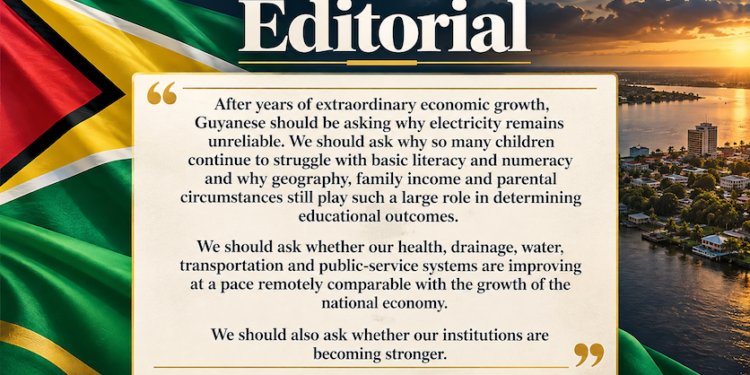
Guyana continues to attract global attention for its extraordinary economic growth. The International Monetary Fund (IMF) projects that the country’s economy will expand by 16.2 percent in 2026 and 19.7 percent in 2027, making Guyana one of the fastest-growing economies in the world.
The government has understandably celebrated these forecasts. Yet beyond the impressive headlines lies a troubling reality that raises a fundamental question: who is truly benefiting from Guyana’s oil-driven prosperity?
For many ordinary citizens, daily life tells a very different story from the one reflected in GDP statistics. Rising living costs, stagnant wages, inadequate public services and growing economic pressures continue to define the experiences of thousands of Guyanese. While economic growth has surged since the discovery of offshore oil in 2015, poverty remains stubbornly high. Reports indicate that nearly half of the population lives in poverty, while a significant portion continues to experience extreme deprivation.
This disconnect between national wealth and individual wellbeing highlights one of the most pressing challenges facing the country. Economic growth, by itself, does not automatically translate into improved living standards. Without effective policies and equitable distribution mechanisms, wealth can become concentrated among a small segment of society while the majority struggles to share in the benefits.
Analysts point to several factors contributing to this imbalance. Among them is the phenomenon commonly known as “Dutch Disease,” in which large inflows of resource revenues can weaken other productive sectors of the economy. As oil earnings expand, agriculture, manufacturing and other traditional industries may find it increasingly difficult to compete, reducing opportunities for broad-based employment and economic diversification.
At the same time, inflation and rising prices continue to place pressure on households, particularly in rural and low-income communities. For many families, any gains from economic growth are quickly eroded by higher costs for food, transportation and other essentials.
Equally concerning is the issue of inclusive growth. Development experts have long argued that economic expansion must be accompanied by policies that ensure citizens share meaningfully in the benefits. Growth that enriches a narrow group while leaving large segments of the population behind risks deepening social divisions and undermining public confidence in national institutions.
Questions have also been raised about governance and accountability. Resource-rich countries frequently face challenges when governments become increasingly reliant on revenues from natural resources rather than on taxation. In such circumstances, the relationship between citizens and the state can weaken, reducing incentives for accountability and effective public service delivery.
Guyana’s Natural Resource Fund was established to help manage oil revenues responsibly and ensure that resource wealth benefits both present and future generations. However, the effectiveness of that objective depends heavily on transparency, strong oversight and public confidence in how revenues are spent.
The country’s unprecedented wealth should provide an opportunity to transform healthcare, education, infrastructure and social services. It should also create pathways out of poverty for vulnerable communities and generate opportunities for young people entering the workforce. Yet many Guyanese continue to question whether these benefits are reaching those who need them most.
According to one analyst, Guyana’s challenge is not a lack of resources but a failure to ensure that those resources are distributed in ways that improve the lives of ordinary citizens. That requires greater investment in people, stronger accountability mechanisms and a commitment to ensuring that development is inclusive rather than exclusive.
The issue is not whether Guyana is growing. The numbers clearly show that it is. The real issue is whether that growth is producing meaningful transformation in the lives of the people whose natural resources are generating the wealth.
An economy can expand at record rates while poverty persists. It can attract international praise while citizens struggle to meet basic needs. The true measure of success is not the size of the economy but whether prosperity is broadly shared.
Guyana’s oil boom presents a historic opportunity. Whether it becomes a foundation for national development or a symbol of missed opportunity will depend on the choices made today. Economic growth alone is not enough. Growth must translate into improved living standards, reduced poverty and greater opportunity for all Guyanese if the promise of the oil era is to be fully realised.