Conflicting accounts surrounding the repatriation of dozens of Indian nationals employed by EKAA HRIM Earth Resources have raised fresh questions about who ultimately financed their return home and whether commitments made by the company and government agencies were fulfilled.
The issue resurfaced on June 3 when Opposition Leader and We Invest in Nationhood (WIN) leader Azruddin Mohamed announced on social media that he had donated his entire April parliamentary salary, along with additional personal funds, to assist 38 Indian nationals whom he described as trafficked workers left stranded in Guyana.
“This month’s assistance included the full contribution of the Opposition Leader’s monthly salary, along with additional funds from his personal resources, toward airfare for the affected Indian nationals,” Mohamed stated. He added that four businessmen also contributed financially and said the workers expressed gratitude for the assistance.
Mohamed’s statement, however, appears at odds with information released days earlier by the Ministry of Labour and Manpower Planning.
In a statement issued on May 29, the Ministry said EKAA Quarry had informed officials that, despite what it considered breaches of contract by some workers, it remained willing to repatriate employees with three months or less remaining on their contracts. The Ministry said it had identified five such workers and was engaging the company regarding arrangements for their return.
The Ministry also stated that 15 workers had expressed a desire to remain in Guyana and continue working, and that employment opportunities had been secured for them while work permit applications were being processed. Regarding the remaining 17 workers, the Ministry said it was continuing engagements with the Indian High Commission and other stakeholders concerning repatriation arrangements.
Mohamed’s announcement raises an obvious question: if repatriation discussions involving the company, the Ministry and the Indian High Commission were already underway, why was private funding allegedly needed to purchase airline tickets for the workers’ return?
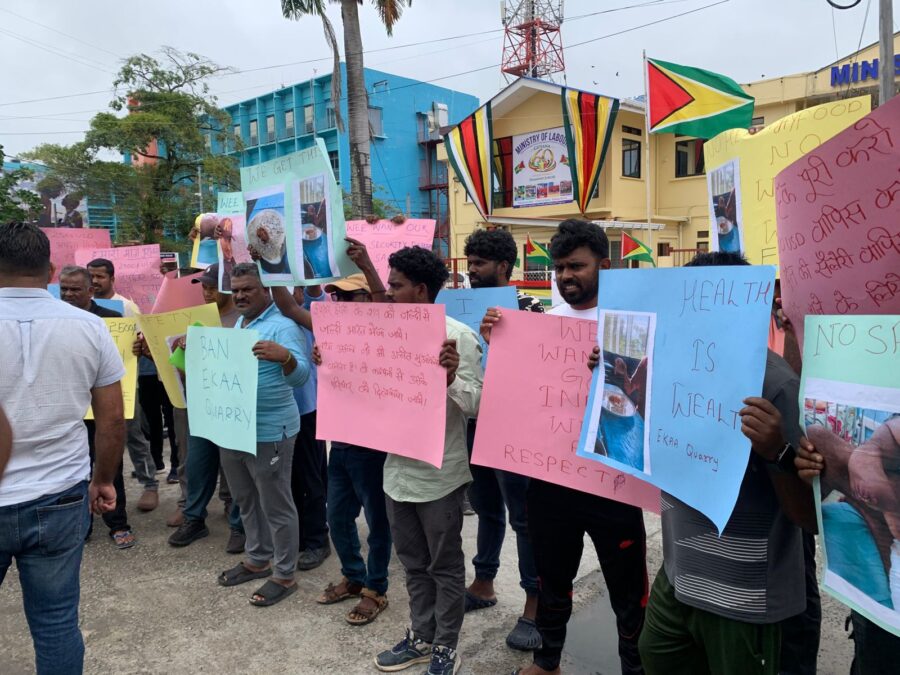
The controversy stems from a labour dispute involving dozens of Indian nationals employed at EKAA HRIM Earth Resources’ US$20 million quarry operation in Batavia, Region Seven. The matter attracted national attention following the death of an Indian worker at the site and subsequent intervention by Mohamed.
In a statement issued on May 16, Mohamed said more than 38 Indian nationals sought assistance after he visited the quarry owned by businessman Sarju Bhaskar. The workers reportedly raised concerns about their working and living conditions, compensation, the retention of passports by the company and arrangements for returning to India.
During its investigation, the Ministry of Labour confirmed that workers had complained about their passports being held by the company. According to the Ministry, the passports were subsequently returned following intervention by labour officials.
The Ministry also examined allegations that workers were being deprived of approximately US$2,500 each.
Mohamed maintained in his June 3 statement that EKAA Quarry “continues to owe each worker approximately $2,500 USD that was deducted from their salaries as a security deposit,” adding that some workers had reportedly been informed that those monies would not be returned.
The Ministry’s findings differed substantially.
According to the Ministry, officials reviewed contracts presented by the workers and found that 11 employees possessed agreements stating that US$2,500 would be deducted and paid as a bonus at the end of the contractual period. However, those contracts were governed by the laws of Mauritius in some cases and the United Arab Emirates in others.
The Ministry further stated it found that the remaining 26 workers were employed under contracts providing for a lower salary during the first six months and a higher rate thereafter, which officials interpreted as a probationary arrangement.
“In the circumstances, there was no evidence to support the contention that the monies were being withheld from the workers, nor was any contract presented that could be applied to the laws of Guyana for enforcement,” the Ministry concluded.
The conflicting accounts have left a series of important questions unanswered. If the Ministry of Labour, the Indian High Commission and EKAA Quarry were already engaged in repatriation discussions, why was private funding allegedly required to purchase airline tickets? Who ultimately bore the financial responsibility for repatriation—the company, the Government of Guyana, the Indian High Commission, private donors, or some combination thereof?
Equally unresolved are questions surrounding the workers’ claims that they are owed approximately US$2,500 each. While the Ministry concluded that there was no evidence of monies being improperly withheld, the workers and Mohamed maintain that substantial sums remain outstanding.
Beyond the dispute over airfare and wages lies a broader issue. The death of a worker at the quarry, complaints that passports were retained by the company before being returned following intervention by labour authorities, allegations of unpaid monies, and uncertainty over repatriation arrangements have cast an uncomfortable spotlight on the treatment of migrant labour in Guyana’s booming natural resources sector.
The episode has renewed scrutiny of whether existing oversight mechanisms are adequate to protect foreign workers and whether state agencies, employers and diplomatic representatives responded effectively when concerns first emerged. With key aspects of the matter still contested, the controversy is likely to remain under public scrutiny long after the workers have returned home, serving as a test of Guyana’s ability to balance rapid economic expansion with the protection of workers’ rights and welfare.
See Mohamed’s full statement below-
This month’s assistance included the full contribution of the Opposition Leader’s monthly salary, along with additional funds from his personal resources, toward airfare for the affected Indian nationals. Four businessmen also assisted with finances.
The beneficiaries expressed gratitude for the support and assistance provided.
EKAA Quarry failed to honor its commitments to the workers. The company continues to owe each worker approximately $2,500 USD that was deducted from their salaries as a security deposit, with some workers being informed that these funds will not be returned.