President Irfaan Ali’s announcement that Guyanese and Barbadians will soon be able to travel between the two countries using digital identification cards instead of passports has been hailed as another step toward deeper Caribbean integration. Yet the disclosure that airlines are not yet ready to facilitate the arrangement has also highlighted a familiar CARICOM problem: ambitious regional policy announcements often racing ahead of the systems, logistics and institutions needed to make them work smoothly.
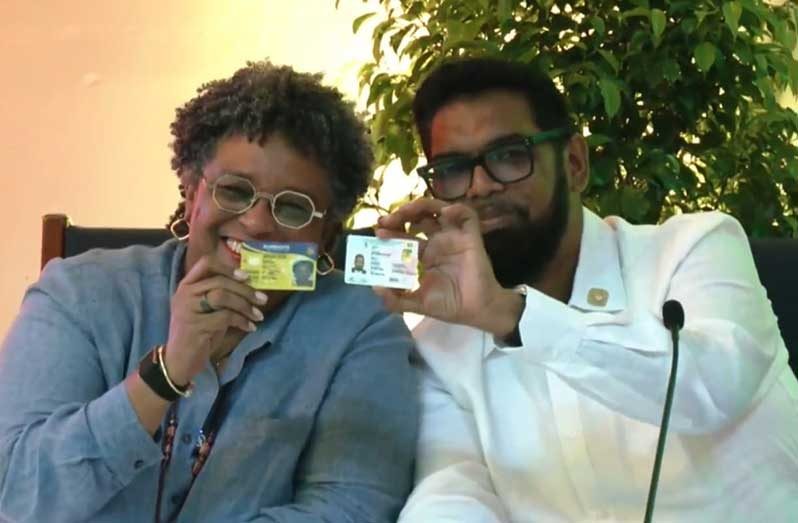
Speaking Tuesday alongside Barbados Prime Minister Mia Mottley at the Guyana National Stadium, Providence, President Ali said the digital ID travel arrangement would take effect from July, explaining that the delay was necessary because airlines still need time to adapt.
“Today, you will see the power of the digital ID card as from July, and that is not because the system is not ready, that is because the airlines need some time to adjust to the new system,” Ali said.
His remarks inadvertently underscored a longstanding regional deficiency — the tendency within CARICOM to announce integration measures before critical stakeholders, including transportation providers, immigration systems and border management agencies, are fully aligned operationally.
The initiative would allow Guyanese and Barbadians to travel between the two countries using digital identification cards, even in cases where travellers do not possess passports.
Prime Minister Mottley described the initiative as a breakthrough that would eventually be expanded to other Caribbean countries.
“Both gentlemen had to work with multiple departments across both Barbados and Guyana, as well as the regional security architecture, and in short order, less than six weeks’ time, they were able to allow us to align this possibility that enures not to the benefit of the Cabinet of Guyana or the Cabinet of Barbados, nor enures to the private sector of Guyana or the private sector of Barbados, but it is now benefit to benefit each and every citizen,” Mottley said, referring to Barbados Minister of Innovation Jonathan Reid and Guyana’s Minister of Government Efficiency Zulfikar Ally.
She added: “Even if a person does not have a passport but has a digital ID card, they could now travel between the two countries.”
While the initiative reflects the growing push toward digital governance and freer regional movement, observers note that the airline readiness issue exposes the practical complexities that continue to hamper Caribbean integration more than 50 years after the establishment of CARICOM itself.
CARICOM was founded on July 4, 1973 with the signing of the Treaty of Chaguaramas by four Caribbean leaders widely regarded as the “Founding Fathers” of the regional movement: Prime Minister Forbes Burnham of Guyana, Prime Minister Errol Barrow of Barbados, Prime Minister Michael Manley of Jamaica and Prime Minister Dr. Eric Williams of Trinidad and Tobago.
The creation of CARICOM followed the collapse of the West Indies Federation and was intended to promote economic integration, functional cooperation, coordinated foreign policy and ultimately improve the quality of life for Caribbean people through greater regional unity.
Over time, membership expanded beyond the original four countries. CARICOM’s full members are Antigua and Barbuda, Bahamas, Barbados, Belize, Dominica, Grenada, Guyana, Haiti, Jamaica, Montserrat, St. Kitts and Nevis, St. Lucia, St. Vincent and the Grenadines, Suriname, and Trinidad and Tobago.
The Community’s associate members are Anguilla, Bermuda, the British Virgin Islands, the Cayman Islands, and the Turks and Caicos Islands.
One of CARICOM’s longstanding objectives has been the free movement of Caribbean nationals, goods, services and capital. However, implementation has often proven uneven and slow, with regional transportation remaining among the bloc’s biggest weaknesses.
For decades, Caribbean leaders have spoken about seamless regional travel, harmonised immigration procedures and reduced barriers to movement, yet travellers across the region still frequently encounter expensive airfares, limited routes, inconsistent immigration treatment and administrative confusion.
The digital ID initiative is therefore being viewed as both symbolic progress and a reminder of CARICOM’s recurring implementation gap.
Observers point out that introducing a new travel identification system requires extensive coordination involving airlines, immigration authorities, airport systems, border security databases, international aviation regulations and passenger verification protocols. Without those systems fully synchronised, policy announcements risk creating confusion rather than seamless integration.
The fact that airlines reportedly require a two-month adjustment period after the political announcement suggests that critical operational stakeholders were not fully prepared before the initiative was publicly unveiled.
Still, the move signals the growing importance of Guyana and Barbados within regional leadership circles. Both Ali and Mottley have increasingly positioned themselves as advocates for accelerated Caribbean integration, digital transformation and greater regional self-sufficiency.
Whether the digital ID initiative becomes a model for wider CARICOM integration or another example of ambitious regional policy struggling against institutional and logistical realities may depend less on political declarations and more on whether the Caribbean’s fragmented systems can finally move at the same pace as its rhetoric.