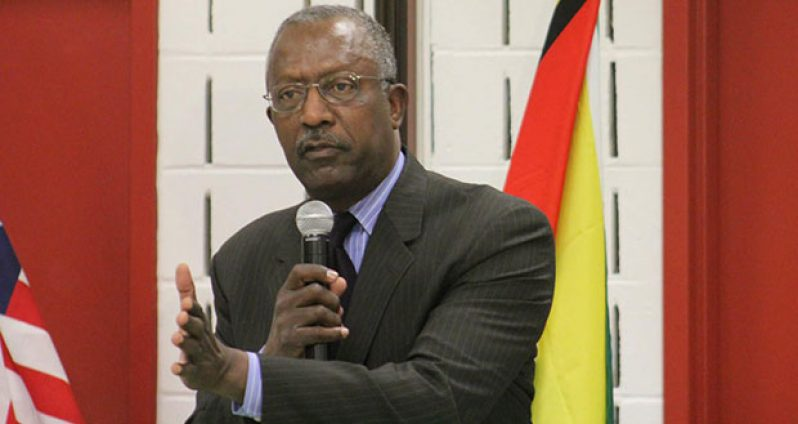
Today Guyana marks 60 years of Independence. Retired Colonel Desmond Roberts remains one of the living links to the historic midnight when the Golden Arrowhead first rose above an independent nation.
On May 26, 1966, Roberts was a young Second Lieutenant in the newly established Guyana Defence Force (GDF) when he was entrusted with raising Guyana’s national flag as British Guiana formally became the independent nation of Guyana.
Despite the significance of the occasion, Roberts recalled in a previous interview with the Guyana Chronicle that he initially viewed the assignment as simply another military duty.
“I didn’t think of it as something special; it was just something to do,” he said. “The rehearsals were tough.”
Roberts’ journey to that defining moment began in 1965 after completing his ‘A’ Levels and spending a brief period working at the Statistical Bureau. He joined the military and departed for the prestigious Mons Officer Cadet School in England, becoming one of the first officers of the British Guiana Special Services Unit to receive training there. Upon returning home, he accepted an invitation to join the newly formed GDF as the colony prepared for independence.

The road to Independence night was not without obstacles. During rehearsals, Roberts was removed from the parade after being dismissed as a novice by a British Army colonel.
“They said it was Prime Minister Forbes Burnham who gave the instruction, but I doubt that. It was the same British officer,” he recalled.
Just days before the ceremony, however, he was unexpectedly reinstated.
“I don’t know what happened, but a day or two before the event, I was back in the parade.”
Adding to the challenge, the flag that would ultimately be raised was not the same one used during rehearsals.
“It wasn’t the same flag that we were rehearsing. This was a new flag which entailed a completely different system of getting it up,” he explained.
Because the final Golden Arrowhead was much larger, Lieutenant Ulric Pilgrim was assigned to assist him.
As midnight approached, thousands gathered at what is now the National Park to witness the birth of a new nation.
“On the night, the park was packed to capacity,” Roberts remembered. “I was nervous about getting it right.”
Then came the moment that would become part of Guyana’s history.
“The flag started to go up rather slowly, but then when it was almost at the top, the wind did the trick and it flew beautifully.”
The memory remains vivid six decades later.
“It was really a beautiful flag. Nobody had ever seen it. People were gasping and some even started crying.”
For Roberts, one of the most memorable scenes unfolded immediately afterwards when Prime Minister Forbes Burnham invited Opposition Leader Dr Cheddi Jagan to join him.
“Then Prime Minister Burnham called up Dr Cheddi Jagan and the two embraced,” he recalled. “It was really a remarkable moment. It set in motion all kinds of ideas that the whole nation will come together. At the time it looked hopeful.”
That hope for national unity remains one of the enduring lessons Roberts carries from Independence Day.
“We have to change this nonsense about race and ethnicity for this country to develop,” he said. “We have no reason to be poor. I hope that one day everyone would be wealthy in Guyana—and by that I mean, able to live a comfortable life. We have everything to make it possible.”
The raising of the Golden Arrowhead was only the beginning of Roberts’ service to Guyana.
After serving at Eteringbang in the North West District, he organised the first GDF athletics championships in 1967. He later became Officer Commanding No. 4 Company and assumed command of the unit during the 1969 Rupununi Uprising, one of the young nation’s earliest security challenges.
His career advanced rapidly. He served as General Staff Officer Two in 1970 and 1971 and as second-in-command of the Second Battalion in 1972. Promoted to Major in 1973, he became the first military director of the Guyana Youth Corps before later serving as Assistant Director General of the Guyana National Service.
In 1976, he was promoted to Deputy Director General of the National Service and later served as Director General from 1979 to 1981. He also served as Guyana’s non-resident Military Attaché to Brazil and coordinated Guyanese, North Korean and United Nations Environment Programme teams involved in the Eclipse Falls hydro-project. In 1986, he was appointed Commander, Administration and Logistics, serving until his retirement from the GDF in 1990 with the rank of Colonel.
From the young officer who helped raise the Golden Arrowhead on Independence night to a senior military leader who contributed to national development, Roberts’ life has been closely intertwined with Guyana’s story.
Sixty years later, he remains guided by the same hopes that filled the air on Independence night—unity, opportunity and progress for all Guyanese. His story is a reminder that Independence was not only the birth of a nation, but also the beginning of a continuing journey toward a more united and prosperous Guyana.
Roberts’ recollections of Guyana’s Independence celebrations were previously shared in interviews with the Guyana Chronicle.