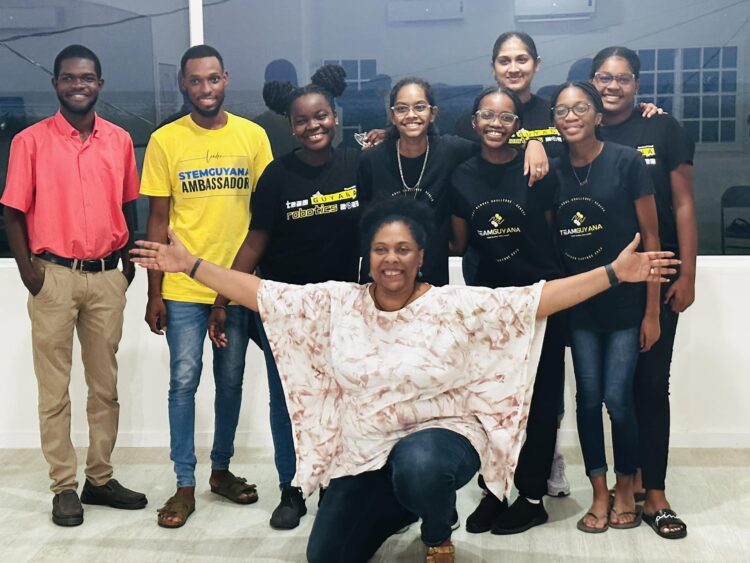
Guyana must urgently address weaknesses in literacy and technology education if it hopes to prepare young people for an economy increasingly shaped by artificial intelligence (AI), according to AI expert and STEM education pioneer Dr. Karen Abrams.
In an opinion piece published in Kaieteur News on May 17, Abrams, Founder and Executive Director of STEMGuyana, argued that every Guyanese child needs to master three essential literacies—traditional literacy, digital literacy and AI literacy—to remain competitive in the labour market of the future.
“How a child encounters artificial intelligence depends entirely on the teacher,” Abrams wrote. In some classrooms, she said, AI appears “intimidating, abstract, and disconnected from anything that matters in a young person’s life,” while in others it is taught as naturally as reading. “The difference between those two classrooms is not the technology. It is the adult standing in front of the children.”
Abrams, who holds a doctorate in educational administration and has been at the forefront of introducing coding, robotics and AI education to Guyanese children through STEMGuyana programmes, contended that AI literacy is no longer optional.
“Every Guyanese student must develop AI literacy if they are to be competitive in the labour market they will actually enter, in this country or anywhere else in the world,” she wrote.
However, she stressed that AI literacy cannot be developed in isolation and must be built upon a foundation of traditional literacy and digital literacy.
The first challenge, she said, is ensuring students remain in school long enough to acquire fundamental academic skills.
Abrams’ concerns come against the backdrop of a 2024 assessment by the United Nations Development Programme (UNDP), which found that large numbers of Guyanese students fail to complete secondary education. The report attributed the trend to longstanding inequalities within the education system, including overcrowded classrooms, inadequate resources, teacher-related shortcomings and school violence, all of which undermine students’ ability to remain in school and acquire advanced skills.
Referencing a recent report on the findings, Abrams noted that the average Guyanese student leaves the school system around Grade Nine, at approximately age 14.
“Children who leave school before completing secondary education will likely not develop AI literacy, will probably not develop digital literacy, and will probably not develop the foundation for any of the higher-order skills the next economy will demand,” she wrote.
According to Abrams, the economic consequences of early school leaving are becoming more severe as automation and AI transform workplaces. While previous generations could still find employment in sectors such as agriculture, construction and services without completing secondary school, future workers may face fewer opportunities as routine tasks become increasingly automated.
“The conversation about innovation in this country has to start there,” she said, describing secondary-school retention as “the precondition for everything else this country wants to become.”
Abrams identified digital literacy as the second critical pillar. She argued that the ability to use social media platforms should not be mistaken for genuine technological competence.
“Too many Guyanese students and adults can use WhatsApp, Facebook, and TikTok, but still struggle to attach a document, format a report, search responsibly, complete an online form, manage a spreadsheet, join a virtual class, protect a password, or troubleshoot a simple device problem,” she wrote.
Digital literacy, she explained, involves using technology productively for learning, work and problem-solving, while also developing the ability to critically assess online information.
With the internet increasingly saturated by AI-generated content, deepfakes and misinformation, Abrams warned that students must learn how to verify information and question sources.
“A child without the habit of asking who made this, why, and on what evidence will not navigate that environment safely, let alone productively,” she stated.
Only after acquiring those foundations can students effectively develop AI literacy, Abrams argued.
Drawing on STEMGuyana’s experience teaching children as young as nine years old, she said young learners can readily understand concepts such as machine learning, neural networks and large language models when they are explained appropriately.
“What surprises them most, in our experience, is how much guesswork the systems actually do,” she wrote.
Abrams emphasised that students must understand that AI systems generate predictions rather than certainties, making human oversight and verification essential.
Looking ahead, she predicted that AI fluency will become a basic workplace expectation by 2032, much as computer literacy is today.
“The young people who are fluent in those tools, who can create and manage AI agents, implement APIs and other technologies will out-produce those who are not, by margins large enough to determine who is hired, who is promoted, and who is paid well,” Abrams wrote.
She also argued that Guyana and the wider Caribbean must move beyond training AI users and cultivate AI engineers, scientists and developers capable of creating technologies tailored to sectors such as agriculture, healthcare, climate adaptation and financial services.
Summing up her prescription for the country’s future, Abrams wrote: “Three literacies, in this order. Regular literacy, defended against the dropout crisis. Digital literacy, taught with judgement and skill. AI literacy, built on the others rather than substituted for them.”
“Get this right,” she concluded, “and Guyanese students can compete anywhere in the world. Get it wrong, and the most consequential decade in this country’s history will pass with another generation prepared for the economy of the past.”