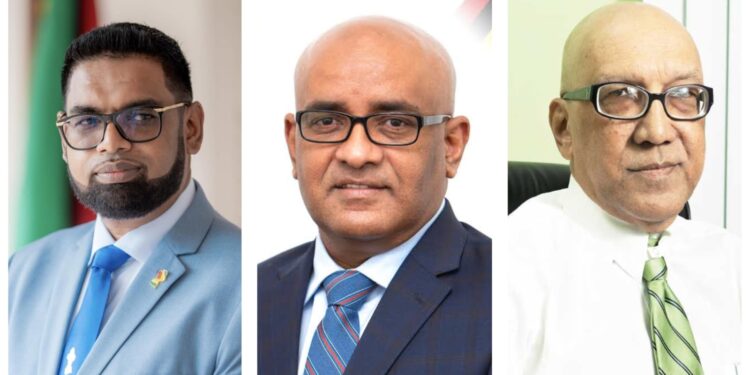
Former head of the Environmental Protection Agency, Dr. Vincent Adams, said Guyana’s authorities and judiciary are enabling ExxonMobil to evade full financial responsibility for a potential catastrophic oil spill offshore Guyana, warning that the country is being exposed to “financial bankruptcy and environmental catastrophe” while the oil giant reaps enormous profits.
In a blistering public letter following the Court of Appeal’s decision overturning Justice Sandil Kissoon’s landmark 2023 ruling on unlimited parent company liability coverage, Adams contended that Exxon is being protected and “green-lighted” by the State despite clear permit provisions requiring the company and its co-venturers to guarantee all spill-related costs.
“Founding fathers Forbes Burnham and Cheddi Jagan must be turning in their graves witnessing the surrendering of Guyana’s sovereignty to new colonial masters such as corporate giant Exxon,” Adams declared.
Adams, a former Executive Director of the EPA and retired senior manager at the United States Department of Energy (DOE), said he personally established the Parent Company Guarantee (PCG) policy while heading the EPA specifically to prevent Exxon from insulating itself from liability through its Guyanese subsidiary, ExxonMobil Guyana Limited (EMGL).
The former EPA head argued that the Court of Appeal effectively allowed Exxon to sidestep responsibility by accepting arguments that EMGL alone is liable under the Production Sharing Agreement and environmental permits, despite the subsidiary lacking the financial capacity to cover a major disaster.
“Consequently, in the event of a spill, EMGL declares bankruptcy and Exxon goes scot-free, leaving Guyana holding the bag of financial bankruptcy and environmental catastrophe,” Adams warned.
Guyana’s Court of Appeal recently overturned Justice Kissoon’s May 2023 decision which had required Exxon and Stabroek Block partners Hess Corporation and CNOOC to provide an unlimited parent company guarantee covering all costs associated with an oil spill.
Kissoon had ruled that Guyana’s environmental permits clearly mandated such coverage to protect the country from the potentially devastating impacts of offshore oil operations. However, the Appeal Court accepted arguments that the permits did not expressly state the term “unlimited.”
Adams described that reasoning as “nonsensical,” insisting the permits’ language requiring coverage for “all costs” unmistakably means unlimited liability.
“It is therefore unfathomable how such ‘unambiguous language’ could mean anything but an ‘unlimited guarantee’, since all means no limit,” he wrote.
He accused the Court of ignoring key operative wording in the permits while embracing what he called Exxon’s “ghost defence arguments.”
“Confusingly, the Court also found that ‘while Exxon remains liable for pollution related damages, that liability does not automatically require unlimited financial assurance’, completely ignoring the key operative words ‘all costs’ at Clause 14.10,” Adams stated.
At the heart of Adams’ criticism is his contention that Exxon has been enabled by regulators and successive government actions to weaken safeguards that were originally imposed on the company.
He noted that Exxon had previously accepted and signed onto the parent company guarantee provisions beginning with the Yellowtail exploration permit in 2019, but claimed the issue only became contentious after the People’s Progressive Party/Civic (PPP/C) returned to office in 2020.
“Exxon had willingly agreed to, signed, and honored the PCG language first enshrined in the yellowtail exploration well permit in 2019 and repeated in all of the subsequent permits thereafter; but, only became an issue when the PPPC[ People’s Progressive Party/Civic] took office and sided with Exxon to negate it,” Adams alleged.
The controversy unfolds as Exxon continues to expand operations in Guyana under the leadership of Darren Woods, the Chairman and Chief Executive Officer of ExxonMobil Corporation. Woods has repeatedly described Guyana as one of Exxon’s most important global oil developments, with the company projecting billions of barrels in recoverable resources and rapidly increasing production targets offshore Guyana.
Adams argued that while Exxon’s global leadership and shareholders stand to benefit from enormous profits generated in Guyana, the country itself is being left dangerously exposed if a major offshore disaster occurs without full parent company backing.
He further argued that the Government effectively admitted regulatory breaches if it testified that no legally binding side agreement existed among Exxon, Hess and CNOOC detailing how environmental liabilities would be shared.
“The only required side Agreement was to be amongst Exxon, CNOOC and HESS,” Adams wrote, adding: “If the Govt testified that such an Agreement never existed, then they admitted to violating the permits by approving startups without that Agreement.”
Guyana became a major oil-producing nation after Exxon discovered massive offshore reserves in the Stabroek Block in 2015. Since production began in 2019, the country has emerged as one of the world’s fastest-growing economies. However, the rapid expansion of offshore drilling has also generated increasing concerns over environmental oversight and the country’s preparedness for a large-scale spill.
Adams warned that the latest court ruling now leaves Exxon free to aggressively expand production while Guyana shoulders the risk.
“Exxon is green-lighted to recklessly produce above the legal safe limits enshrined in the Environmental Impact Assessment, thus enhancing the chances of a spill without any liability coverage by virtue of this ruling,” he charged.
The former EPA head also accused Exxon of causing environmental harm through the discharge of produced water and gas flaring operations offshore Guyana.
“Besides dumping billions of barrels of hot, toxic, radioactive and oil laced produced water into our clean ocean, destroying its ecology and millions of fish eggs and fish life, and flaring of billions of cubic feet of toxic produced gas into our pristine air,” Adams wrote, Exxon is now being allowed to avoid bearing the full consequences of a potential disaster.
Produced water is a byproduct of oil extraction that can contain hydrocarbons, heavy metals and naturally occurring radioactive substances. Environmental groups internationally have long warned about the ecological risks associated with offshore discharge practices.
Adams also pointed to international examples where parent companies attempted to shield themselves from liability through subsidiaries, including litigation involving Shell plc in Nigeria.
“A case in point is the litigation in the British Courts involving Nigerians suing Shell Oil Co. for costs covering oil spills in Nigeria; but, because of the absence of a PCG, Shell’s defence was that the spills occurred under their subsidiary company as their operator, making Shell not liable,” he noted.
He also referenced the 2022 oil spill involving Repsol in Peru, where authorities moved aggressively against the company and strengthened liability laws after approximately 12,000 barrels of oil contaminated coastal areas.
The legal battle over Exxon’s liability coverage is expected to continue before the Caribbean Court of Justice, Guyana’s final appellate court. Adams said the outcome will determine whether Guyana protects its sovereignty and environment or continues enabling multinational oil interests at the expense of its citizens.