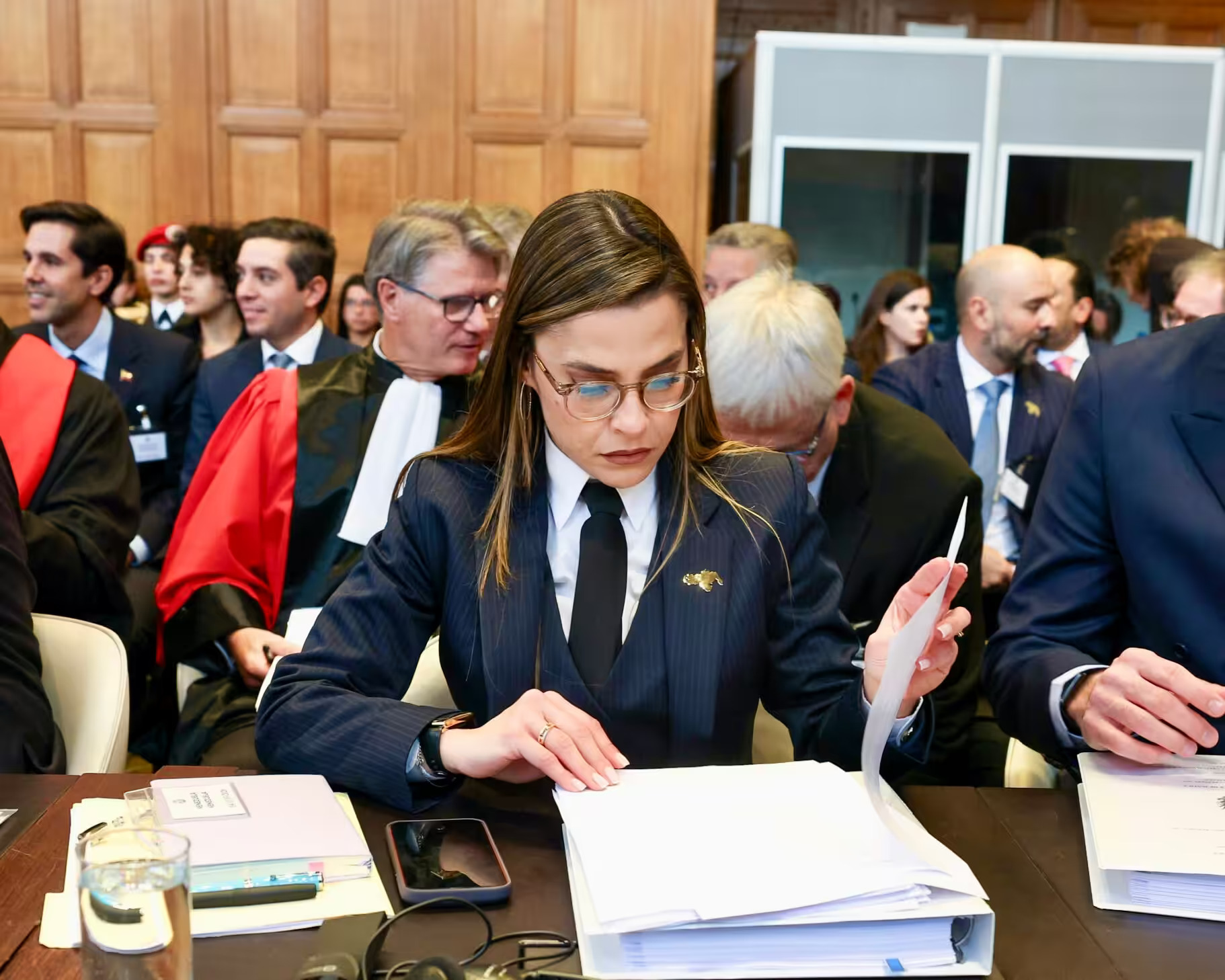
In a statement delivered to the International Court of Justice (ICJ) on Monday, the government of Venezuela refuted Guyana’s allegations regarding an alleged Venezuelan acquiescence to the 1899 Arbitral Award regarding the Venezuela’s eastern state of Guayana Esequiba.
Venezuela’s Attorney General Arianny Seijó categorically dismissed the theory that the award could be remedied through the subsequent conduct of the parties, arguing that professors Rubén and Azaría have demonstrated that this position is fundamentally flawed and lacks evidentiary basis in international law.
The Venezuelan representative was unequivocal in stating that no legal principle in international law allows an arbitral award’s nullification to be remedied through the conduct of the parties.
“What was born of illegality and fraud cannot be remedied,” said Seijó, recalling that Venezuela always opposed such a principle, particularly during the Vienna Conference on the Law of Treaties.
Evidence exposing the colonial fraud
Venezuela obtained this evidence following the publication of the Mallet–Prevost memorandum. Around the same time, British archives were partially opened, and investigations were carried out that allowed Venezuela to demonstrate the flaws of the award.
Venezuela’s conduct, Seijó stressed, reflects the degree of seriousness and diligence expected of a state under international law with respect to challenging an arbitral award of the importance and magnitude of the fraudulent 1899 award.
British imperialist greed against a devastated country
The attorney general identified British imperialist greed as one of the circumstances of the era and confirmed that Venezuela was the victim of territorial dispossession. The Venezuelan delegation denounced Guyana’s attempt to wilfully deny the asymmetry of power that existed between Venezuela and the dominant powers of the time.
A country devastated by war was in no position to confront the world’s greatest naval and military power in order to preserve its right to invalidate an award. The representative described as “absurd” Guyana’s claim, which asks the ICJ to consider as reasonable a proposition that is even more irrational.
Guyana contends that Venezuela, despite its extreme military weakness in the early 20th century, was in a position to challenge an arbitral award without even possessing the evidence that demonstrated its invalidity and that Venezuela should have been prepared to withstand a new war it would undoubtedly have lost again.
A claim contrary to justice and good faith
The attorney general concluded that Guyana’s claim is contrary to justice and good faith and defies all reason. Venezuela made clear that the true subject of the dispute is the 1966 Geneva Agreement, the instrument that replaced the colonial and fraudulent legal framework.
Before presenting the final conclusions, Seijó raised a third crucial point. As professors Tamms and Paquet explained clearly, even if the dispute were to concern the 1899 award, Guyana’s assertion that the award is valid would fail entirely. The documentary evidence and historical context dismantle any attempt to legitimize an instrument born of imperial coercion and colonial fraud.
Orinoc Tribune