by Randy Gopaul-
The irony at the heart of Guyana’s independence struggle is difficult to ignore. Cheddi Jagan fought passionately for British intervention in Guyana’s constitutional crisis, only to reject the very solution Britain imposed when it threatened his hold on power.
That solution was proportional representation.
But to understand why Britain imposed proportional representation, one must first understand that Guyana was already descending into political and racial violence long before PR was introduced.
By the early 1960s, British Guiana had become increasingly unstable. After the 1961 elections, Cheddi Jagan’s People’s Progressive Party won government under the existing First Past the Post electoral system, despite winning less than an outright majority of the national vote. The opposition argued that the system exaggerated the PPP’s parliamentary dominance while shutting smaller parties out of representation. Political protests intensified. Ethnic tensions deepened. Strikes crippled industries. Violence spread across communities.
British officials increasingly feared that the colony was becoming ungovernable.
From London’s perspective, the existing electoral system itself had become part of the problem.
Under First Past the Post (FPTP), the country is divided into constituencies, and the candidate with the most votes in each constituency wins the seat, even without receiving more than 50 percent of the vote. The system often produces “winner-take-all” outcomes. A party can secure less than half the total national vote yet still dominate Parliament because its support is geographically concentrated. Smaller parties are frequently squeezed out because only the top candidate wins representation.
That had been the PPP’s advantage.
Under FPTP, Jagan’s PPP had repeatedly transformed pluralities into commanding parliamentary majorities in 1953 and 1957. The system amplified the PPP’s strength and weakened competitors such as Forbes Burnham’s PNC and Peter D’Aguiar’s United Force.
Britain feared that granting independence under this structure would leave large segments of the population permanently alienated from political power.
Proportional Representation (PR) offered a different model.
Under PR, parliamentary seats are allocated according to the percentage of votes each party receives nationally or across large districts. If a party wins 30 percent of the vote, it receives roughly 30 percent of the seats. The system is designed to reflect the electorate more fairly, protect smaller parties, and reduce one-party domination. But PR also almost guarantees coalition governments in divided societies because it becomes difficult for a single party to secure an outright majority.
To British officials, PR appeared to be a constitutional safety valve for an increasingly fractured colony.
The British believed proportional representation would force compromise, encourage coalition politics, and prevent any one ethnic or political group from monopolizing power. Smaller parties such as the United Force would survive under PR rather than being politically crushed under FPTP.
At the 1963 Lancaster House Independence Conference in London, the constitutional battle reached its climax.
Forbes Burnham argued that Guyanese leaders should resolve their differences among themselves rather than surrender the country’s future to British arbitration. He maintained that Guyana’s political problems were domestic matters that Guyanese leaders should settle independently.
Cheddi Jagan took the opposite approach.
Believing Britain would ultimately preserve democratic fairness, Jagan asked Colonial Secretary Duncan Sandys to intervene and arbitrate the dispute. Peter D’Aguiar supported Jagan’s request.
Burnham objected strongly, warning against allowing Britain to impose constitutional arrangements on Guyana. But Sandys warned Burnham that refusing arbitration could delay independence and leave him blamed for blocking Guyana’s freedom. Reluctantly, Burnham agreed.
Then came the political earthquake.
Duncan Sandys announced that British Guiana would move from First Past the Post to Proportional Representation before independence elections were held.
Cheddi Jagan immediately understood the implications.
Under PR, the PPP might still emerge as the largest party, but it could lose its parliamentary dominance because smaller parties would now gain representation proportional to their support. Coalition politics would replace winner-take-all government.
The man who had insisted on British arbitration now rejected the British solution.
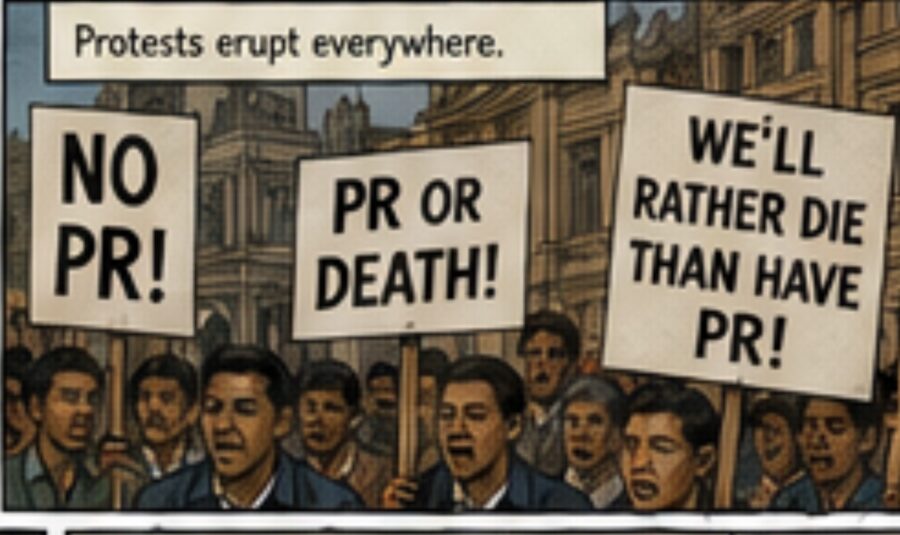
Jagan reacted furiously. He believed Britain had betrayed him. He denounced proportional representation and launched what he himself described as a “hurricane of protest” against the new electoral system. The PPP and its youth arm, the Progressive Youth Organisation, organized demonstrations and political agitation throughout the country.
Slogans appeared across Georgetown and the countryside:
“No PR.”
“PR or Death.”
“We’ll Rather Die Than Have PR.”
The irony was extraordinary. Jagan had insisted that the Colonial Secretary arbitrate the dispute. Yet when the Colonial Secretary imposed a system that threatened the PPP’s path to outright power, Jagan mobilized national resistance against the decision.
Meanwhile, violence intensified further.
The sugar strike expanded political tensions. Entire communities became polarized. Houses were burned. Schools required police protection. Bombings and retaliatory killings spread fear across the colony. The explosion aboard the Son Chapman launch in July 1964 killed more than forty Afro-Guyanese passengers but it was the slaughter and dismembering of elderly Back farmers; Mr and Mrs Sealey at Buxton that triggered retaliatory violence in the Wismar-Mackenzie area. Villages erected barricades and vigilante groups formed for self-defense.
The British became even more convinced that winner-take-all politics in such an environment was dangerous and.
Yet history would also prove that Jagan’s fears about PR were politically rational.
In the December 1964 elections, the PPP won the largest share of the national vote: 45.8 percent. It also won the largest number of parliamentary seats, 24 out of 53.
Burnham’s PNC won 40.5 percent and secured 22 seats.
Peter D’Aguiar’s United Force won 12.5 percent and secured 7 seats.
Under the old First Past the Post system, Jagan’s PPP would likely have won another parliamentary majority and retained full control of government, just as it had done previously.
But proportional representation changed the arithmetic of power.
Jagan won the plurality, but not the majority.
Burnham, however, could command a majority by forming a coalition with D’Aguiar’s United Force.
Governor Sir Richard Luyt therefore acted according to Westminster constitutional tradition. In Westminster systems, the decisive issue is not which party wins the most votes nationally. The decisive issue is who can command the confidence of the legislature.
Burnham and D’Aguiar together controlled 29 seats, enough for a governing majority.
Jagan controlled only 24.
The Governor therefore invited Forbes Burnham, not Cheddi Jagan, to form the government.
This remains one of the great constitutional paradoxes in Guyanese history and it must be noted that Japan called for partition in a letter to Colonial Secretary Sir Anthony Greenwood. Similar calls were made by the Mirror newspapers.
Britain used proportional representation to elect the legislature specifically to prevent one-party domination. But once the legislature was elected, the British applied the traditional Westminster principle that government belongs to whoever can command a parliamentary majority, even if that leader did not receive the largest share of votes individually.
In simple terms, Guyana used PR to distribute seats, but Westminster coalition rules to choose the Prime Minister.
To PPP supporters, this felt like betrayal.
To Britain and Burnham’s supporters, it was parliamentary democracy functioning exactly as intended.
Cheddi Jagan initially refused to resign. He insisted, in effect, that his party had won because it received the largest share of votes and the largest bloc of seats. But Westminster systems do not operate on plurality alone. Governments survive through parliamentary majority support.
Only after an Order in Council was issued from London was Jagan removed from office.
The deeper truth of 1964 is that the battle over PR versus FPTP was never merely technical or academic. It was a battle over who would inherit the state at independence.
Under FPTP, the PPP would likely have governed alone.
Under PR, coalition politics prevented that outcome.
And so the great irony remains: Cheddi Jagan demanded British intervention to resolve Guyana’s constitutional crisis, but when Britain imposed a system designed to dilute winner-take-all power, he became one of its fiercest opponents and led protests against the very constitutional solution he had once invited Britain to impose.