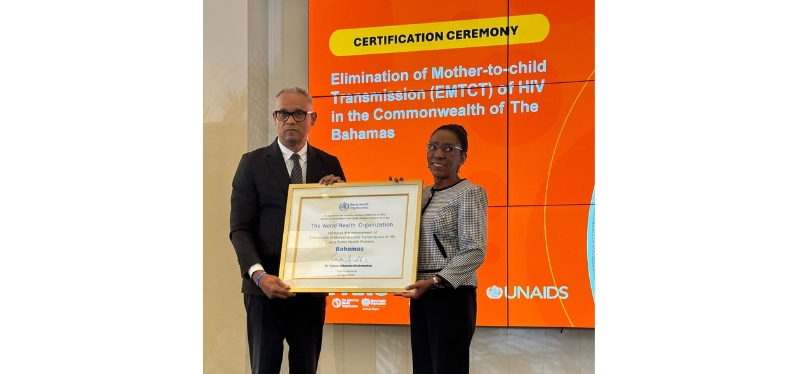
The Bahamas has secured a major public health victory after being officially certified by the Pan American Health Organisation and the World Health Organisation for eliminating mother-to-child transmission of HIV—an achievement being hailed as a significant breakthrough for healthcare in the Caribbean.
The certification marks a major milestone in the global fight against HIV/AIDS and means that HIV-positive mothers in The Bahamas now have access to systems of testing, treatment and care robust enough to ensure babies are born free of the virus.
Regional health leaders say the achievement reflects years of disciplined public health planning, strong healthcare delivery, and sustained investment in maternal and child health.
Pan Caribbean Partnership against HIV and AIDS, in congratulating The Bahamas, said the accomplishment demonstrates what can be achieved through coordinated leadership, committed healthcare workers and public trust in the health system.
The Bahamas now becomes the 11th CARICOM country to achieve elimination of mother-to-child transmission of HIV, joining a growing regional list of countries recognised for meeting international public health standards.
The Bahamas joins Antigua and Barbuda, Belize, Dominica, Jamaica, Saint Kitts and Nevis, Saint Vincent and the Grenadines, Anguilla, Bermuda, the Cayman Islands, and Montserrat as CARICOM territories certified for the elimination of mother-to-child transmission of HIV.
Health officials in The Bahamas said the achievement was driven by a deliberate strategy centered on universal antenatal care, routine HIV screening for pregnant women, and integrated maternal health systems supported by laboratory services and infectious disease programmes.
The certification is particularly significant because it aligns with the global goal under the United Nations Sustainable Development Goals to end AIDS as a public health threat by 2030.
Regional officials say the achievement not only protects newborns and families but also reinforces the Caribbean’s position as a global leader in public health progress, showing that even small states can deliver world-class healthcare outcomes.
While celebrating the milestone, health leaders cautioned that sustaining the gains will require continued investment in prevention, testing and maternal care to ensure the success is maintained for future generations.