A major independence anniversary initiative spearheaded by the Office of the Leader of the Opposition was launched this week with a pointed message: Guyana’s 60th anniversary must not be reduced to spectacle, but reclaimed as a moment of national meaning, identity, and purpose.
At a press conference on Tuesday, We Invest in Nationhood (WIN) General Secreatry and Member of Parliament Odessa Primus outlined the framework of the six-week national programme themed “Rooted in Identity – Rising in Destiny,” positioning it as a corrective to what organisers see as a drift toward superficial observance.
“Guyana’s independence is more than a date on the calendar; it is the culmination of sacrifice, resilience, and the enduring spirit of a people determined to define their own destiny,” Primus said. “This initiative seeks to restore meaning, dignity, and national pride… by engaging citizens in a journey that honours our past, examines our present, and inspires our collective future.”
The programme will roll out in six phases—Remember, Reflect, Reclaim, Rise, Serve, and Celebrate—each designed to move citizens beyond passive observance into active engagement. From historical storytelling and national dialogue to cultural expression, community service, and a climactic Independence Week production titled “The Dawn of a Nation: Guyana 60,” the initiative aims to reach across regions and communities.
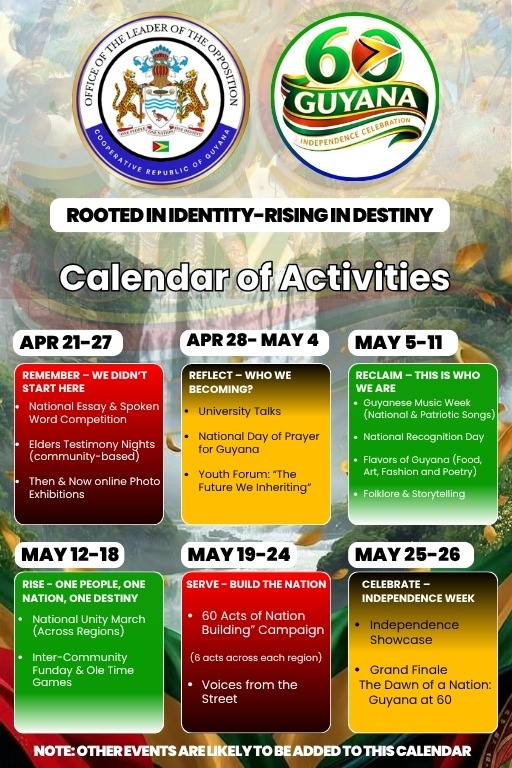
Primus emphasised that the campaign is structured to “foster deeper awareness, unity, and participation,” culminating in what she described as “a powerful showcase of Guyana’s journey, from struggle to sovereignty and from identity to destiny… reigniting a spirit of unity, purpose, and pride that will carry us forward as one people, one nation, with one shared destiny.”
But it was the accompanying address by Opposition representative Clayton Halley that sharpened the political tone of the launch, raising concern that the meaning of independence is being eroded.
“Today, we gather not merely to launch a calendar of events but to ignite a national awakening,” Halley declared. “As we approach sixty years of independence, we must ask ourselves an honest question: What does this moment truly mean to us as a people?”
He continued with a direct critique: “There is a growing concern among many Guyanese that the depth of our history is being overshadowed by surface-level celebration. That the meaning of independence risks being diluted into moments that entertain us but do not necessarily transform us.”
Halley was careful to strike a balance, noting, “We are not here to condemn celebration; celebration has its rightful place. But we are here to declare that Guyana deserves more.”
Framing the initiative as both cultural and civic intervention, he argued that national development must extend beyond economic gains. “The truth is, our greatest resource is not oil, nor gold, nor land; it is our people. If we are to truly move forward as a nation, then we must invest not only in infrastructure but also in identity. Not only in development but also in destiny.”
The initiative, he said, is intended to “remind every Guyanese… that we are part of something greater than ourselves,” urging citizens to actively participate rather than passively observe.
“So, I invite you to not just observe, but to participate, to engage and to celebrate with the understanding that if we get this right, sixty years will not just be a milestone we mark but a turning point we remember.”
With further details on events and participation expected in the coming days, the programme signals an attempt by the opposition to shape the national narrative around Guyana’s diamond jubilee—casting it not just as a celebration of the past, but as a test of the country’s unity, identity, and direction for the future.