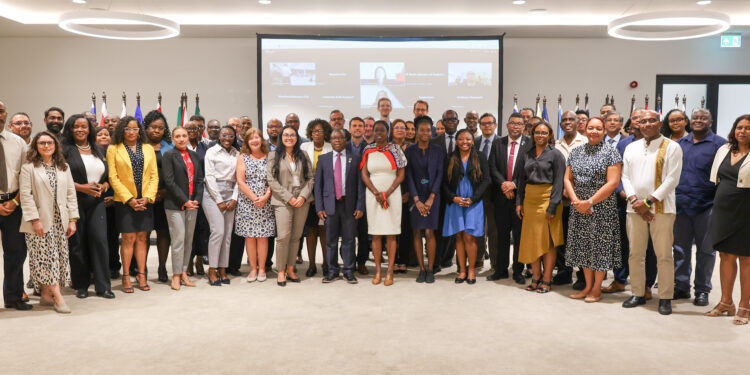
(CARICOM)- In a significant step toward securing the ecological and economic future of the Caribbean, the Caribbean Community (CARICOM) Secretariat convened a high-level Partners Roundtable and Structured Dialogue on 26 March, 2026. The event, titled “CARICOM Leadership in Oceans, Biodiversity and Climate,” was convened in the margins of the 124th Special Meeting of the Council of Trade and Economic Development for Ministers of Environment and Sustainable Development (COTED Environment).
Critical to the success of the dialogue was the leadership of the United Kingdom’s Foreign, Commonwealth and Development Office (UKFCDO), represented by Chargé d’Affaires Mr Liam McShane at the UK High Commission in Georgetown. The UK diplomat co-chaired the proceedings with The Honourable Orlando Habet, Minister of Sustainable Development, Climate Change and Solid Waste Management for Belize, in his capacity as Chair of COTED Environment. This co-chairmanship underscored the UK’s commitment to supporting CARICOM in its mission to improve sustainable ocean management and regional governance.
A Focused Agenda for Regional Sustainability
The dialogue brought together leading regional experts who updated partners on the pressing environmental challenges facing Small Island Developing States (SIDS). Participants benefited from presentations by Dr LaDaana Kanhai of The University of the West Indies, who focused on marine biology and ecology; Mr Mansfield Blackwood of the Caribbean Community Climate Change Centre, who addressed climate-related issues; and Dr Helena Jeffery Browne of the OECS Commission, who expounded on biodiversity and ecosystem services.
Elevating the Partnership for the Blue Economy
The United Kingdom’s support and active participation represented a shift toward more integrated models of development assistance. Participants engaged in a structured dialogue designed to move beyond traditional “beneficiary” roles toward a model where CARICOM nations act as co-designers of programmes and solutions. Key discussion points championed by the chairs and development partners included:
- Policy Alignment: Ensuring partner support directly reinforces the CARICOM Fisheries Policy and the Environment and Natural Resources Policy Framework.
- Innovative Finance: Identifying equitable mechanisms for distributing funds through the Global Biodiversity Framework Fund (GBFF), Cali Fund, and the Loss and Damage Fund.
- Transboundary Action: Addressing shared threats such as sargassum influxes, marine pollution, and the protection of migratory species.
- Science and Technology: Closing technology gaps in marine science and renewable energy while strengthening regional research institutions.
Looking Ahead: NDCs 3.0 and Ocean Health
As CARICOM Member States prepare to finalise and implement NDCs 3.0, the UK and other partners explored ways to enhance technical and financial support for climate-resilient agriculture and nature-based solutions. The dialogue concluded with a commitment to develop long-term implementation roadmaps for ocean health and biodiversity.
By co-leading this initiative, the UKFCDO has reaffirmed its role as a primary partner in the Caribbean’s journey toward climate resilience, ensuring that the Region’s unique vulnerabilities remain at the forefront of the global environmental agenda.
The dialogue was part of a wider project funded by the UKFCDO to develop the CARICOM Ocean Policy and improve governance arrangements for sustainable ocean management within CARICOM.