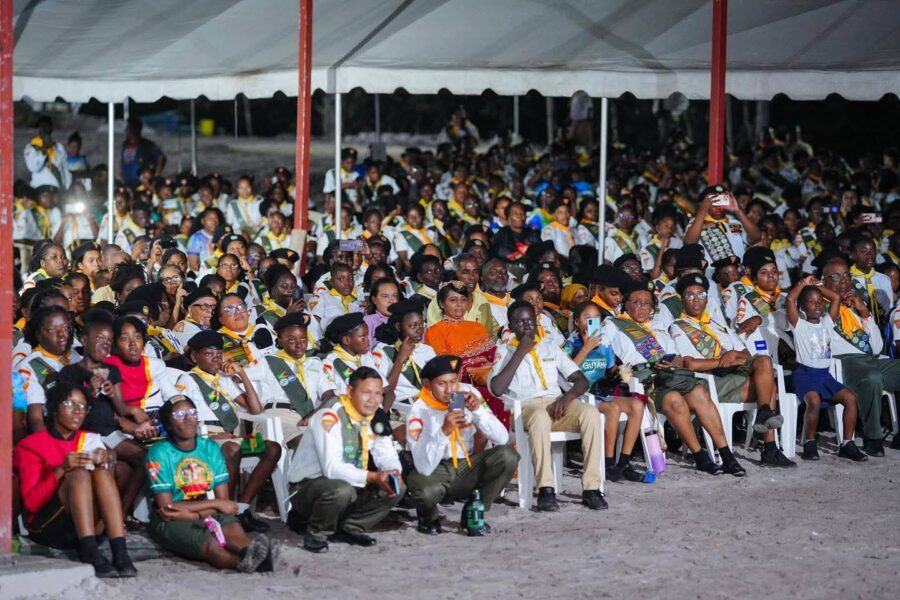
Concerns are intensifying within the Seventh-Day Adventist Church community following remarks by Pastor Exton Clarke, President of the Guyana Conference, who publicly praised President Irfaan Ali during Wednesday’s opening ceremony of the Caribbean Union Conference Pathfinder Camporee at Loo Creek along the Soesdyke–Linden Highway. The controversy has been further sharpened by the fact that President Ali himself addressed the gathering from the pulpit—an appearance some Adventists say blurs the Church’s long-held line between spiritual mission and partisan politics.
While Clarke lauded the President as “a statesman, a visionary leader…with a heart for God,” several Adventists, speaking on condition of anonymity, say the move risks politicising a denomination that has long upheld a principle of political neutrality.
Concerned members argue that Clarke’s remarks signal a troubling shift, warning that he is “now merging faith and politics as one,” which they described as a dangerous development. They also questioned the justification for the President’s prominent role, including references to government support for infrastructure at the campsite. “If he feels that an invitation to President Ali could result in the cleanliness of the environment that he brags about, it is unfortunate,” one member said.

Others are calling on Clarke to demonstrate balance by inviting Opposition Leader Azruddin Mohamed, Forward Guyana Movement leader Amanza Walton-Desir, and lead parliamentarian of A Partnership for National Unity (APNU), Dr. Terrence Campbell, to religious events, noting that Adventists support a range of political parties and would welcome broader inclusion.
Members stressed that the Seventh-day Adventist Church has historically maintained a clear position of political non-partisanship, grounded in the separation of church and state and the preservation of its spiritual mission.
Official guidance outlines that the Church does not endorse or oppose political parties or candidates, and that political involvement is a matter of individual conscience rather than institutional direction. The Church has also emphasised that political advocacy should not originate from the pulpit or divide its membership, reaffirming that its primary role is spiritual, not political.
Some members went further, questioning whether Clarke’s actions elevate political leadership above the church’s spiritual foundation. “Is he changing the doctrine of the church by putting the President at the centre, or higher than Christ?” one member asked, expressing disappointment that Clarke appears to be imposing a personal relationship with the President on the wider church.
They stressed that President Ali’s presence does not necessarily reflect religious freedom, but could instead be seen as influence, pointing to the constitutional separation of church and state. As concerns grow, members are urging church leaders to reaffirm the Adventist Church’s long-standing neutrality and ensure that faith remains distinct from political power.