GEORGETOWN, Guyana — Opposition Member of Parliament Saiku Andrews has launched a blistering attack on the PPP/C Government’s expanding involvement in commercial activity, warning that the state is increasingly using taxpayers’ money to compete directly against Guyanese businesses while neglecting the essential public services it was elected to provide.
Andrews made the comments at a PNCR press conference while condemning the Government’s decision to move Guyana Water Incorporated (GWI) into the bottled-water business, an industry already populated by private manufacturers, distributors and retailers.
At the heart of Andrews’ criticism is a larger question: Why is a government that professes support for private enterprise using a state utility and public resources to enter markets in which Guyanese entrepreneurs have already invested their own capital and assumed their own risks?
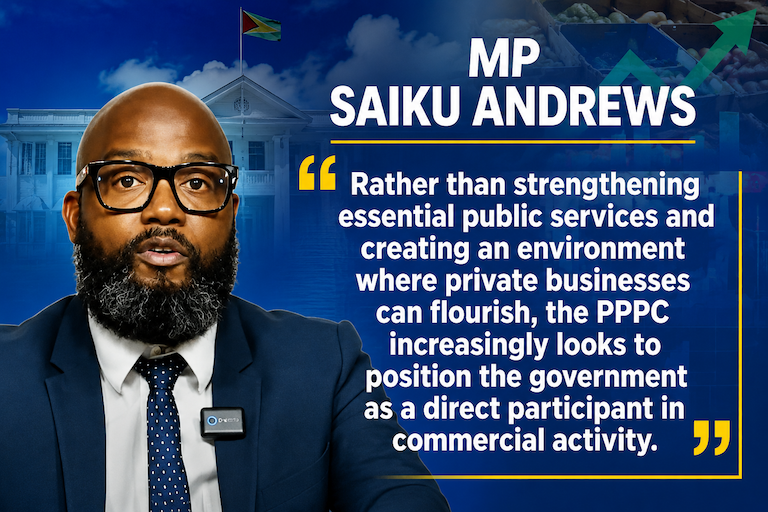
“Rather than strengthening essential public services and creating an environment where private businesses can flourish, the PPPC increasingly looks to position the government as a direct participant in commercial activity,” Andrews said.
The MP argued that GWI has more than enough problems within its existing mandate to justify the Government’s full attention.
Thousands of Guyanese, he said, continue to experience low water pressure, interruptions, aging infrastructure and discoloured water. Yet rather than concentrating GWI’s resources on improving the national water system, the Government is pushing the utility into an entirely different commercial undertaking.
Andrews said every dollar committed to the proposed bottled-water venture represents money that could instead be spent replacing deteriorating mains, increasing treatment capacity, reducing water losses and ensuring households have reliable access to clean water.
Government Versus Its Own Private Sector
The controversy goes beyond bottled water.
Andrews portrayed the decision as part of an emerging economic model under the PPP/C in which the Government is no longer satisfied with regulating markets, providing infrastructure and establishing conditions for investment, but increasingly wants to become a commercial player itself.
“Bottled water production is already a private sector industry,” Andrews said.
“Instead of competing with Guyanese manufacturers, distributors, and exporters, the government should be creating the conditions that would enable them to grow.”
She argued that a responsible government should reduce the cost of doing business, improve infrastructure, provide reliable utilities and encourage investment rather than deploy state-owned enterprises against businesses financed by private citizens.
The implications could be significant.
A private manufacturer must raise capital, pay commercial interest rates, purchase equipment, meet payroll, pay taxes and absorb losses if the business fails.
A state-owned competitor, by contrast, potentially has access to taxpayer-funded infrastructure, government procurement systems, state property and other public resources.
That creates an obvious question about whether competition between the two can ever be genuinely equal.
Andrews said Guyanese manufacturers are already struggling with unreliable electricity, high operating costs, logistics problems and rising production expenses. Instead of addressing those structural disadvantages, she accused the Government of preparing to compete against the very businesses confronting them.
Private-Sector Source Raises Even More Explosive Concern
A private-sector representative, who requested anonymity, raised an even more serious allegation, telling this publication that the concern among some businesspeople extends beyond unfair competition.
“We are witnessing in real time government corruption because we believe this operation will eventually be sold to some crony after the project is funded by government coffers,” the representative said.
The individual provided no evidence establishing that such a sale has been arranged, and the allegation remains unproven. But the concern points to a critical question the Government may now be required to answer: What is the long-term ownership and commercial plan for this operation?
If taxpayers finance the establishment of the enterprise, who will ultimately own it? How will contracts be awarded? Who will supply equipment and materials? Who will distribute the product? Will private companies be given an opportunity to participate through an open and competitive process?
And, crucially, will the Government commit publicly that a taxpayer-financed enterprise will not subsequently be transferred to politically connected private interests?
These questions become particularly important because, as Andrews observed, every state commercial venture creates opportunities for “political appointments, procurement contracts, preferred suppliers, and the allocation of public resources.”