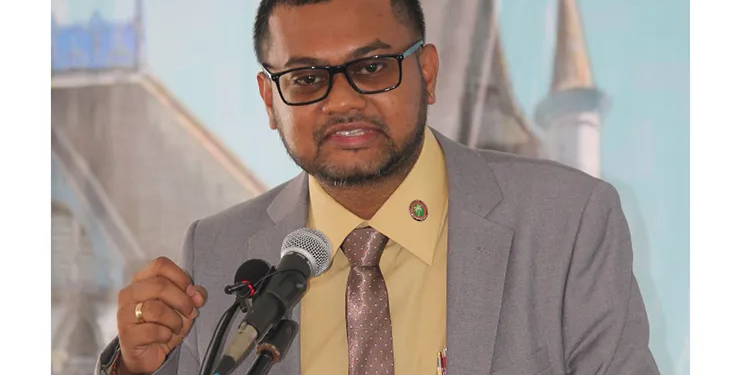
Former Mayor of Georgetown, Ubraj Narine, has raised concerns about what he describes as politically selective enforcement of Guyana’s tint laws, stating that documentation in his possession supports claims that government affiliates have been granted exemptions while ordinary citizens are denied similar consideration.
In a statement and accompanying column, Narine said recent developments have deepened questions about fairness and transparency in the granting of tint permits. “Only yesterday, I published an editorial questioning whether tint enforcement in Guyana is being applied fairly. Today’s developments reinforce those concerns,” he wrote.
He said paperwork available to him indicates that the Minister of Home Affairs, who has responsibility for tint permits, approved exemptions for “PPP [People’s Progressive Party] associates and personal acquaintances,” while other applicants—including Members of Parliament, medical doctors, journalists and ordinary Guyanese—were denied.
“This reportedly includes journalist Travis Chase, a survivor of a previous assassination attempt,” Narine added.
According to the former mayor, the disparity is also reflected in enforcement practices. “At a time when the entire nation is subjected to rigid enforcement and excessive fines, PPP affiliates, friends, and family members are granted waivers allowing full tinting—front, back, and sides. This selective application of the law reflects clear inequality in enforcement,” he said.

Narine framed the issue as a wider governance concern, arguing that inconsistent application of the law undermines public trust. “Guyana cannot function properly when laws are enforced based on political affiliation rather than fairness and consistency. When one votes for the PPP, this is the outcome,” he stated.
His concerns were further detailed in a personal account of a recent encounter with police during a tint enforcement exercise along the West Coast Demerara.
“[Wednesday] morning, while travelling to Parika to perform funeral rites, I was stopped by police officers at the Den Amstel Police Station… I was instructed to remove the visor and the tint from my vehicle’s front windscreen. I complied fully and without resistance,” Narine said.
However, he said that while complying, he observed other motorists with “far heavier tint” being stopped and then allowed to proceed without taking similar action. When he queried the apparent inconsistency, he was told by an officer that the drivers had “made calls to higher authority.”
“If this account is accurate, it represents favouritism at its highest and most dangerous level,” Narine wrote. “Law enforcement cannot operate on the basis of who has influence, connections, or access to power. The law must be blind, or it ceases to be law at all.”
While making clear that he supports reasonable traffic regulations, Narine argued that enforcement must be consistent and transparent. “What I object to is selective enforcement. Without transparent and uniform mechanisms, tint enforcement risks becoming nothing more than a money-making exercise, disproportionately targeting those without connections while shielding the well-connected,” he said.
He also raised concerns about police conduct, alleging that officers took photographs of him and his vehicle without explanation and indicated that the images would be shared with political officials.
“This raises serious concerns about abuse of power, breaches of privacy, and the politicisation of routine policing,” he stated, questioning how citizens can maintain confidence in law enforcement under such conditions.
Narine called on the Traffic Department and the Guyana Police Force to act decisively to ensure impartial enforcement. “Enforcement must be guided by law, not by phone calls, political affiliations, or personal connections. Fairness is not optional in a democracy—it is foundational,” he said.
He warned that failure to address the issue could further erode public trust. “When that trust is eroded by favouritism and misconduct, the damage extends far beyond a single traffic stop. It strikes at the credibility of the entire system. This is a matter that demands urgent correction, not quiet acceptance.”