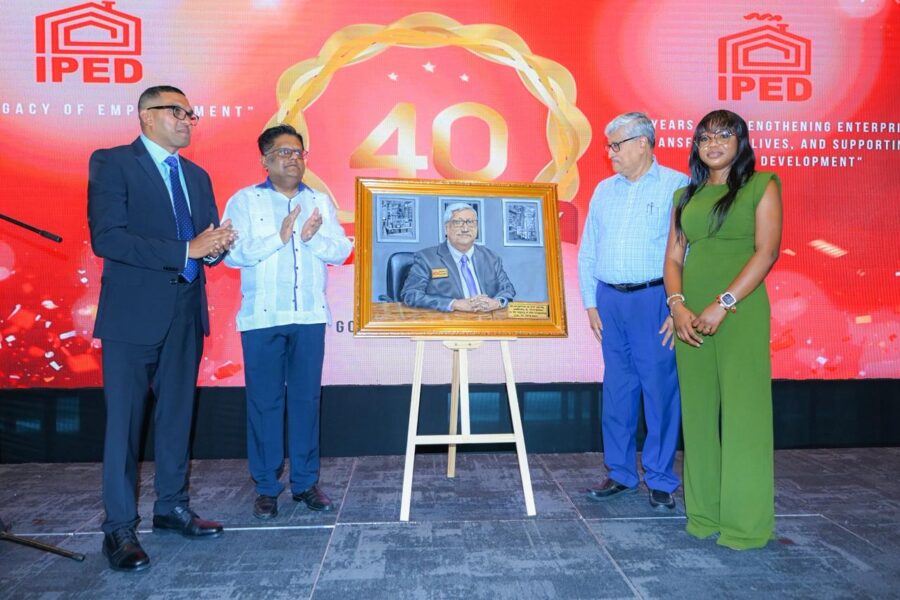
Senior Minister in the Office of the President with Responsibility for Finance, Dr. Ashni Singh, has urged entrepreneurs to take advantage of Guyana’s rapidly expanding economy, as the Institute of Private Enterprise Development (IPED) celebrated its 40th anniversary on Friday.
Delivering the keynote address on behalf of President Irfaan Ali at the Pegasus Hotel, Dr. Singh assured that the government remains committed to maintaining a business-friendly environment.
He encouraged entrepreneurs to capitalise on the opportunities being created, urging them to “respond to this environment and seize the opportunities that are being created.”
Highlighting government initiatives to support business development, Dr. Singh pointed to plans for a Guyana Development Bank, through which loans of up to $3 million will be provided without interest or collateral requirements.
“And just to be clear, this is not intended to displace or to compete with the banking sector or micro-enterprise entities like IPED. Our vision is that this seed capital that we’ll be providing through the Development Bank will see the leveraging of additional resources through institutions like IPED,” he explained.
Reflecting on IPED’s journey since its establishment in 1986, the minister compared its growth to Guyana’s broader economic transformation. He paid tribute to the late founder, Dr. Yesu Persaud, and urged young people to pursue entrepreneurial ventures.
“Establish a business if you haven’t yet established one,” he said, adding, “and grow your business, if you have already established your small business to see it become a medium-sized business and ultimately a large business. This is the intention of institutions like IPED. This was and remains the vision of Dr. Yesu Persaud, who founded this remarkable institution 40 years ago.”
Dr. Singh highlighted IPED’s significant impact, noting that the organisation has disbursed more than 147,000 microcredit loans valued at over $64 billion across 700 villages nationwide. He also pointed out that loan approvals increased from $2.9 billion in 2020 to $5.7 billion in 2025.
“Anybody who has doubled their business over this period has done remarkably well and IPED must be commended,” he said, while noting that the entity has also reduced its interest rates by half.
Chairman of IPED, Komal Samaroo, in his remarks, reflected on the economic conditions at the time of the institution’s founding.
“It is very difficult to describe and to give you the feeling of what it was to live in an economy where everything was state controlled, where every import has to be licensed, where I spent hours sitting at the Governor’s office at the Central Bank to get a release of foreign exchange.” Samaroo said.
“And so, today, in an economy that is the fastest growing in the world, an economy that is liquid from revenue generated from oil and gas, it is very difficult to conceptualize what life was then. So, I just want to give a flavor of the context within which IPED was born,” he added.
“It is very difficult to describe and to give you the feeling of what it was to live in an economy where everything was state controlled, where every import has to be licensed, where I spent hours sitting at the Governor’s office at the Central Bank to get a release of foreign exchange. We had to go to Knowledge Sharing Institute to queue up to get groceries. That was what life was in the 1970s,” Samaroo said.
Samaroo’s reference period was marked not only by a state-controlled economy, but also by a global economic downturn, largely triggered by OPEC’s increase in oil prices. Small, non-oil-producing economies like Guyana were among the hardest hit. Today, the economy is driven by Guyana’s oil wealth, largely exploited by foreign capital. Yet, in the same economy, nearly two-thirds of the population live in poverty, with 32% in abject poverty, according to a 2025 report by the Inter-American Development Bank.
Samaroo also encouraged young entrepreneurs to remain committed to building their businesses, noting that “growing a business requires discipline, requires determination, requires vision.”
The event also highlighted ongoing support for micro and small enterprises, including a US$5 million loan agreement signed earlier this year between IPED and the Inter-American Development Bank (IDB). The funding is expected to expand financial support for women, youth, and rural entrepreneurs, while helping IPED diversify its funding sources.
As part of the anniversary celebrations, IPED showcased the legacy of its founder, Dr. Yesu Persaud, along with testimonials from entrepreneurs who have benefited from the organization’s support over the years.