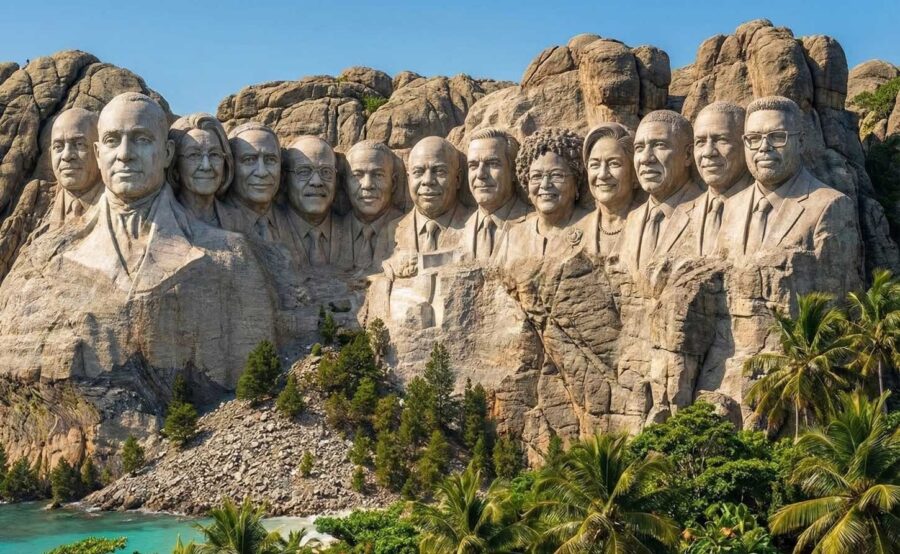
“Uneasy lies the head that wears a crown.” — William Shakespeare, Henry IV, Part 2
By Calvin Brown (WiredJA)- There is a dangerous romanticism that attaches itself to political power. From the outside, the office of Prime Minister or President carries an air of majesty — the motorcades, the protocols, the cameras, the front pages.
But strip away the ceremony and what remains is something considerably less glamorous: the crushing weight of governance. The sleepless nights. The impossible decisions. The unrelenting public scrutiny. The burden, as Shakespeare so perfectly observed five centuries ago, of a crown that never rests comfortably on any head.
A recently circulated compendium of annual salaries paid to Caribbean heads of government has reignited a conversation that is long overdue in our region.
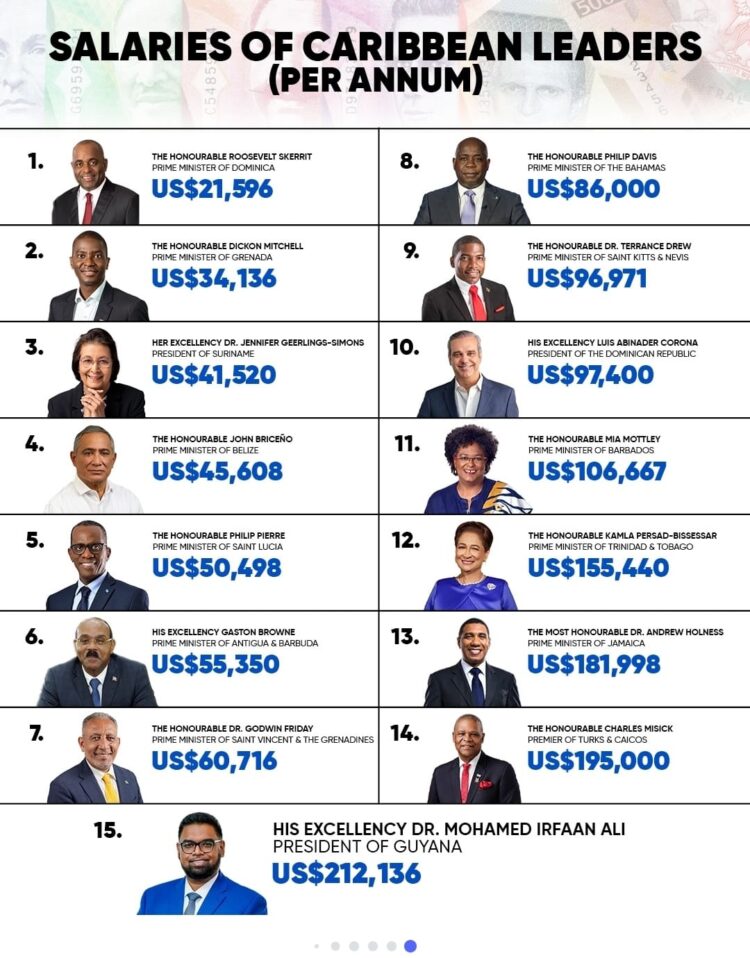
The figures — reproduced below as provided, and offered here without personal endorsement of their absolute accuracy — present a striking picture of the economic reality facing those who lead some of the smallest and most vulnerable nations on the planet.
The public deserves to engage seriously with this information, even as we urge caution in treating these numbers as definitively verified.
The Numbers in Context
The salary range revealed in the compendium is nothing short of extraordinary in its span. At one end sits the Honourable Roosevelt Skerrit, Prime Minister of Dominica, reportedly earning US$21,596 per annum — a figure that would not be considered a living wage in many of the developed nations whose tourists flock annually to his country’s shores. At the other end stands His Excellency Dr. Mohamed Irfaan Ali, President of Guyana, who reportedly draws US$212,136 per year — a salary commensurate with his country’s oil boom but still modest by the standards of global leadership.
Between these two poles lies the full spectrum of Caribbean political leadership. Prime Minister Dickon Mitchell of Grenada earns a reported US$34,136 annually. President Jennifer Geerlings-Simons of Suriname receives US$41,520. Belize’s John Briceño earns US$45,608, while Philip Pierre of Saint Lucia draws US$50,498. Prime Ministers Gaston Browne of Antigua and Barbuda and Godwin Friday of St. Vincent and the Grenadines reportedly earn US$55,350 and US$60,716 respectively.
Moving up the scale, The Bahamas’ Philip Davis reportedly receives US$86,000 per annum, followed by Dr. Terrance Drew of St. Kitts and Nevis at US$96,971, and Dominican Republic President Luis Abinader Corona at US$97,400. Barbados’ Mia Mottley commands US$106,667, Trinidad and Tobago’s Kamla Persad-Bissessar reportedly earns US$155,440, and Jamaica’s Most Honourable Dr. Andrew Holness draws US$181,998 annually. Turks and Caicos Premier Charles Misick, governing a British Overseas Territory, reportedly receives US$195,000.
Nobody Should Envy These Leaders
Before any reader settles into comfortable outrage at the higher figures or cheap satisfaction at the lower ones, a moment of honest reflection is warranted. Governance — real governance, in small island states buffeted by hurricanes, battered by global commodity shocks, constrained by debt, and perpetually at the mercy of international financial institutions — is among the most demanding vocations a human being can undertake.
Nobody, and we mean this sincerely, should envy any Prime Minister or President in this region.
Consider what it means to lead a country of 70,000 people with a GDP smaller than many a single corporation in North America or Europe. Consider what it means to negotiate at the UN climate table as a small island developing state, knowing that the rising seas threatening your coastline are the product of industrial decisions made thousands of miles away.
Consider what it means to build a budget, a health system, an education sector, a road network — all simultaneously, all underfunded, all under the unforgiving gaze of a connected and vocal citizenry.
The salary attached to the office does not begin to capture the true cost of the commitment. Political leaders in democratic systems routinely sacrifice privacy, family time, personal health, and often financial prosperity itself. The compensation — even at the higher end of the Caribbean scale — pales against the complexity of the responsibility.
The Case for Transparency
That said, the public’s right to know what its elected and appointed officials earn is not merely a matter of curiosity — it is a cornerstone of democratic accountability. Citizens who pay taxes, who cast votes, who bear the consequences of policy decisions, are fully entitled to understand the financial arrangements of their governments. Salary transparency is not an intrusion; it is a democratic imperative.
What this compendium does, whatever its precise accuracy, is force a conversation that has too long been conducted in whispers and assumptions. Why does the leader of one Caribbean nation earn nearly ten times that of another? What factors — economic size, colonial legacy, constitutional structure, oil revenues — determine these differentials?
Are our smallest nations paying their leaders adequately to attract and retain the calibre of talent that effective governance demands? These are not idle questions.
The disparity between PM Skerrit’s reported US$21,596 and President Ali’s US$212,136 is not simply a matter of individual negotiation. It reflects the profound structural inequalities that persist within CARICOM and the broader Caribbean basin — inequalities rooted in colonial history, differential access to natural resources, tourism dependency, and varying levels of institutional development.
A Note on the Data
This publication presents the figures as they appear in the widely circulated compendium. We have not been in a position to independently verify each salary against official government records, parliamentary estimates, or gazette publications.
The figures should therefore be treated as a credible starting point for public discussion rather than as certified data. We invite government communications offices across the region to respond with official confirmation or correction, as appropriate.
What we can say with confidence is this: the conversation these numbers generate — about pay equity, about governance value, about democratic transparency — is entirely legitimate and long overdue.
Our leaders, however imperfect, are human beings undertaking an extraordinarily difficult task in an extraordinarily challenging region. They deserve neither uncritical deference nor reflexive contempt, but the honest, informed scrutiny that democracy demands.
The Crown and Its Cost
Shakespeare’s King Henry IV did not lament his salary when he mused on the sleeplessness of kings. He lamented the burden itself — the knowledge that power, however magnificent in theory, is in practice a relentless, consuming responsibility. The servant who sleeps soundly, he observed, knows a peace that the crowned head cannot.
Caribbean leaders govern in one of the most geopolitically complex, climatically vulnerable, and economically constrained regions on earth. Whether they earn US$21,596 or US$212,136, whether they preside over an oil-rich republic or a hurricane-battered archipelago, the weight of the crown is not diminished by the size of the cheque that accompanies it.
The citizenry of the Caribbean would do well to keep that in mind — even as it rightly demands accountability, transparency, and value for its investment in leadership.
Governance is not easy. It never was. And the head that wears the crown — in Roseau or Nassau, in Kingston or Georgetown — rests uneasily still.
Calvin G. Brown is a political communications consultant and senior correspondent with WiredJa. He is a Justice of the Peace for the Parish of Hanover, Jamaica.
Disclaimer: Salary figures are reproduced from a widely circulated regional compendium. WiredJa has not independently verified these figures against official government records. Readers are encouraged to consult official parliamentary estimates or government gazettes for authoritat