Thursday, April 23, 2026
Village Voice News
ADVERTISEMENT
  • Home
  • News
  • Sports
  • Editorial
  • Letters
  • Global
  • Columns
    • Eye On Guyana
    • Hindsight
    • Lincoln Lewis Speaks
    • Future Notes
    • Blackout
    • From The Desk of Roysdale Forde SC
    • Diplomatic Speak
    • Mark’s Take
    • In the village
    • Mind Your Business
    • Bad & Bold
    • The Voice of Labour
    • The Herbal Section
    • Politics 101 with Dr. David Hinds
    • Talking Dollars & Making Sense
    • Book Review 
  • Education & Technology
  • E-Paper
  • Contact Us
No Result
View All Result
  • Home
  • News
  • Sports
  • Editorial
  • Letters
  • Global
  • Columns
    • Eye On Guyana
    • Hindsight
    • Lincoln Lewis Speaks
    • Future Notes
    • Blackout
    • From The Desk of Roysdale Forde SC
    • Diplomatic Speak
    • Mark’s Take
    • In the village
    • Mind Your Business
    • Bad & Bold
    • The Voice of Labour
    • The Herbal Section
    • Politics 101 with Dr. David Hinds
    • Talking Dollars & Making Sense
    • Book Review 
  • Education & Technology
  • E-Paper
  • Contact Us
No Result
View All Result
Village Voice News
No Result
View All Result
Home Herbal Section

Sesame

Admin by Admin
March 15, 2026
in Herbal Section, The Herbal Section
Sesame

Sesame

0
SHARES
0
VIEWS
Share on FacebookShare on Twitter

(Britannica)-sesame, (Sesamum indicum), erect annual plant of the family Pedaliaceae, grown since antiquity for its seeds, which are used as food and flavouring and from which a prized oil is extracted. Widely cultivated, the sesame plant is found in most of the tropical, subtropical, and southern temperate areas of the world. The aroma and taste of sesame seed are mild and nutlike. The chief constituent of the seed is its fixed oil, which usually amounts to about 44 to 60 percent. Noted for its stability, the oil resists oxidative rancidity. The seeds are also high in protein and are rich in thiamin and vitamin B6.

History and uses

READ ALSO

Health Benefits of Bitter Kola

Madagascar Periwinkle – Uses, Side Effects, and More

The sesame plant likely originated in Asia or East Africa, and ancient Egyptians are known to have used the ground seed as grain flour. The seeds were used by the Chinese at least 5,000 years ago, and for centuries they have burned the oil to make soot for the finest Chinese ink blocks. The Romans ground sesame seeds with cumin to make a pasty spread for bread. Once it was thought to have mystical powers, and sesame still retains a magical quality, as shown in the expression “open sesame,” from The Thousand and One Nights tale of “Ali Baba and the Forty Thieves.”
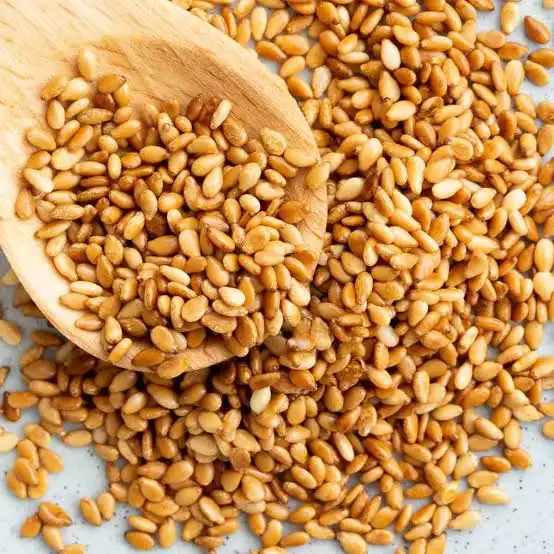
Toasted Sesame Seeds

Sesame oil is used as a salad oil or cooking oil, in shortening and margarine, in cosmetics, and in the manufacture of soaps, pharmaceuticals, and lubricants. The press cake remaining after the oil is expressed is highly nutritious.

The whole seed is used extensively in the cuisines of the Middle East and Asia. Halvah is a confection made of crushed and sweetened sesame seeds. In Europe and North America the seeds are used to flavor and garnish various foods, particularly breads and other baked goods.

Depending on conditions, sesame varieties grow from about 0.5 to 2.5 meters (2 to 9 feet) tall; some have branches, others do not. One to three flowers appear in the leaf axils. The hulled seeds are creamy or pearly white and about 3 mm (0.1 inch) long and have a flattened pear shape. The seed capsules open when dry, allowing the seed to scatter. Considerable hand labor is needed in harvesting to prevent loss of the seeds. With the development of a nonscattering variety of the plant in the mid-20th century, mechanised harvesting of the crop was made possible.
ShareTweetSendShareSend

Related Posts

kola tree
Herbal Section

Health Benefits of Bitter Kola

by Admin
April 19, 2026

Bitter kola, also known as bitter cola or Garcinia Kola, is a plant found in Central and Western Africa that...

Read moreDetails
Cape periwinkle, graveyard plant, Madagascar periwinkle, old maid, or pink periwinkle
Herbal Section

Madagascar Periwinkle – Uses, Side Effects, and More

by Admin
April 12, 2026

Catharanthus roseus (L.) G.Don This plant is also known as bright eyes, Cape periwinkle, graveyard plant, Madagascar periwinkle, old maid, or...

Read moreDetails
Pelargonium sidoides (Google photo)
Herbal Section

Pelargonium Sidoides – Uses, Side Effects, and More

by Admin
April 5, 2026

Pelargonium sidoides is a flowering plant native to South Africa. It's used as medicine by the native populations of South...

Read moreDetails
Next Post
Dr. Henry Jeffrey

'Cuba: some thoughts’


EDITOR'S PICK

WORD OF THE DAY: DESPOT

February 8, 2023
The late Jared Jagnandan

Statement: Jagnandan’s parents renew call for justice following his death

November 28, 2024
Kamla Persad Bissessar - Trinidad and Tobago Prime Minister

Trinidad receives US licences for cross-border energy work with Venezuela

February 14, 2026

Young people in Guyana’s advancement 

February 3, 2021

© 2024 Village Voice

No Result
View All Result
  • Home
  • News
  • Sports
  • Editorial
  • Letters
  • Global
  • Columns
    • Eye On Guyana
    • Hindsight
    • Lincoln Lewis Speaks
    • Future Notes
    • Blackout
    • From The Desk of Roysdale Forde SC
    • Diplomatic Speak
    • Mark’s Take
    • In the village
    • Mind Your Business
    • Bad & Bold
    • The Voice of Labour
    • The Herbal Section
    • Politics 101 with Dr. David Hinds
    • Talking Dollars & Making Sense
    • Book Review 
  • Education & Technology
  • E-Paper
  • Contact Us

© 2024 Village Voice