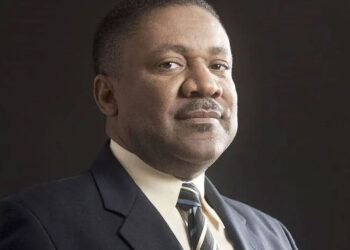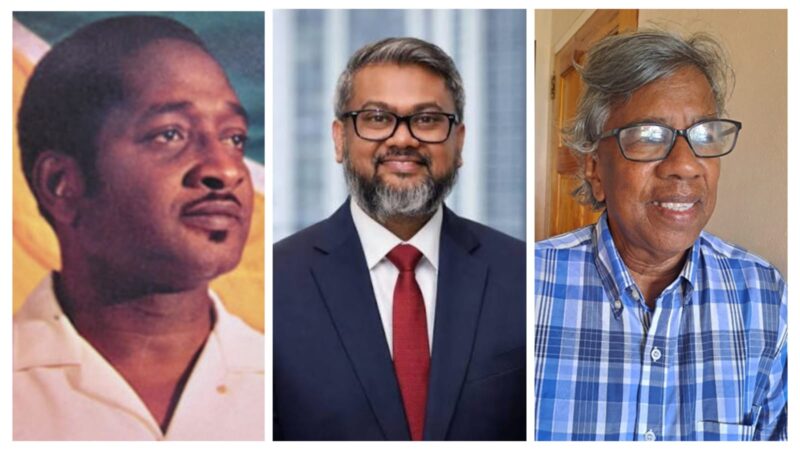
Former Georgetown Mayor Pt. Ubraj Narine has entered the ongoing debate over Guyana’s political history, mounting a strong defence of late President Forbes Burnham in a Village Voice News op-ed published Wednesday while sharply criticising columnist Freddie Kissoon over his recent commentary.
Responding to Kissoon’s February 23 column in the Guyana Chronicle, Narine argues that the portrayal of Burnham is “not history; it is hostility dressed up as scholarship,” and contends that the veteran columnist has abandoned positions he previously held. Narine also noted that Kissoon’s column cast aspersions on Burnham’s legacy and included personal criticism suggesting that Narine, like social activist Mark Benschop, “doesn’t read.”
Narine acknowledged he was not born during Burnham’s presidency but rejected the notion that historical understanding depends on lived experience. Instead, he emphasised research and critical analysis, asserting that such study supports the view that Burnham remains “among the most consequential leaders Guyana and the wider Caribbean have produced.”
Republic date controversy
Attention was taken of Kissoon of promoting a false narrative regarding the timing of Mashramani and Burnham’s birth date. According to Kissoon, “Burnham put the event on this day so it would be close to his birthday.”
Burnham was born on 20 February 1923, while Guyana became a Republic on 23 February 1970. The February 23 date was not linked to Burnham’s birthday but instead commemorates the start of the Berbice Slave Rebellion, which began on 23 February 1763. The date of the Republic honours the first major struggle for freedom, and contrary to Kissoon’s claim the observance was not designed for personal glorification.
Citing Kissoon’s earlier writings
To reinforce his broader argument about Kissoon’s intellectual laziness and inconsistency, Narine cited a 2018 column in which Kissoon acknowledged Burnham’s complexity and contributions.
In that earlier reflection, Kissoon wrote: “I am not a fan of Forbes Burnham… He had vision, was a transformative thinker, and a fighter against White domination of Guyana.”
Kissoon also warned at the time against inaccurate portrayals of Burnham, arguing that “nakedly foolish things” were often said about the former president.
Writing on the history of the University of Guyana, Kissoon maintained that while Cheddi Jagan founded the institution, Burnham played a decisive role in its development, concluding that the university was “a baby of both Jagan and Burnham.” He correctly credited Burnham with relocating the campus to Turkeyen, expanding academic programmes, attracting international scholars and investing heavily in the institution’s growth.
In his earlier commentary, Freddie Kissoon argued that Cheddi Jagan opposed several policies introduced under Forbes Burnham, including the National Insurance Scheme and the 1974 Sugar Levy, both of which he noted were later retained and utilised by successive PPP administrations.
Kissoon also wrote that Jagan had criticised the state takeover of the Chronicle but that subsequent PPP leaders made extensive use of the newspaper. He specifically stated that then President “Bharrat Jagdeo, used the Chronicle as a floor cloth in ways Burnham never did.”
Within that context, Kissoon contended that focusing solely on Burnham’s remark describing the University of Guyana as “Jagan’s night school” overlooks Burnham’s significant contribution to the institution’s expansion and development.
Narine said those acknowledgements stand in stark contrast to Kissoon’s current critique, which he accused of misrepresenting Burnham’s legacy.
Broader defence of Burnham’s record
Beyond rebutting Kissoon, Narine’s op-ed highlights Burnham’s leadership during the Cold War period, pointing to Guyana’s attainment of republican status, the assertion of sovereignty, and diplomatic management of the Venezuelan territorial controversy as defining achievements.
He also underscored Burnham’s nationalisation policies, the establishment of state institutions such as the National Insurance Scheme and National Flour Mill, and major infrastructure projects including the Demerara Harbour Bridge and the Mahaica–Mahaicony–Abary agricultural scheme.
Narine further highlighted free education from nursery to university and cultural initiatives aimed at fostering national consciousness. While acknowledging “errors, excesses and contradictions” during Burnham’s rule, he rejected characterisations equating the period with slavery or colonialism as historically inappropriate.
The op-ed also cautions against selective invocation of historian and activist Walter Rodney, urging more nuanced historical engagement.
Concluding, Narine called for what he described as mature debate rather than “ritualised demonisation,” maintaining that Burnham’s imprint on Guyana remains enduring.
The exchange underscores persistent divisions within Guyanese public discourse over Burnham’s legacy — a debate that continues to resurface each February as the nation marks its Republic anniversary.