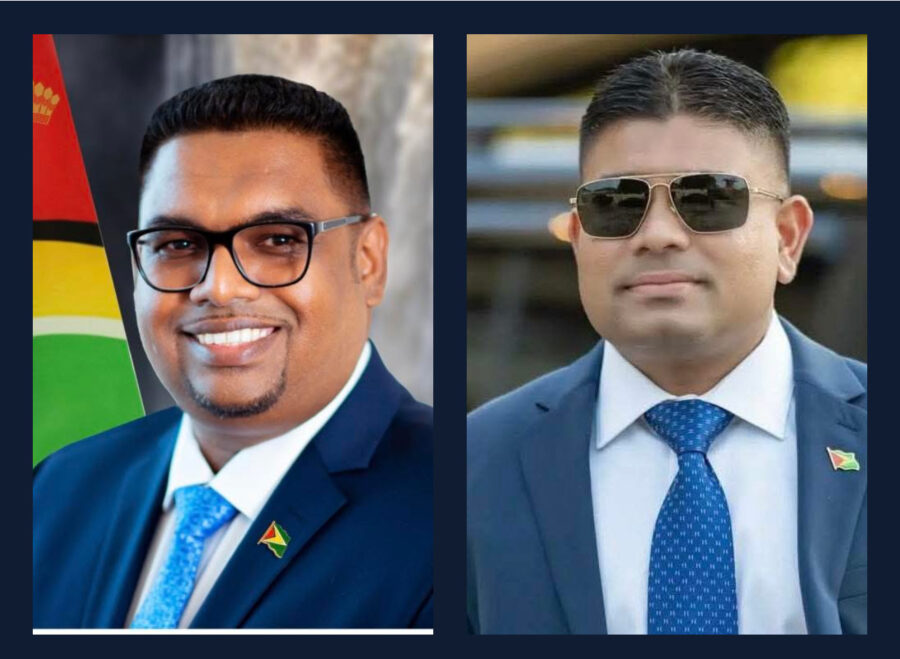
President Irfaan Ali declared that Guyana’s Republic is “strong,” “secure,” and “prosperous” as the country marked its 56th Republic Anniversary with a flag-raising ceremony, while Opposition Leader Azruddin Mohamed urged renewed commitment to accountability and justice.
Delivering the feature address at the flag-raising event last evening, President Ali reflected on Guyana’s transition to republican status in 1970, describing it as the moment the nation “severed the remaining vestiges of colonial monarchy” and asserted its sovereignty.
Guyana attained republican status on February 23, 1970 under the Forbes Burnham-led People’s National Congress government, replacing the British monarch as Head of State and marking a decisive step in the country’s constitutional and political evolution toward full sovereignty.
“I stand before you to declare, with confidence and with pride, that our Republic is thriving,” Ali said. “It is a Republic that is robust in its foundations, radiant in its promise, and resolute in its purpose.”
The President highlighted economic performance as a key indicator of national progress, noting that Guyana’s economy grew by 19.3 per cent in 2025. He described the expansion as broad-based, citing growth across several sectors.
“The non-oil economy grew by a staggering 14.3%. Agriculture expanded by 11.5%. Bauxite surged by 53.4%. Gold rose by 11.6%. Our manufacturing sector grew by 20%, while construction hammered out a phenomenal 31% growth,” he said.
Ali added that employment creation has also been significant, stating that between 2020 and 2024 some 104,000 jobs were generated. He linked government housing programmes, cash grants and tax relief measures to efforts aimed at placing “disposable income directly into the hands of our people.”
The Head of State also pointed to improvements in national security, saying serious crime figures had declined sharply when comparing the periods 2016–2020 and 2021–2025.
“In the earlier period, we averaged 2,827 serious crimes per year. Since 2021, that number has plummeted to just 1,441—an almost 50 per cent decline,” he said, thanking members of the security services for their work.
On foreign policy and territorial integrity, Ali reaffirmed Guyana’s position before the International Court of Justice regarding the 1899 Arbitral Award, declaring that “history and international law are on our side” and that Guyana’s borders remain “sacred.”
Ali also underscored Guyana’s growing international profile, describing the country as a leader in climate action and a contributor to regional food security initiatives within CARICOM. He said investments in education, healthcare and infrastructure are intended to reduce inequality and ensure inclusivity.
“The growing prosperity must mean better lives for our citizens,” he stated, adding that government initiatives are aimed at empowering Indigenous peoples, youth and women.
However, even as the President highlighted achievements, international assessments have pointed to persistent social and governance challenges. Reports have indicated that more than half of the population lives in poverty, with about 32 per cent in abject poverty and child malnutrition remaining a concern. The 2025 Transparency International report also described corruption as a continuing challenge, while analysts have argued that the management of the state excludes the Opposition and several sections of civil society.
Turning to democracy, the President said the 2025 elections represented “the resounding affirmation” of the people’s right to choose their leaders. General and regional elections were held on September 1, 2025, with the Guyana Elections Commission (GECOM) declaring the governing People’s Progressive Party/Civic victorious with 36 of the 65 seats and more than 55 per cent of the vote, while the We Invest in Nationhood (WIN) party led by Azruddin Mohamed emerged as the main opposition with 16 seats.
However, the polls have been accompanied by political controversy. Opposition figures, including Mohamed, questioned the credibility of the results and claimed irregularities, with the WIN leader asserting that his party had won the elections despite the official declaration and calling for stricter adherence to provisions of the Representation of the People Act governing electoral administration and transparency.
International observer assessments added further context. The European Union (EU) Election Observation Mission reported that while Election Day was peaceful and generally well administered, the process unfolded in a climate of deep political polarisation and an uneven playing field that reduced public confidence. EU observers also raised concerns about incumbency advantages, shortcomings in campaign finance transparency, and broader accountability issues affecting perceptions of fairness.
Ali used the occasion to call for greater national pride, urging citizens to treat patriotism as a shared responsibility. “National pride is not for one of us: it is not for one party; it is for all of us,” he said, linking pride to environmental stewardship, community harmony and shared prosperity. Even as the President made the lofty statement, he failed to acknowledge the presence of the Opposition Leader at the flag-raising event.
Meanwhile, Opposition Leader Azruddin Mohamed, who attended the ceremony with Members of Parliament from We Invest in Nationhood, issued a brief statement marking the anniversary.
“As our Golden Arrowhead was hoisted, it reminded us that the strength of our Republic lies in its people,” Mohamed said. He added that the opposition recommits to “serving the people of Guyana, defending justice, demanding accountability, and working toward a nation that delivers prosperity and opportunity for all.”