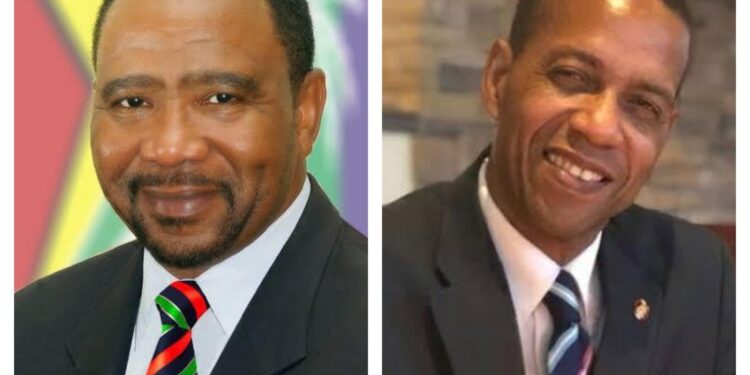
By Romona Baxter- Black History Month (Guyana) offers a fitting moment to celebrate those whose vision and dedication have quietly transformed our national landscape. Among these luminaries stands Dr. Ulric Neville Trotz — a scientist, educator and institution builder whose life’s work has helped shape Guyana’s scientific foundation and the Caribbean’s climate resilience agenda. This tribute recognises not only his academic brilliance and pioneering leadership but also the enduring institutions and generations of scholars influenced by his unwavering commitment to science in service of society.
Happy birthday to you Sir!
Here’s to A Ray of Hope!
This tribute is but a microcosm of the depth and breadth of his extensive contribution to the development of science and technology in Guyana, the Caribbean and the wider world.
Many of us live within well-functioning institutions without pausing to consider their nascent beginnings. They serve us so seamlessly that we often forget there was a time when their very existence had to be imagined, designed, and built into our national framework.
Institution builder.
Pragmatist.
Catalyst. Mentor.
A staunch fan of Manchester United.
A lover of cricket
A former choir singer.
He emerges as a multidimensional scientist, institution builder, and regional visionary whose work has profoundly shaped climate resilience across the Caribbean.
He is a disciplined analytical mind — driven by an innate curiosity and fascination with the chemical world, committed to rigorous evidence (“I had done the analysis myself”), and guided by an unwavering ethic of timely, results-oriented delivery. He was never content with isolated scientific work.
Having started from humble beginnings, focus, academic excellence and momentum led him to Enterprise High School, thence to Queen’s College through a middle school scholarship. From there the trajectory of his life in the sciences took decisive shape.
In 1957, he proceeded to the University of Edinburgh on a Government scholarship in Chemistry, graduating with honours.
In 1962, he returned to Guyana not simply with a degree. He returned with a duty.
After serving as the country’s handwriting and ballistics expert, his deep personal introspection about the role of science — whether it was truly building society — redirected his path toward nation-building.
He became a founding faculty member of the Chemistry Department at the University of Guyana, and, along with colleagues, helping to design and implement the Bachelor’s degree curriculum in Chemistry. At that time, the University of Guyana was still in its infancy.
He played an integral role in the development of the National Science Research Council. From this emerged the following three committees.
- The Standards committee
- The science and industry committee, and
- The agriculture committee.
The science committee led to the establishment of the Institute of Applied Science and Technology(IAST) at the university of Guyana in 1977.
The standards committee led to the establishment of the Guyana National Bureau of Standards in 1985 under the Standards Act No. 11 of 1984.
The agriculture committee led to the formation of the National Agricultural Research Institute (NARI) and now, the NARI Extension, in 1984.
It is important to note that these institutions are continuing to function today, which attests to his superb scientific foresight.
Regionally and internationally, his influence widened.
His tenure at the University of Guyana led to the formation of several initiatives.
He worked with a team to establish the Iwokrama International Centre for Rain Forest Conservation and Development, advancing the powerful principle that a nation can use a forest without losing it. On a regional level, he played a pivotal role in operationalizing the Caribbean Community Climate Change Centre (5Cs) in Belize.
He’s passionate about using science and technology for the creation of national wealth and contributing to the country’s national development.
Dr. Ulric Trotz completed his PhD (Doctorate) in Organic Chemistry at the University of Toronto.
He is held in high esteem by his colleagues and former students, many of whom went on to excel in graduate studies in Chemistry and lead distinguished careers locally and internationally. One of them became a lead researcher at Pfizer and credits him for his achievements.
He recently released his autobiography “A Ray of Hope” in 2024. I was especially tickled by his excitement in recounting the coveted President’s Trophy victory in a cricket match, defeating the team from the president’s office. He hopes for the return of his beloved West Indies cricket team to its glory days. When I spoke with him, I discovered he’s a staunch Manchester United supporter through thick and thin.
He credits his years at the University of Guyana as the most rewarding in his teaching career.
Dr. Trotz’s academic excellence did not end with him. His children, whom he loves dearly, have also distinguished themselves as high academic achievers.
Today, on this twenty-first day of Black History Month (Guyana), I present Dr. Ulric Neville Trotz — exemplary Guyanese scientist, institution builder, and architect of Caribbean climate resilience.
Dr. Ulric Trotz’s journey reflects the profound impact of purposeful scholarship and visionary leadership. From humble beginnings to international acclaim, his legacy is etched in the institutions he helped build, the students he inspired, and the regional initiatives he championed. Today, as we honour him during Black History Month (Guyana), his story stands as both celebration and challenge — a reminder that dedication to knowledge, nation-building and regional cooperation can illuminate pathways for future generations. Truly, Dr. Trotz remains a ray of hope whose contributions will continue to resonate for decades to come.
—————