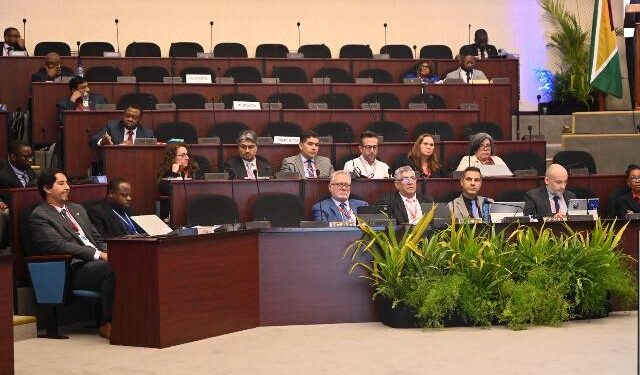
By Mark DaCosta – As the National Assembly debated the 2026 budget last week, opposition voices rang out sharply against the government’s proposals, condemning the financial framework as out of touch with the struggles of ordinary Guyanese. Hon. Vinceroy Jordan, A Partnership for National Unity’s (APNU’s Shadow ) parliamentarian with responsibility for Agriculture, highlighted serious flaws, warning that the budget risks entrenching poverty rather than offering relief.
The APNU Coalition’s stance frames this budget as a reflection of the People’s Progress Party/Civic (PPP/C) government’s failure to prioritise the well-being of the populace. According to their assessment, the proposed allocations do not tackle the critical issues of poverty, food security, and agricultural development. This harsh appraisal aligns with the findings from the Inter-American Development Bank, which highlights that a staggering 58 percent of our citizens live in poverty, and one in three Guyanese faces abject poverty. Jordan’s statements resonate with palpable frustration, as he points to the stark contrast between the government’s promises and the lived realities of the people.
As Dr. Ashni Singh, minister responsible for Finance lauds the budget’s goals, he is met with accusations of merely rebranding the APNU’s 2025 Manifesto theme of “Putting People First.” According to Jordan, this government’s financial strategy lacks substance and fails to institute meaningful change. Rather than presenting a coherent plan to uplift the people, the budget appears to be “just a wholesale shoplifting” of prior proposals, raising questions about genuine governance priorities.
A central point of contention emerges from the allocation for agriculture, which stands at $113.2 billion. However, only $1.9 billion is earmarked for livestock and a mere $3.3 billion for other crops. This is a stark reminder of the neglect faced by sectors that could contribute significantly to food security. Jordan underscores this disparity, suggesting that the government’s focus on infrastructure is misplaced when such a small percentage of the budget supports sustainable agriculture essential for feeding the population. “This is not putting people first,” he asserts, challenging the notion that Guyana can reclaim its historical role as the Caribbean’s breadbasket under the current funding trajectory.
Moreover, the opposition criticises the absence of direct measures to combat the high cost of living and insufficient wage increases for public servants. A proposed $5,000 increase to the old-age pension and a $3,000 boost to public assistance are branded as inadequate gestures, failing to reflect the cost-of-living challenges many Guyanese face daily. Jordan emphasises that “the only people they are putting first are themselves, their friends, families, and favorites,” encapsulating the sentiment that the current administration is out of touch with the struggles of ordinary citizens.
The opposition’s condemnation extends to specific sectors like fisheries and sugar production. With a reported reduction in the fisheries allocation by $200 million, the APNU claims this move signals a lack of support for hardworking fishermen who deliver essential resources to our tables. Similarly, the government’s tender-heartedness for the beleaguered sugar industry is scrutinised, with continued losses reported from the Guyana Sugar Corporation (GuySuCo) operations presenting a dire economic burden.
In his speech, Jordan highlights the absurdity of “spending GYD $275 to produce a pound of sugar while selling it at $35,” branding the current economic practices as fundamentally flawed. He vocally questions the logic behind this and seeks a coherent plan for the sugar industry — a sentiment mirrored by many frustrated citizens witnessing the cyclical vulnerabilities of production and pricing.
Region Five, a microcosm of the systemic failures detailed in the budget, reflects another dimension of governance inadequacies. The government’s budgeting of $8.4 billion fails to address the markedly increased population and subsequent needs for social services and infrastructure. With a population growth of 13,000 since the last census, the allocation falls woefully short of what is necessary for effective governance and development. Jordan argues, “how could a mere $1 billion increase cater to an increase of 13,000 Guyanese?” underscoring the strain on local services, education, and healthcare.
The opposition’s vision for the agricultural sector includes a strategic plan to enhance sustainability, ensuring that food production is effectively regulated across all regions. Jordan asserts that “every region must become self-sustainable,” aimed at creating independent agricultural capacities that can both feed local populations and export surplus to broader markets. The apparent neglect within this budget to bolster local agriculture presents a concerning narrative of economic management that favours short-term infrastructural gains over long-term food security and rural development.
As the opposition prepares to reject the proposed budget, discussions surrounding accountability and transparency grow louder. Jordan presses for clarity regarding cash grants distributed to farmers, urging the government to release lists of beneficiaries to prevent accusations of discrimination and malpractice. This plea encapsulates a broader demand for openness that citizens across our nation crave, amidst growing dissatisfaction with political leadership.
Essentially, the 2026 budget raised by the current PPP/C government begs the question of whether it truly reflects the needs of its people or serves merely as a financial summary devoid of purpose. As it stands, many feel it is an exercise in futility—one that elevates the privileged while leaving the majority of our population enmeshed in the grips of poverty. The contrasting visions articulated by the opposition suggest a profound urgency for transformative action, urging the government to adopt policies that genuinely favour the needs of those they are sworn to serve, rather than perpetuating a cycle of neglect and disenfranchisement.