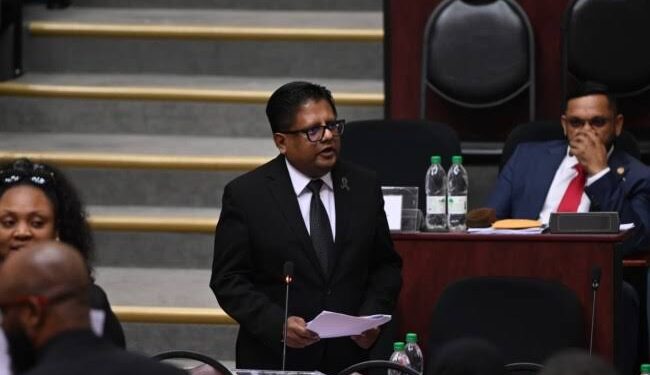
Guyana’s Budget 2026, delivered by Ashni Singh on January 26 under the lofty banner “Putting People First,” is the largest fiscal plan in our history. At $1.558 trillion, it arrives amid headline numbers any government would boast about: GDP growth of 19.3 percent in 2025, oil production nearing 830,000 barrels per day, and a Natural Resource Fund balance of US$3.25 billion. On paper, this is the story of a nation transformed by oil wealth.
But budgets are not judged by their size or their slogans. They are judged by what they choose to measure, what they choose to prioritise, and what they choose to ignore. When this budget is examined against its own stated objective of centering people, and against basic international standards for poverty reduction in resource-rich developing countries, a deeply troubling picture emerges. The contradictions are not subtle. They are structural.
Start with the most uncomfortable fact in the entire 109-page speech. Poverty barely exists in it. The word “poverty” appears only twice, and even then only as a passing reference to long-defunct Poverty Reduction Strategy Papers. There is no statement of Guyana’s current poverty rate. There is no Gini coefficient. There is no discussion of income inequality. There is no poverty reduction target. There is not even a rudimentary explanation of how record growth is translating, or is supposed to translate, into improved living standards for those at the bottom.
This omission is not academic. It is fatal to the credibility of a budget that claims to put people first.
International best practice is unequivocal on this point. The World Bank’s Poverty Assessment Framework, the OECD’s guidance for resource-rich economies, and the Sustainable Development Goals all begin with the same premise, you cannot reduce poverty unless you measure it. Not vaguely. Not historically. Precisely and currently. Policymaking without baseline data on poverty incidence, depth, and severity is not strategy. It is guesswork dressed up as governance.
Guyana does not lack growth. Guyana lacks transparency about who that growth is reaching.
The last comprehensive Household Budget Survey is years out of date. The 2022 Census is mentioned in the appendices, but even there the government concedes that key indicators still require revision. Yet this budget presses forward without presenting updated poverty or inequality statistics. No benchmarks. No timelines. No distributional analysis. Nothing that allows citizens, researchers, or Parliament to evaluate whether trillions in spending are improving lives or merely circulating within already advantaged circles.
For a government presiding over one of the fastest-growing economies on earth, this silence is not accidental. It is revealing.
Other resource-rich countries understood early what Guyana now seems determined to avoid. Norway tied oil revenues to measurable social outcomes and transparent reporting. Botswana set explicit poverty and inequality targets alongside diamond revenue management. Even Trinidad and Tobago, in its earlier phases of energy governance, attempted to link energy windfalls to social indicators, however imperfectly. These countries recognised a simple truth, growth figures mean nothing if they are not interrogated through the lens of distribution.
Guyana is also a signatory to the Sustainable Development Goals. Goal 1 requires national poverty statistics and explicit poverty reduction targets. Budget 2026 does not merely fall short of that obligation. It ignores it entirely.
This is why the theme “Putting People First” rings hollow. You cannot put people first if you do not count the poor. You cannot claim inclusive growth while refusing to publish inequality data. You cannot credibly manage an oil economy while avoiding the most basic questions about who benefits and who is left behind.
A $1.558 trillion budget that cannot tell us how many Guyanese are poor, where they live, or whether their circumstances are improving is not people-centered. It is politically convenient. And in a country standing at the crossroads of extraordinary wealth and extraordinary risk, convenience is the most dangerous policy choice of all.