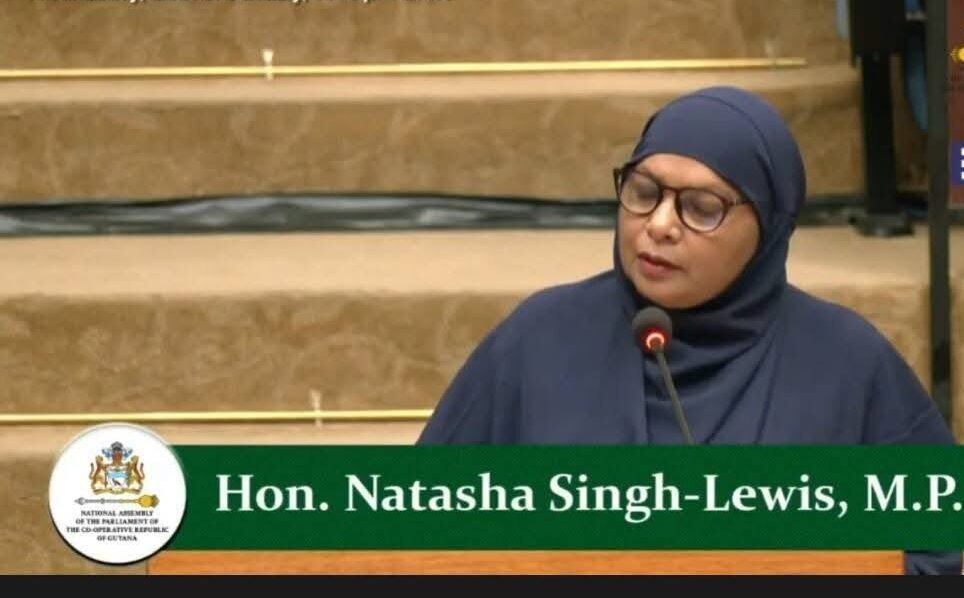
Natasha Singh-Lewis, Member of Parliament for We Invest in Nationhood (WIN), on Monday outlined major concerns with the Government’s $1.558 trillion 2026 budget, accusing the administration of hypocrisy, weak governance and a failure to protect Guyana’s most vulnerable citizens.
Speaking during the budget debate in the National Assembly, Singh-Lewis congratulated new and returning parliamentarians and welcomed the newly elected Leader of the Opposition, Azruddin Mohamed- WIN leader- saying Guyana “deserves the leadership of young people.” She later pointed to what she described as a contradiction between Finance Minister, Dr. Ashni Singh’s rhetoric and his conduct in the House.
Referring to a section of the budget speech that called for a “more humane and caring society,” Singh-Lewis said the appeal was undermined by the Minister’s own actions moments earlier. “These lofty pronouncements ring hollow—they are rendered meaningless and insincere—by the Minister’s own actions,” she said, accusing him of launching a personal attack on an opposition member. “You cannot build a ‘One Guyana’ on a foundation of personal bitterness in the People’s Assembly.”
She also alleged political victimisation of WIN candidates, including the closure of their bank accounts, questioning where the compassion and tolerance described in the budget speech had been in those instances.
Turning to the substance of the estimates, Singh-Lewis said she assessed the budget against the United Nations Sustainable Development Goals (SDGs) and concluded that the government’s theme of “putting people first” was “a farce.” Citing a 2025 Inter-American Development Bank report, she said approximately 58 per cent of Guyana’s population—about 452,400 people—live in poverty.
“This budget demonstrates inequality…a demonstration of two Guyanas and not one Guyana,” she said, arguing that tax concessions favour those who already have assets while offering limited relief to low-income households. She criticised a $5,000 increase in old-age pensions, noting it amounted to about $160 per day. “In this oil producing nation 160 can’t buy a pack of tennis roll,” she told the House.
Much of Singh-Lewis’ contribution focused on what she described as systemic failures within the Ministry of Human Services and Social Security. She cited high staff turnover, heavy reliance on contract workers and weakened institutional capacity, arguing that these challenges have contributed to rising child abuse cases, gender-based violence and neglect of pensioners and persons with disabilities.
She noted that nearly 8,000 cases of child abuse were reported over the past two years, while femicide cases rose from 13 in 2024 to 22 in 2025. “Something is rotting in the Child Protection Agency,” she said.
Singh-Lewis also raised concerns over the management of state-funded childcare facilities at Anna Catherina and Providence, which she said were commissioned or allocated significant funding but remain non-operational. She questioned who should be held accountable for what she described as waste and poor oversight.
As part of her presentation, the WIN MP outlined a series of policy recommendations aimed at strengthening social protection and accountability. She called for a full audit of the Child Protection Agency, particularly its safeguards for children and its management of the growing number of abuse cases, as well as a parliamentary investigation into child abuse nationwide and the development of clear prevention measures.
On gender equality, Singh-Lewis urged the National Assembly to implement the recommendations of the Women and Gender Equality Reports through the Parliamentary Sectoral Committee on Social Services and to consider establishing a national paternity leave policy to allow fathers to support mothers and newborns after childbirth.
She also recommended expanding the Menstrual Hygiene Programme through the Ministry of Human Services and local government, with special attention to girls in hinterland and remote regions.
To address mental health challenges, Singh-Lewis proposed government-supported mental health programmes within the public service, allowing workers to access therapists through a reimbursement system similar to the National Insurance Scheme’s medical benefits.
She further called for transparent and accountable appointment processes for members of the Boards of Guardians in each administrative region.
Regarding the childcare facilities, Singh-Lewis requested immediate parliamentary oversight investigations into the procurement, commissioning and abandonment of the Anna Catherina centre, along with a full ministerial statement outlining the condition of both facilities and a costed timeline for opening the Anna Catherina centre and completing the Providence project.
Reaffirming her advocacy for vulnerable populations, Singh-Lewis said, “Our children, our women, our elderly, and our public servants deserve systems that work and leadership that puts people first. These recommendations are practical steps toward building a Guyana where every citizen is protected, supported, and valued.”