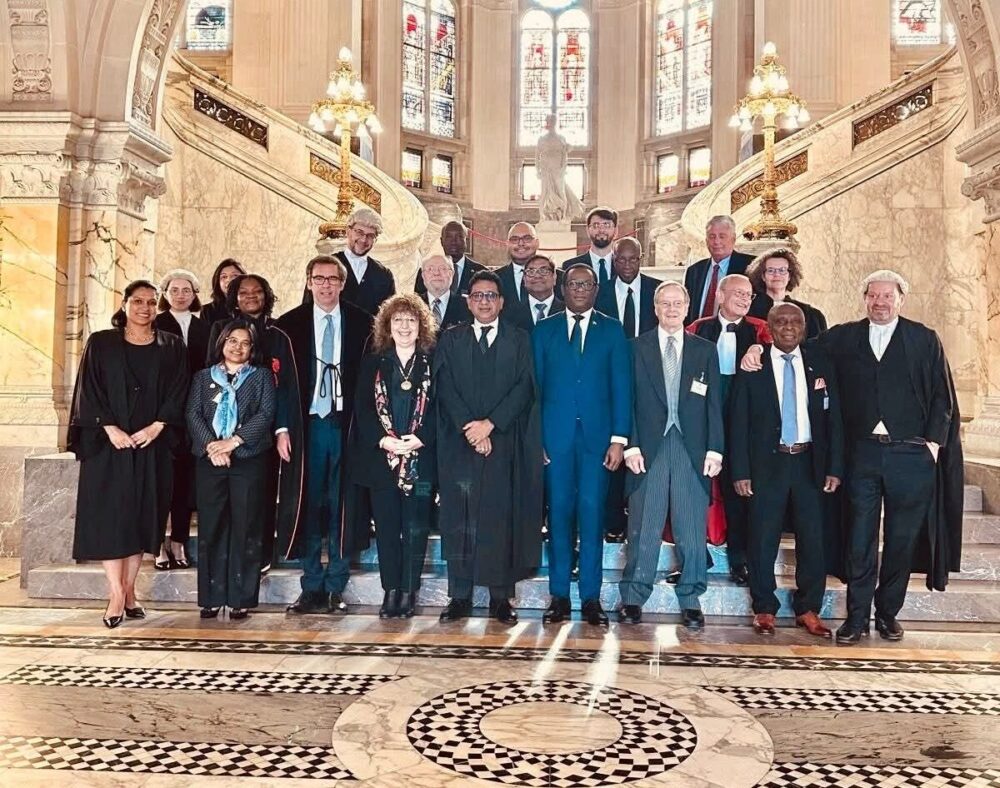
The International Court of Justice (ICJ) on Wednesday heard Venezuela’s oral arguments in the long-running border controversy with Guyana, with Caracas maintaining its rejection of the court’s jurisdiction while Guyana’s legal team, led earlier this week by veteran diplomat Carl Greenidge, mounted a forceful historical and legal defence of the 1899 Arbitral Award.
The hearings, now in their substantive phase at the Peace Palace in The Hague, are aimed at determining the validity of the Arbitral Award of October 3, 1899, which Guyana says legally and finally settled the boundary with Venezuela, placing the Essequibo firmly within Guyana’s sovereign territory.
On Wednesday, Venezuela’s agent, Samuel Moncada, repeated Caracas’ longstanding argument that it does not recognise the ICJ’s authority to adjudicate the dispute.
Moncada told the court that the 1899 Award was “fraudulent” and the product of colonial-era coercion, insisting that the 1966 Geneva Agreement displaced the arbitral award and mandates direct bilateral negotiations as the mechanism for settlement. Venezuela argued that any judicial intervention by the ICJ would improperly interfere with that agreement and its intended diplomatic process.
But Guyana’s case, presented earlier in the week, directly challenged that narrative.
Greenidge, Guyana’s Agent before the Court and one of the architects of the country’s modern border diplomacy, told the judges that Venezuela itself was the party that insisted on arbitration in the 19th century after failing to secure its territorial ambitions through diplomacy.
“The history is clear,” Greenidge argued, noting that it was Venezuela—not Britain—that pressed for arbitration, severed diplomatic ties with Britain in 1887, and enlisted the United States to help force an arbitration agreement that culminated in the 1899 Award.
That argument strikes at the core of Venezuela’s fraud claim.
Guyana’s position is that Venezuela cannot credibly denounce as illegitimate the very arbitral mechanism it actively pursued and secured.
Greenidge also dismantled Venezuela’s historical claim to occupation and administration of the Essequibo, presenting maps and historical records showing that Dutch—not Spanish—settlers established and administered the territory from the 16th century onward.
He pointed to enduring Dutch place names across the Essequibo as evidence of continuous Dutch and later British administration, while emphasising that Venezuela has failed to produce evidence of effective Spanish or Venezuelan control over the territory.
Guyana’s legal team also broadened the stakes beyond legal theory.
Foreign Minister Hugh Todd told the Court that Venezuela’s claim threatens Guyana’s sovereignty, peace and development, warning that the Essequibo comprises more than 70 per cent of Guyana’s territory and is home to hundreds of thousands of Guyanese citizens.
Guyana has also asked the ICJ to order Venezuela to reverse a series of recent actions—including constitutional changes, official maps and plans for local elections in the disputed territory—which Guyana says violate provisional measures previously issued by the Court.
The latest hearing unfolded against heightened regional tensions.
Venezuela continues to treat the Essequibo as part of its national territory following a controversial 2023 referendum and subsequent legislative actions incorporating the region into its administrative structure.
Guyana has consistently argued that such actions are unlawful and amount to an attempt to alter the status quo while the matter remains before the Court.
The ICJ had already ruled in 2020 that it has jurisdiction to hear Guyana’s case, a point Venezuela continues to reject even while participating in the merits phase.
The hearings continue through May 11, after which the Court will begin deliberations.
Its final ruling—though still months away—could permanently settle one of South America’s oldest territorial disputes.
For Guyana, the case is about preserving sovereignty over a territory it says has been legally settled for 127 years.
For Venezuela, it is the continuation of a claim revived in 1962 and now colliding with the full force of international adjudication.