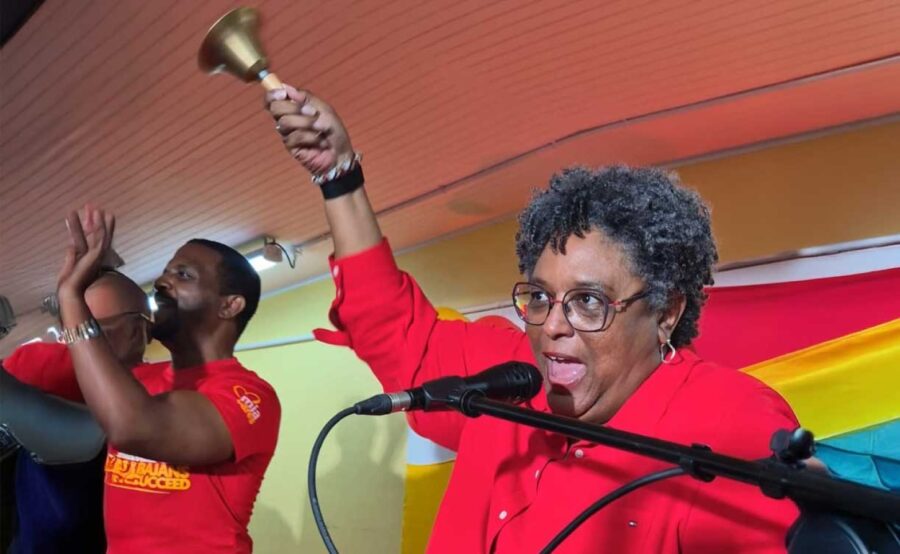
By Mark DaCosta- In a significant political move, Prime Minister Mia Amor Mottley of Barbados has announced the dissolution of Parliament and called for snap elections scheduled for February 11, 2026. This decision arrives as a response to the perceived weakness of the opposition, the Democratic Labour Party (DLP), which has struggled to mount a credible challenge in the face of Mottley’s Barbados Labour Party (BLP) dominance.
The forthcoming election has been framed as a necessary exercise in democratic renewal. Mottley stated, “If a leader wishes to continue, you must come back to us for a new mandate,” highlighting her intent to reaffirm her leadership amidst growing scrutiny. This decision is particularly striking given that Mottley initially indicated her second term as Prime Minister would be her last. However, citing global instability and calls from supporters, she has opted to pursue a historic third term — a move viewed by many as politically calculated.
Barbados has witnessed a remarkable political landscape in recent years, with the BLP securing every single seat in the House of Assembly during both the 2018 and 2022 elections. Now boasting 60 consecutive constituency victories, the BLP has effectively created a one-party parliament, raising concerns about democratic processes and governance. Critics argue that Mottley’s leadership has led to a lack of meaningful opposition, with some commentators referring to her as a “de facto dictator.” Such characterisations, while arguably exaggerated, reflect a growing unease regarding concentrated power in Barbadian politics.
The DLP, led by Ralph Thorne, is entering this election severely weakened and inadequately prepared. With just over three weeks to mobilise its campaign, the DLP has only managed to name 15 candidates for the 30 available seats. Thorne himself, a former BLP member who crossed the floor to take on leadership roles within the DLP, faces internal party conflicts that have detracted from substantive political discourse. Political analyst Peter Wickham’s assessment of Thorne — that he “was never a serious political leader”— epitomises the current challenges the DLP encounters.
Under Thorne’s leadership, the DLP appears to be relying on fear-mongering tactics to galvanise support, particularly concerning the CARICOM free movement of people initiative. The party has accused the current administration of manipulating voter rolls by including Caribbean nationals. Mottley dismissed these accusations as “fanciful” and “irresponsible,” asserting that such claims are not founded in reality.
Despite Mottley’s significant achievements as the first female Prime Minister and her reputation as a climate champion, her administration is not without its faults. Barbados currently has a public debt of approximately $15 billion, and with debt servicing projected to consume $8.45 billion over the next five years, questions arise regarding the sustainability of her policies. The nation’s economy is still heavily reliant on tourism, a sector vulnerable to disruptions from pandemics or natural disasters, as illustrated by the impacts of COVID-19.
Moreover, Mottley has borrowed $7.3 billion since assuming office, despite proclaiming decreasing debt-to-GDP ratios — a financial figure that has improved primarily due to the 2018 debt restructuring rather than effective fiscal management. The anticipated contraction of real GDP growth in 2025 to a mere 2.7 percent, attributed to global economic headwinds, further complicates the outlook for her government.
The critical undercurrent in this narrative is the state of democracy in Barbados. A functioning opposition is essential for healthy governance, holding the ruling party accountable and ensuring that diverse viewpoints contribute to national policy-making. As it stands, the absence of a robust opposition raises alarms about the implications of Mottley’s potential third term. It leaves governance subject to fewer checks and balances, ultimately relying on civil society, the media, and the conscience of officials.
As Barbadians head towards the upcoming election, the stakes are exceedingly high. The potential for the BLP to extend its unprecedented hold on power presents unanswered questions about the future of democracy on the island. The February 11 elections may determine whether an effective opposition can emerge from the ruins of the DLP or if Mottley’s reinvigorated mandate will further entrench her party’s dominance.
In the context of our nation’s political complexities, the situation in Barbados serves as a cautionary tale for those of us in Guyana. We must not overlook the importance of a healthy political ecosystem where diverse ideologies are represented and where the governing body is held to account. The recent developments in Barbados are a stark reminder of the fragile nature of democracy and the necessity for robust opposition in safeguarding national interests against the backdrop of power consolidation. As we observe our Caribbean neighbour, Guyanese citizens should remain vigilant and engaged, ensuring that our political landscape remains vibrant and representative of the peoples’ will