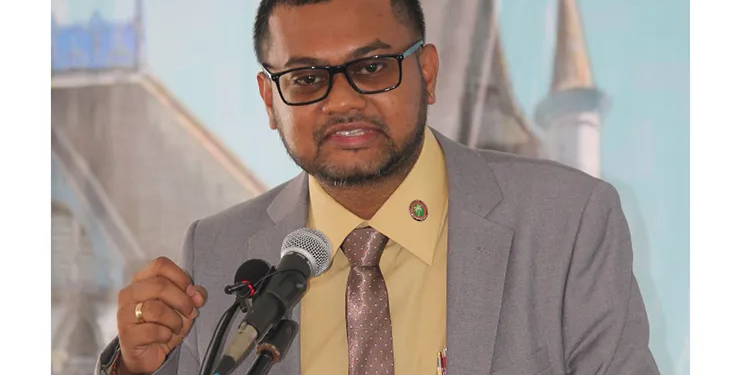
Guyana Police Force Senior Superintendent Mitchell Caesar has had his United States visa revoked, according to multiple sources, a development that has reignited public debate over long-standing but unresolved allegations surrounding his conduct.
Sources confirmed that Caesar was questioned by U.S. authorities in 2024 while entering the United States on vacation leave. Details of that encounter have not been disclosed, and U.S. authorities have not stated whether the visa revocation is connected to any of the allegations surrounding the senior officer. No official explanation has been issued by either U.S. or Guyanese authorities.
The development has renewed attention on Caesar’s professional history, which has been marked by repeated allegations but no criminal convictions. In 2022, he became the focus of national controversy following the fatal shooting of Ricardo “Paper Short” Fagundes outside Palm Court on March 21, 2021, an incident that sparked widespread public outrage and calls for a thorough and transparent investigation. Bascom also alleged that a police officer accepted a $30 million bribe to suppress the case.
The probe into Fagundes’ killing was later clouded by controversy when then–Detective Sergeant Dion Bascom publicly alleged that senior police officials interfered with the investigation. Despite intense scrutiny and sustained public concern, no official findings or conclusions have been released.
The U.S. Department of State, in its 2022 Country Report on Human Rights Practices, highlighted Bascom’s allegations in its section on ‘Corruption and Lack of Transparency in Government.’ The report cited his claim that a businessman paid bribes to members of the Guyana Police Force in an effort to undermine the investigation into Fagundes’ killing.
Over the years, Caesar has also faced allegations of corruption, bribery and interference in criminal investigations, including claims that charges were manipulated to the detriment of innocent individuals. He has further been linked, by allegation, to associations with questionable figures. None of these claims has been tested in court, and no charges or convictions have resulted.
Additional concerns reportedly surfaced during Caesar’s 2024 visit to the United States, when U.S. law enforcement agents questioned him about allegations that he targeted critics of the governing People’s Progressive Party and the Guyana Police Force. Investigators were reportedly interested in whether he attempted to obtain information about the homes and movements of such individuals. Those claims remain unproven.
In December, the Caribbean Guyana Institute for Democracy (CGID) issued a statement alleging that Caesar traveled to New York in 2024 and was involved in a plot to have its president, Rickford Burke, killed. The organisation said further information has since emerged to support its claims. The allegation has not been tested in any court, and Caesar has not publicly responded.
Caesar, who has served as head of the GPF’s Major Crimes Unit, was reportedly detained and questioned by U.S. agents upon arrival at New York’s JFK Airport in March 2024. The circumstances and outcome of that questioning have not been made public.
The revocation of Caesar’s U.S. visa now stands as the most significant official action taken against a senior law enforcement officer surrounded by years of allegations. With no formal explanations forthcoming from authorities, calls continue to mount for transparency and accountability surrounding the circumstances that prompted U.S. action and the continued absence of clear answers at home.