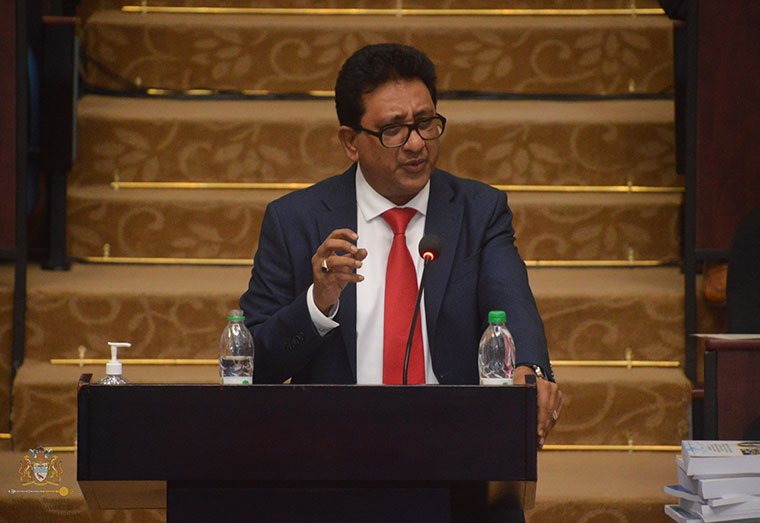
Attorney General and Minister of Legal Affairs, Mohabir Anil Nandlall, SC, has outlined an ambitious slate of legislative reforms slated for 2026, including updates to the Evidence Act and Companies Act, the introduction of long-absent Trust legislation, and revisions to Guyana’s Cybersecurity Act. While the proposals suggest long-overdue modernization, they also raise questions about whether the People’s Progressive Party (PPP) government will craft laws that genuinely serve the wider public interest, given its record of advancing legislation that many view as uneven, targeting opponents, and insufficiently inclusive.
Speaking on his weekly Issues in the News programme on Tuesday evening, Nandlall said reforming the Evidence Act is a priority, noting that the current law dates back to the colonial era.
“Nothing that was relevant in 1893 can be relevant now. So, by the sheer passage of time, the Evidence Act is outmoded and outdated,” he said. “That act was born out of a different era. We are now living in an ICT world.”
According to the attorney general, a draft modern Evidence Act—modelled on internationally recognised legislation from Australia—has already been completed and is expected to go to Cabinet before public consultations begin. He noted that Barbados and several other Caribbean countries have already enacted similar laws.
Amendments are also planned for the Companies Act of 1995. While Nandlall said the law has generally worked well, he argued that developments in finance and increasingly complex business practices now require updates. He disclosed that consultations have already started with members of the legal profession, accountants, and private-sector stakeholders.
However, questions persist about who will ultimately be classified as “stakeholders” in this process, including whether political parties—particularly those outside the governing People’s Progressive Party—will be meaningfully included. It remains unclear whether consultations will draw from an independent and broad cross-section of society, or be confined largely to individuals, institutions, and interests perceived as aligned with the PPP administration.
Another major reform on the agenda is the introduction of Trust legislation. Guyana currently has no law governing trusts, despite their growing importance in financial and commercial transactions.
“Our economy is growing, our financial sector is expanding and becoming more sophisticated, and we must have the mechanisms that the Trust Act provides to protect our financial system,” Nandlall said. “In any event, the Financial Action Task Force has already identified the lack of a trust law in Guyana as a critical deficiency, and we have to fill that deficiency very early.”
The attorney general also announced plans to revise Guyana’s Cybersecurity Act to align it with evolving international standards, including the new United Nations Convention on Cybercrime. He said the revisions are intended to strengthen the country’s ability to combat online offences while safeguarding freedom of expression.