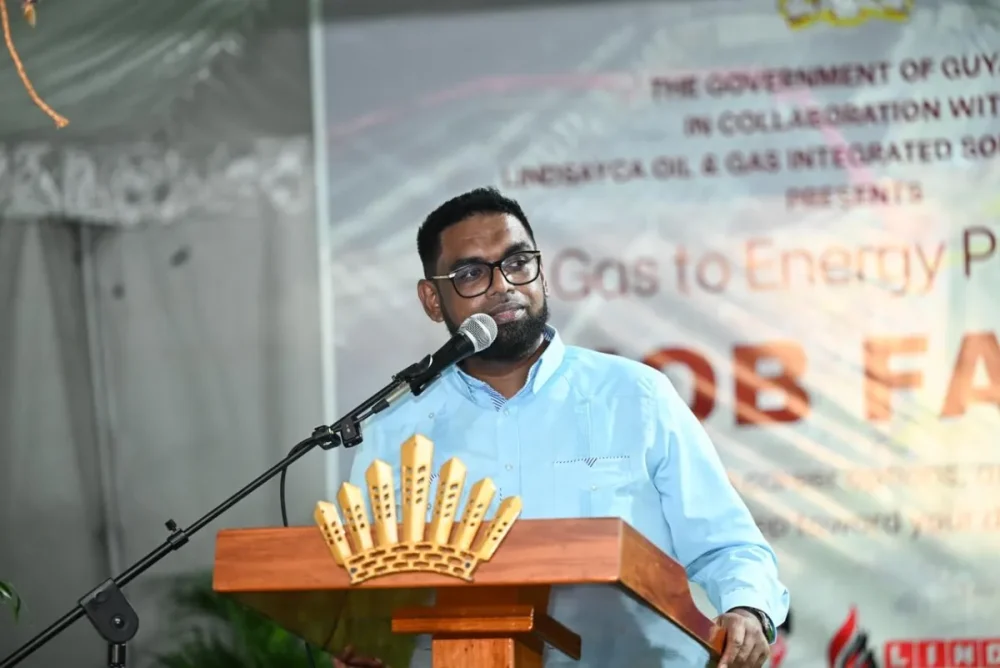
By Timothy Hendricks- In an unexpected turn of events, one week before Christmas, President, Irfaan Ali chose to address the nation not from the National Assembly, but from the lawns of the Arthur Chung Conference Centre – surrounded by his ministers, MPs, and a government-aligned audience. This choice raises profound and searching questions about democratic norms, institutional respect, and political optics.
In a functioning parliamentary democracy, a national policy address – especially one that purports to chart the next five years – belongs within the hallowed halls of the Assembly, with the Opposition present to ask questions, apply scrutiny, and represent dissenting voices. Instead, the President’s decision to speak from outside that constitutional forum signals a troubling disregard for democratic process and political inclusivity.
It was no benign oversight. Members of the Opposition and independent observers alike noted that no invitation was extended to opposition parties – a deliberate exclusion that undermines the very spirit of national dialogue. At a time when Guyana’s Parliament lies stalled and the nation lacks a formally appointed Leader of the Opposition, the President’s choice brings into stark relief how far his rhetoric is removed from democratic reality.
This is not mere symbolism – it is a political statement with real consequences.
One of the most striking moments in President Ali’s speech was his attempt to reassure the public about economic support and social upliftment. Yet this reassurance resonates hollowly with many citizens who recall explicit campaign language about cash grants in the lead-up to the elections – remarks that were widely interpreted as promises of material support for struggling families over Christmas.
In the aftermath, the opposition’s leader rightly castigated this as a broken “moral contract” with the electorate. The original sentiment stirred hope among public servants, low-income households, and informal workers who planned personal budgets around this implicit commitment. Instead of fulfilling that promise, the administration pivoted to offering a relatively modest sum – far removed from the perceived pledge. This is not just semantic sleight of hand; it is a substantive breach of trust. For many across the country, this shift from campaign fervor to governing pragmatism feels less like responsible leadership and more like political expediency.
President Ali’s speech leaned heavily on language of unity, national purpose, and collective ambition. Yet, his actions tell a different story.
Throughout his tenure, the President has invoked themes of one Guyana and shared prosperity. But on this occasion, unity was conspicuously absent when it mattered most – during the articulation of his five-year plan. The Opposition was neither consulted nor included, and Guyanese citizens were presented with a fait accompli instead of a collaborative vision.
This theatrical staging – framed as “inclusive governance” – rings hollow in light of actual political practice. In essence, the President’s public rhetoric about unity stands in stark contrast to a moment that excluded opposition voices at a cornerstone democratic juncture.
Perhaps the most persistent theme in President Ali’s public statements over recent years has been prosperity – especially tied to Guyana’s oil-led economic growth. While it is true that Guyana’s economy has seen significant expansion since oil production began, with rapid GDP growth and increased revenue streams, these macroeconomic successes have not translated into tangible improvements for many citizens.
Take, for example, the repeated pledges to improve infrastructure, create jobs, and lower energy costs. These remain largely aspirational for countless households facing high living costs, unpredictable electricity expenses, and stagnant wages. Promises about universal 24-hour electricity and modern healthcare facilities continue to be future-oriented aspirations rather than universal realities, especially outside major urban centers.
When leaders trumpet visionary technological integration – such as ambitious AI platforms or digital governance tools – it sounds forward-looking. But for everyday Guyanese struggling with school fees, transportation, basic utilities, and securing stable employment, such visions feel remote, abstract, and disconnected from lived experience.
This disconnect matters. Leadership is not judged solely on aspirational rhetoric, but on whether governance tangibly improves the quality of life for all citizens. On this score, the President’s lofty language often outpaces measurable results.
The most jarring irony of this address was that it came in the absence of an active Parliament and without a recognised Leader of the Opposition. For a national agenda that purports to guide the next five years, this omission is not trivial – it is foundational. Democracy thrives on institutional engagement, debate, and accountability. When those pillars are sidelined, governance becomes less representative and more insular.
President Ali’s decision to speak outside Parliament, to a friendly crowd of government loyalists, while ignoring the formal structures of democratic debate, highlights a troubling departure from the principles of inclusive governance that he professes to uphold.