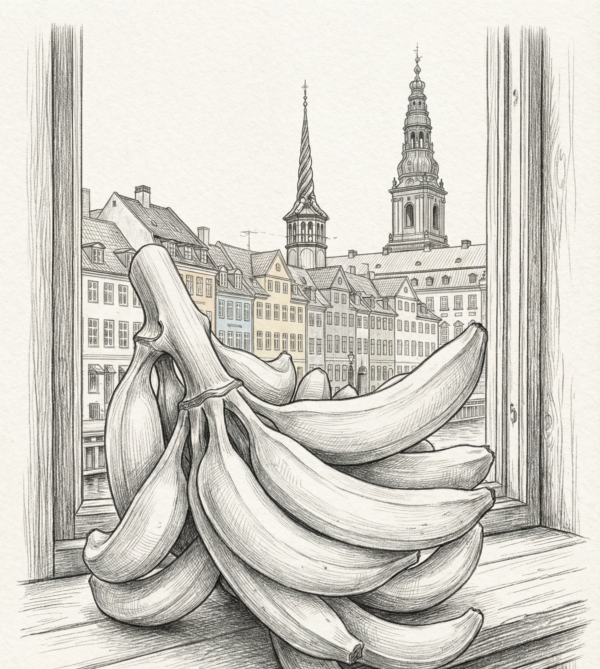
(Guyana Business Journal)- Copenhagen, Denmark-Six thousand Guyanese dollars for a bunch of plantains. That, in a nutshell, is the price of building Rome overnight. Guyana, the newest petro-state on the block, is discovering what Norway learned half a century ago and what the Dutch discovered before that: oil wealth is a mixed blessing. From the rather different vantage point of Copenhagen—a city more accustomed to pickled herring than plantains—the dynamics at play in Georgetown are strikingly familiar.
The arithmetic is straightforward. Construction is booming at nearly 30% growth. Retail and wholesale trade are expanding rapidly. Gold prices are up. All of this is pulling labour away from the fields and into the cities [1]. Meanwhile, wages are rising, cash is flowing, and a growing population—swelled by oil workers and Venezuelan migrants—is demanding more food. Supply is down; demand is up. Prices, inevitably, follow.
The Bank of Guyana’s latest figures show food prices climbing 5.8% in the first half of 2025, with vegetables up a rather eye-watering 18% [1]. The International Monetary Fund, in its customarily diplomatic way, has flagged “labour shortages” and “wage pressures” as concerns [2]. Translation: the boom is overheating.
This is textbook Dutch Disease, the economic malady named after the Netherlands’ unhappy experience with natural gas in the 1960s. The symptoms are well known: a resource windfall drives up the exchange rate and wages, making traditional exports uncompetitive and sucking workers out of agriculture and manufacturing. Norway caught the bug, too, but managed to treat it. Denmark, though not an oil giant, has long wrestled with how to keep farmers profitable in a high-wage economy. Both offer lessons for Guyana—if it cares to listen.
Consider first the Danish model. Denmark’s agricultural prowess is built not on vast prairies or cheap labour, but on farmer-owned cooperatives. The movement began in the 19th century, when Danish farmers, facing stiff competition from larger producers, decided that if they could not beat them individually, they would join forces collectively [4]. They pooled resources to build their own dairies, slaughterhouses, and export companies. The principle was simple: one farmer, one vote; profits shared in proportion to contribution. “Collaboration,” as the Danes like to say, “is the essence of Denmark’s DNA within food and agriculture” [4].
What is less well known is that Guyana was doing something remarkably similar—and rather earlier. In the 1830s and 1840s, freed slaves pooled their meager savings and purchased abandoned sugar estates. History records that they carried their money in wheelbarrows to pay for their purchases [8]. These “village cooperatives” were, in effect, the first cooperatives in the Caribbean. Many eventually failed—starved of credit, denied access to technology, and actively sabotaged by the planter class—but the spirit endured. It was this spirit that led Guyana, in 1970, to declare itself the world’s first “Co-operative Republic,” with the lofty aim of making “the small man the real man” [9].
The experiment did not end well. By the 1980s, Guyana’s cooperative sector had become a vehicle for political patronage rather than economic empowerment. As a government policy document later admitted, with commendable candour, it was “the attempt to foist socio-political objectives on the movement” that was to blame, not the cooperative model itself [9]. The institutions survived—the Kuru Kuru Cooperative College still exists—but the movement withered.
The lesson is not that cooperatives do not work. They manifestly do, as Denmark’s Arla Foods and Danish Crown attest. The lesson is that cooperatives work when they are grounded in member autonomy, sound business principles, and freedom from political interference. Guyana has the historical foundation; what it needs is a modern framework. A National Cooperative Development Program, offering training, credit, and technical support, could help revive a proud tradition and give small farmers the collective muscle to capture more value from the food chain.
Norway’s contribution to this discussion is rather different. When oil was discovered on the Norwegian continental shelf in 1969, the country was already a stable democracy with a competent bureaucracy [5]. This mattered enormously. The Norwegians established a sovereign wealth fund in 1990 and, in 2001, adopted a fiscal rule limiting government spending to the expected real return on the fund—originally 4%, now 3% [5]. The philosophy, as one economist put it, was that “the resources belong to the nation, and the development should benefit the society as a whole, including future generations” [5].
Guyana has its own Natural Resource Fund, but the temptation to spend is proving hard to resist. The IMF has noted, with evident concern, that recent increases in the withdrawal ceiling have provided “substantial room to expand capital expenditure” [2]. This is polite IMF-speak for “you are spending too fast.” Without a credible fiscal anchor, the NRF risks becoming a piggy bank for the present rather than a nest egg for the future. Norway’s experience suggests that the political will to save is as important as the institutional machinery.
Copenhagen offers a third lesson, this time in urban food policy. The Danish capital has used its considerable purchasing power to reshape the food system. Ninety percent of food served in public institutions—schools, hospitals, daycares—must now be organic, with a significant share sourced locally [6]. The city has also launched campaigns to reduce food waste and promote food literacy. The result is a virtuous circle: public procurement supports local farmers, who in turn supply healthier food to public institutions.
Denmark is not, it should be noted, immune to food price inflation. The Danmarks Nationalbank reported in September 2025 that food prices had risen 32% since 2021, double the rate of overall consumer prices [7]. But the central bank’s analysis pointed to global supply-side factors—weather, disease, commodity markets—rather than domestic policy failures. The implication is clear: governments cannot control global food prices, but they can address local supply constraints and use public procurement to support domestic producers.
What, then, should Guyana do? Four things, primarily. First, launch a National Cooperative Development Program to revive and modernise the cooperative tradition, equipping farmers with the skills and capital to compete. Second, strengthen the fiscal rule governing the Natural Resource Fund, committing to a spending limit that prevents overheating and ensures intergenerational equity. Third, develop a National Food and Nutrition Security Strategy that uses public procurement to support local agriculture and promote healthier diets. Fourth, invest in agricultural research and development to fund innovation in climate-resilient crops and sustainable farming practices.
None of this will be easy. The political pressures to spend are intense, and the benefits of restraint are often invisible—the inflation that did not happen, the crisis that was averted. But the alternative is clear enough. Countries that squander resource windfalls tend to end up poorer, not richer, than they started. The “resource curse” is not inevitable, but avoiding it requires foresight, discipline, and a willingness to learn from others.
From Copenhagen, the view is clear. Guyana has the resources, the history, and the opportunity to chart a different course. The Nordic nations did not achieve their prosperity by accident. They built institutions, invested in people, and made difficult choices. Guyana can do the same—if it chooses. The price of a bunch of plantains is, in the end, a small thing. But it is also a symptom of a much larger challenge: whether Guyana’s oil wealth will be a blessing or a curse. The answer lies not in the ground, but in the choices made above it.