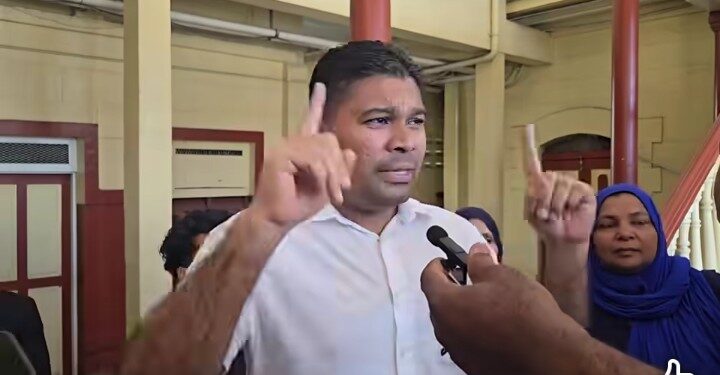
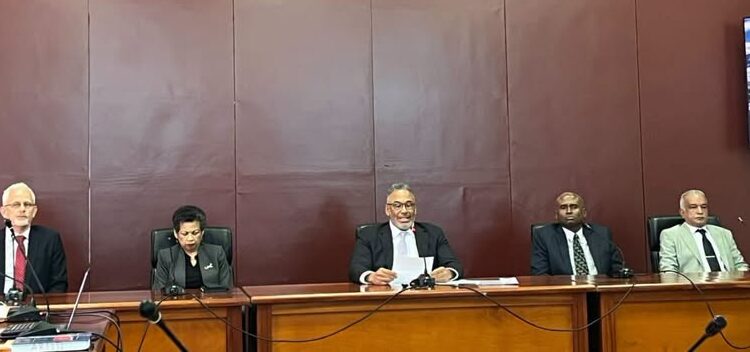
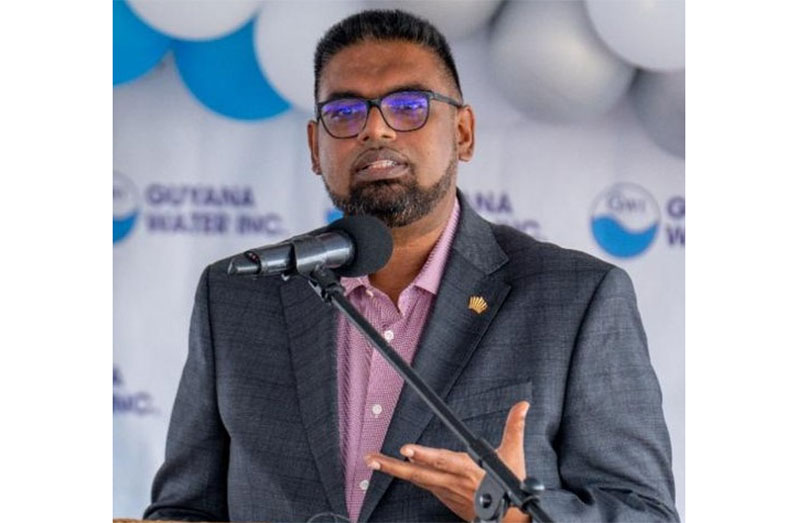
Serious questions are being raised about whether Attorney General and Minister of Legal Affairs Anil Nandlall is attempting to influence the outcome of Principal Magistrate Judy Latchman’s anticipated ruling in the high-profile extradition case involving businessman turned political leader Azruddin Mohamed, Leader of the We Invest in Nationhood (WIN) party, and his father, Nazar “Shell” Mohamed.
Under Guyanese law, matters before the court are considered sub judice, and the presumption of innocence remains a constitutional and common-law right until a court rules otherwise. Yet, in this case, several senior members of the People’s Progressive Party (PPP) appear to be violating these very principles, issuing public pronouncements that seem designed to shape public opinion and potentially pressure the court.
The Attorney General himself is on record making public declarations before the court has spoken, stating that Azruddin Mohamed’s “election as Leader of the Opposition would tarnish the parliament.” Minister within the Office of the Prime Minister, Kwame McCoy, went even further, attacking Mohamed’s legitimacy and implying wrongdoing not yet proven.
McCoy asked “What gives Azruddin Mohamed the confidence, the surety, that this extradition to the United States will drag on for five years? Who is in his pockets?”
He continued with inflammatory language
“Let us see whether the confidence the Mohameds exudes, the belief that he can kick the matter down the road and avoid extradition, will find the judiciary wanting or whether justice will rise above his money, his arrogance and his manipulation.”
These statements, made while the case is active, stand in sharp contrast to President Irfaan Ali’s own pronouncement that the Mohameds are entitled to full due process of law. Society is not fooled by the “good-cop, bad-cop” display, with one side advocating for fairness and the other publicly attacking the defendants’ credibility.
Last week on his “Issues in the News” programme, Nandlall escalated his political argument against Mohamed, declaring
“The stain and the international stigma that will attach to our parliamentary process, to the institutions of Guyana, by a fugitive offender not only sitting there but holding the post of Opposition Leader, is far graver and will cost us permanent damage.”
Yet he ignored the fact that Mohamed has not been found guilty of any offence while several PPP figures themselves held public office and continued functioning as parliamentarians while facing active criminal charges.
President Irfaan Ali, at the time a sitting Opposition MP, was brought before the court on 19 fraud charges prior to being sworn in as President in 2020; those charges were later discontinued by the Director of Public Prosecutions
Nandlall himself, also an Opposition MP at the time, faced a law-book theft charge, which was dropped after he assumed office as Attorney General
Dr. Jennifer Westford, then Opposition PPP parliamentarian was also charged with the theft of $600 million, and served in the National Assembly while the case was being heard.
Even as he speaks about the Constitution of Guyana and due-process rights, the AG omits the very common-law traditions that underpin them.
The timing of his most recent comments has drawn even sharper scrutiny. On the eve of Magistrate Latchman’s ruling, Nandlall appeared on News Room, outlining what he described as the only two options available to her
-
Uphold the defendants’ submissions and refer the constitutional or legal questions to the High Court for determination
-
Rule the submissions frivolous and vexatious, move forward with the committal hearing, and determine whether there is sufficient or insufficient evidence to extradite before issuing the committal order.
He further stressed that it is the Minister of Home Affairs that make the decision to extradite or not while asserting that “the magistrate has an overriding decision.
By publicly lecturing the country on how the magistrate should interpret the law, on the very day she is expected to rule, the Attorney General appears to be making a case on behalf of the court, not merely offering legal commentary. His argument leaned heavily on the doctrine of precedent, even though he has ignored other legal duties elsewhere, for example when the PPP-elected Speaker Manzoor Nadir was advised to call a meeting with non-government MPs to elect the Leader of the Opposition under Article 184(1).
This article expressly states:
“The Leader of the Opposition shall be elected by and from among the non-governmental members of the National Assembly at a meeting of all such members held under the chairmanship of the Speaker.”
A member of the public observing the proceedings highlighted the implications of the PPP’s statements:
“Note the public hint to Magistrate Judy Latchman to dismiss the request to forward the matter to the High Court based on ‘honouring’ the principle of the doctrine of precedent. In effect, the AG is asking Magistrate to say the matter has already been addressed, therefore this application is vexatious and should be squashed and go no further, preparing the basis for their rushed extradition, which the Act in question empowers the Minister and not the Magistrate to be satisfied to do.”
This latest televised intervention raises the most pressing concern that Nandlall may be attempting to shape the legal and political environment in which Magistrate Latchman delivers her decision, especially as one of the defendants’ central arguments is that the current Fugitive Offenders Amendment Act is unconstitutional.
Given these ongoing public statements by top government officials, society is not fooled the “good-cop, bad-cop” display, and the question is no longer whether Guyanese citizens notice the attempt to influence the judicial process but how overt those attempts have now become.