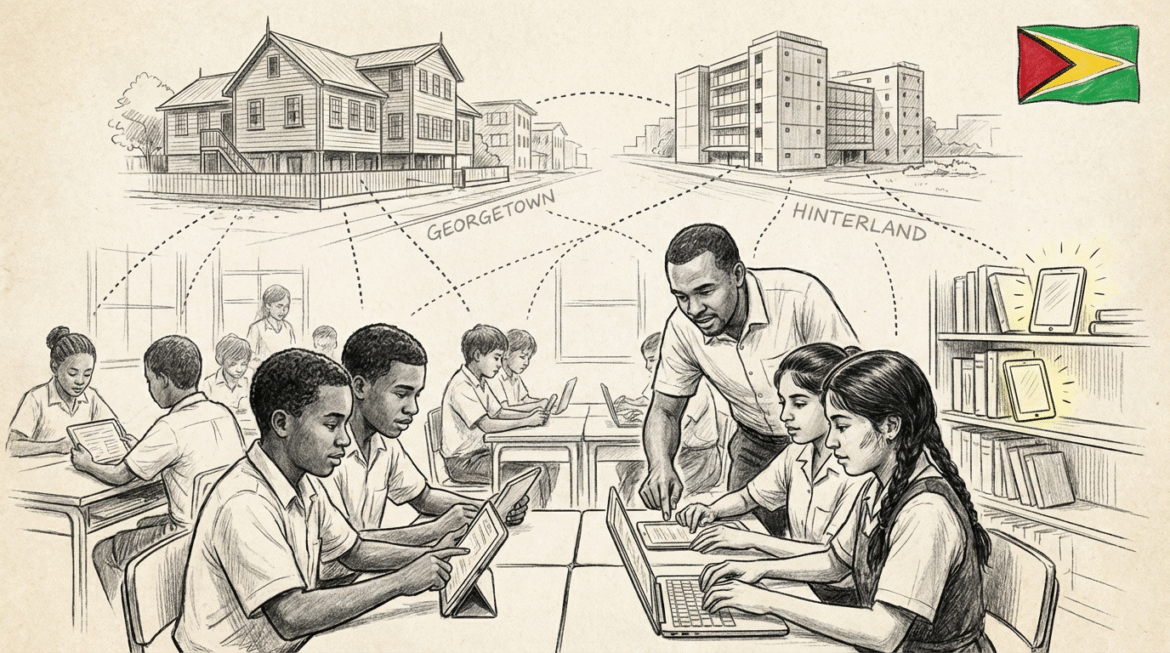
The recent launch of the Guyana Digital School, a repository of digital resources customized for Moodle that serves 10th- and 11th-grade students, represents a potential landmark investment in the nation’s future, leveraging its newfound oil wealth to tackle long-standing educational disparities [1, 2]. The initiative, which provides a free, blended-learning platform to students in Guyana and across the Caribbean, is ambitious and laudable. However, extensive research on educational technology (EdTech) initiatives in developing nations reveals a landscape littered with well-intentioned failures. Success is not guaranteed by technology or funding alone; it requires a deep understanding of the complex interplay between technology, pedagogy, infrastructure, and human factors.
This expanded analysis moves beyond a preliminary assessment to amplify the critical challenges identified in global research, define a concrete and measurable framework for success, and outline a realistic, evidence-based pathway for implementation. The central thesis is that for the Guyana Digital School to succeed, it must be implemented not as a technology project, but as a comprehensive, human-centered educational reform program.
The Challenges: A Research-Based Perspective
While the initial assessment identified key risks such as the digital divide and teacher capacity, research from organizations like UNICEF, which has studied digital learning implementation in over 15 countries, provides a more granular and urgent perspective on the potential pitfalls [9]. The following table amplifies these challenges, translating global lessons into specific, high-stakes questions for Guyana’s implementation strategy.
| Challenge | Core Research Insight (UNICEF) [9] | Critical Questions for Guyana’s Digital School |
|---|---|---|
| 1. The “Plug and Play” Fallacy | “Merely introducing technology into the classroom is not sufficient to improve learning. What matters more is how that technology is integrated into a learning experience.” | Does the implementation plan include detailed, supervised protocols for device charging, storage, scheduling, and troubleshooting in every school? Or does it assume teachers and administrators will figure this out? |
| 2. Teacher-Centricity vs. Teacher Bypass | “If it is not useful for teachers, it will collect dust… ‘Engaging teachers with Technology Increased Achievement, Bypassing Teachers Did Not.’” | Is the teacher training program a one-off technical workshop, or does it provide dedicated, ongoing time for teachers to experiment, collaborate, and integrate the platform into their specific lesson plans? |
| 3. The Non-Negotiable Need for Offline Access | “For digital learning to be equitable and accessible for all, having ‘offline’ functionalities is a must… In places like Mauritania, Guinea, Ghana, and Sudan… an offline solution is non-negotiable.” | With a 52% internet penetration rate [8], is the offline strategy a secondary feature or a primary, day-one design requirement for all core content and functionality? How will content be updated on offline devices? |
| 4. The “Last Mile” of Infrastructure | “Infrastructure matters, and it’s about more than just connectivity or devices… In Sub-Saharan Africa… most children go to schools without electricity.” | Has every target school been audited for reliable electricity, sufficient wall sockets, and secure storage? Is there a funded plan to address these gaps before devices are delivered? |
| 5. The Illusion of PDF-as-Digital Content | “Only one third of national digital learning platforms… had interactive content… If digital learning is reduced to ‘printed’ material on a screen, we may be better off with traditional paper.” | What percentage of the content on the Guyana Digital School is truly interactive (quizzes, simulations, gamified activities) versus static (PDFs of textbooks)? Is there a quality assurance process to ensure engagement? |
| 6. The Blind Spot of Platform-Only Data | “We cannot understand these critical questions if we look only at data that comes from the platform itself. We have to combine data from schools, classes, feedback from teachers and students…” | Is the Monitoring & Evaluation (M&E) plan limited to tracking logins and completion rates? Or does it integrate classroom observations, teacher feedback, and student surveys to understand how and why learning is (or is not) happening? |
| 7. The AI Equity Gap | “If left only to market forces, we may see the benefits of AI in education focused in the Global North, threatening to widen inequalities.” | While the platform uses AI, is there a parallel plan to build AI literacy among Guyanese teachers and students? How will the government ensure the AI tools are culturally relevant and free from algorithmic bias? |
Addressing these amplified challenges head-on is the first step on a realistic path to success. The next step is to define success in concrete, measurable terms.
Defining and Measuring Success: A Multi-Dimensional Framework
To avoid the common pitfall of celebrating high enrollment as a proxy for success, the Guyana Digital School must adopt a rigorous, multi-dimensional framework for defining and measuring its impact. Success is not a single metric but a composite of achievements across five critical domains. The following framework, grounded in educational research, provides a comprehensive, balanced scorecard for the initiative.
| Domain | Weight | What Success Looks Like |
|---|---|---|
| 1. Learning Outcomes | 35% | Students using the platform demonstrate statistically significant and meaningful improvements in academic performance, digital literacy, and mastery of the CXC curriculum compared to non-users. |
| 2. Access & Equity | 25% | The platform is reliably accessible and actively used by students and teachers across all 10 regions, regardless of socioeconomic status, with no significant gap in usage or outcomes between coastal and hinterland areas. |
| 3. Engagement & Usage | 20% | Students are not just logging in; they are consistently and deeply interacting with the platform, completing courses, and demonstrating self-directed learning habits. |
| 4. Teacher Integration | 15% | Teachers are confident and competent in using the platform as an integral part of their daily instruction, viewing it as an indispensable tool for enhancing their teaching. |
| 5. System Sustainability | 5% | The platform operates efficiently, is financially sustainable beyond the initial investment period, and has a robust process for continuous, evidence-based improvement. |
Key Performance Indicators (KPIs) and Targets
Each domain is measured by specific, time-bound KPIs. The table below provides examples of primary KPIs and realistic three-year targets.
| Domain | Primary KPI | Year 1 Target | Year 3 Target |
|---|---|---|---|
| Learning Outcomes | Learning Gain Score: Improvement on standardized pre-post tests. | Establish Baseline | +15-20% Improvement |
| CXC Pass Rate Delta: Difference in pass rates between platform users and a control group. | Establish Baseline | +10 Percentage Points | |
| Access & Equity | Geographic Equity Index: Ratio of active users in hinterland vs. coastal regions. | 0.60 | > 0.85 |
| Platform Accessibility Rate: % of target students with reliable access (connectivity & device). | 60% | 95% | |
| Engagement & Usage | Monthly Active User Rate: % of enrolled students using the platform each month. | 50% | 75% |
| Course Completion Rate: % of students who complete enrolled courses. | 50% | 70% | |
| Teacher Integration | Teacher Adoption Rate: % of teachers actively using the platform weekly. | 60% (in pilot) | 85% (national) |
| Teacher Confidence Index: Self-reported confidence in using digital pedagogy (1-5 scale). | 3.5 | 4.2 | |
| System Sustainability | Platform Uptime: % of scheduled time the platform is fully operational. | 98% | 99.5% |
| Cost Per Active Student: Annual operational cost divided by the number of active users. | Establish Baseline | 15% Reduction |
This framework moves beyond vanity metrics to provide a true measure of educational impact. A failure to meet these targets, particularly on equity and learning outcomes, should be seen as a critical warning sign requiring immediate strategic intervention.
A Realistic Pathway to Sustainable Success
Ambition must be matched with a disciplined, evidence-based implementation strategy. A rushed, technology-first rollout risks squandering the significant financial investment and political will behind this project. The following three-phase pathway, grounded in implementation science research, offers a realistic approach to building a sustainable and impactful national education ecosystem.
Phase 1: The Foundational Year (Year 1) – Pilot, Prepare, and Prove
The primary goal of this phase is not national scale, but deep learning. It involves building a solid foundation by testing assumptions in a controlled environment, de-risking the major challenges, and gathering the baseline data necessary for intelligent scaling.
| Strategic Priority | Key Actions and Initiatives |
|---|---|
| 1. De-Risk the Human Factor | – Develop and Mandate a National Digital Pedagogy Certification: A hands-on training program focused on how to teach with technology, not just how to use it. Provide dedicated time for teachers to experiment and collaborate [9].
Establish a Teacher-Leader Corps: Train tech-savvy teachers in each region to act as mentors and first-line support for their peers. |
| 2. De-Risk the Infrastructure Gap | – Conduct a National School Infrastructure Audit: Assess every target school for electricity, secure storage, and charging capabilities.
Deploy Offline Hubs Immediately: Pilot offline solutions in the most remote schools to make connectivity a non-issue for initial access [9]. Finalize Device Access Strategy: Based on a national student needs assessment, finalize and fund a device subsidy or lending program. |
| 3. Establish a Culture of Evidence | – Launch Baseline Assessments: Administer standardized tests for learning outcomes and digital literacy in a representative sample of pilot and control schools.
Deploy the Full M&E Framework: Implement the multi-source monitoring system from day one. Form an Independent Evaluation Council: Appoint national and international experts to oversee the long-term impact evaluation. |
The critical output of Phase 1 is not national enrollment, but a proven, replicable implementation model and a rich dataset demonstrating its efficacy in the Guyanese context.
Phase 2: Expansion and Iteration (Years 2-3) – Scale, Solve, and Standardize
With a proven model from Phase 1, the goal is now to scale the initiative nationally while using data to solve emerging problems and standardize best practices.
| Strategic Priority | Key Actions and Initiatives |
|---|---|
| 1. Bridge the Digital Divide | – Execute National Rollout: Expand platform access to all target schools, deploying infrastructure solutions (e.g., solar power) based on the Phase 1 audit.
Launch Device Access Program: Implement the device subsidy/lending program, prioritizing students in low-income and remote households. Targeted Equity Interventions: Use monitoring data to identify schools/regions with low engagement and deploy targeted support teams. |
| 2. Drive Deep Integration | – Scale the Teacher-Leader Corps: Ensure every school has a trained mentor.
Develop a “Digital Lesson Plan” Bank: Create and share a repository of high-quality lesson plans that effectively integrate the platform, developed by Guyanese teachers for Guyanese teachers. Launch a Parent Digital Literacy Program: Engage parents through community-based workshops to help them support their children’s learning. |
Phase 3: Maturity and Sustainability (Years 4-5) – Embed, Empower, and Export
The final phase focuses on embedding the Digital School into the very fabric of the national education system, ensuring its long-term sustainability, and positioning Guyana as a regional leader.
| Strategic Priority | Key Actions and Initiatives |
|---|---|
| 1. Ensure Long-Term Sustainability | – Integrate into National Budget: Transition the initiative from a special project to a core, recurring line item in the Ministry of Education’s budget.
Develop Local Content Creation Capacity: Build local teams of curriculum developers and instructional designers to create culturally relevant content. Establish Public-Private Partnerships: Explore partnerships for content, connectivity, and device maintenance to enhance efficiency and innovation. |
| 2. Drive System-Wide Transformation | – Incorporate into Teacher Certification: Make the Digital Pedagogy Certification a mandatory component of all pre-service teacher training programs in Guyana.
CXC Examination Integration: Work with the Caribbean Examinations Council to integrate platform-based assessments and digital portfolios into official examination scores. |
From Vision to Victory
The Guyana Digital School is one of the most promising educational initiatives in the Caribbean, backed by a level of political will and financial resources that is exceptionally rare. Its success has the potential to not only transform education in Guyana but also to create a blueprint for the entire developing world.
However, the research is unequivocal: victory is not inevitable. It will not be secured by the technology alone, but by the quality of the implementation. Success requires embracing the complexities of the human and logistical factors on the ground. It demands a shift in mindset from a technology rollout to a long-term educational reform movement.
By amplifying real-world challenges, defining success in terms of measurable learning and equity, and following a disciplined, phased, and evidence-based pathway, Guyana can turn its ambitious vision into a sustainable, transformative, and resounding victory for its children and the region.
References
[1] News Source Guyana. (2025, December 7). Guyana Digital School seeks to transform education delivery. https://newssourcegy.com/news/guyana-digital-school-seeks-to-transform-education-delivery/
[2] Associated Press. (2025, December 6). Awash in oil money, Guyana unveils a new digital school to boost education in the Caribbean. https://apnews.com/article/guyana-online-learning-digital-school-caribbean-4d501e7ff29e5cd6d513c33fccde8d7c
[3] Guyana Times. (2025, December 6). Over 20,000 students across Guyana, Caricom sign up as Guyana Digital School launches. https://guyanatimesgy.com/over-20000-students-across-guyana-caricom-sign-up-as-guyana-digital-school-launches/
[4] Guyana Digital School. (n.d.). The Four Quadrant Approach to Learning. Retrieved December 7, 2025, from https://digitalschool.moe.edu.gy/
[5] Topping, K. J., Douglas, W., Robertson, D., & Ferguson, N. (2022). Effectiveness of online and blended learning from schools: A systematic review. Review of Education, 10(2). https://bera-journals.onlinelibrary.wiley.com/doi/10.1002/rev3.3353
[6] Basar, Z. M., Mansor, A. N., Jamaludin, K. A., & Alias, B. S. (2021). The Effectiveness and Challenges of Online Learning for Secondary School Students – A Case Study. Asian Journal of University Education, 17(3). https://files.eric.ed.gov/fulltext/EJ1309475.pdf
[7] Bhuasiri, W., Xaymoungkhoun, O., Zo, H., & Rho, J. J. (2012). Critical success factors for e-learning in developing countries: A comparative analysis between ICT experts and faculty. Computers & Education, 58(2), 843-855. https://files.ifi.uzh.ch/hilty/t/Literature_by_RQs/RQ%20306/2012_Bhuasiri_Xaymoungkhoun_Zo_Critical_success_factors_for_e-learning_in_developing_countries.pdf
[8] International Trade Administration. (2024, September 19). Guyana – Digital Economy. U.S. Department of Commerce. https://www.trade.gov/country-commercial-guides/guyana-digital-economy
[9] Dreesen, T., & Giraldo, J. P. (n.d.). Top 10 reasons digital learning succeeds or fails. UNICEF Innocenti Global Office of Research and Foresight. Retrieved December 7, 2025, from https://www.unicef.org/innocenti/top-10-reasons-digital-learning-succeeds-or-fails
The Business Journal