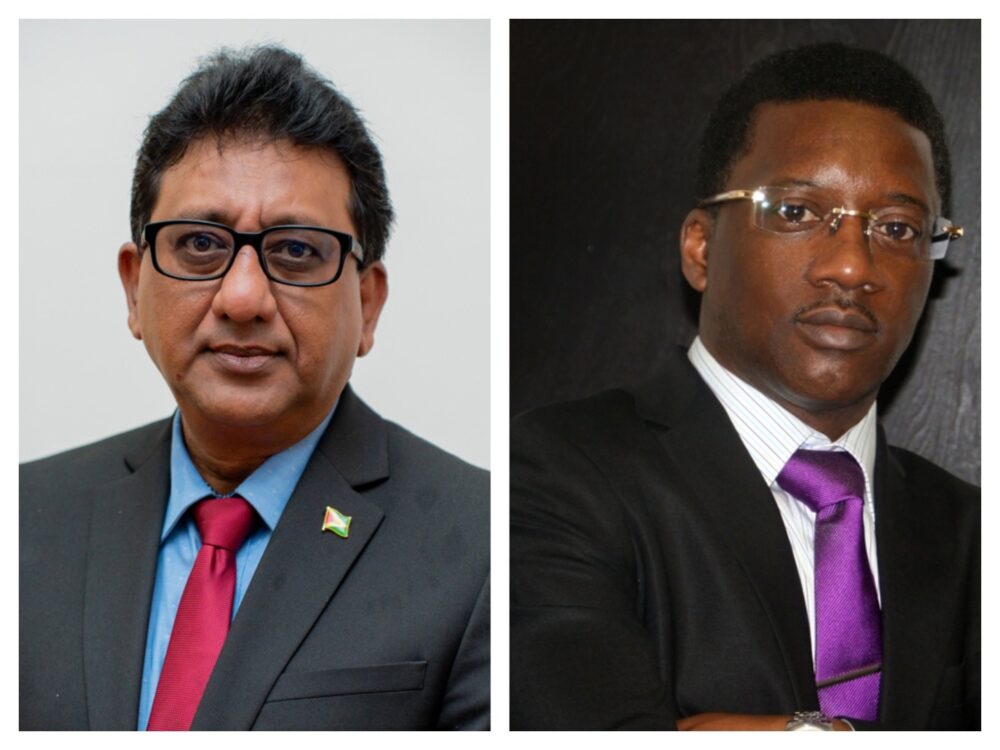
Attorney-at-law Dr. Vivian Williams has openly contested Attorney General (AG) Anil Nandlall’s handling of the extradition process for businessman Nazar “Shell” Mohamed and his son, Azruddin Mohamed, arguing that the AG misapplied the 1931 Extradition Treaty between the United States and Great Britain, inherited by Guyana.
Speaking on the Caribbean Tea on November 11, Williams said Nandlall’s claim that Article 4 of the Treaty guided the government’s withdrawal of charges against the Mohameds “is absolutely wrong.” The lawyer explained that Article 4—covering prior offences—stipulates:
“The extradition shall not take place if the person claimed has already been tried and discharged or punished, or is still under trial in the territories of the High Contracting Party applied to, for the crime or offence for which his extradition is demanded. If the person claimed should be under examination or under punishment in the territories of the High Contracting Party applied to for any other crime or offence, his extradition shall be deferred until the conclusion of the trial and the full execution of any punishment awarded to him.”
Williams emphasised that “the Treaty places a duty on the State to complete its trials and penalties before deferring to another sovereign,” directly contradicting Nandlall’s assertion that the government’s actions were justified under Article 4. He also cautioned that the U.S. would not yield jurisdiction in the way Guyana acted to facilitate the extradition.
Adding to the controversy was the Attorney General’s claim that the United States played a role in hiring the high-priced overseas lawyers. However, the U.S. Embassy in Guyana publicly refuted this, stating that the attorneys were not retained with its approval. The Embassy clarified::
“The attorneys appearing in the Guyanese extradition proceedings of Nazar and Azruddin Mohamed are NOT retained by the U.S. government. They are retained by the Guyanese government and are advocating for the extradition pursuant to the U.S. extradition request.”
Senior Counsel Roysdale Forde, representing the Mohameds, also weighed in on the constitutional limits of extradition. He noted that certain offences in the U.S. indictment are “extra-territorial” and, under Guyanese law, cannot have corresponding offences committed within the country.
Last Thursday, November 13, the Director of Public Prosecutions withdrew charges against the Mohameds for false declaration and fraudulent evasion of taxes, citing the extradition request and “all relevant legal principles, including international comity, appropriateness, and fairness to the defendants.” Nandlall reassured the public, stating:
“For the avoidance of doubt, extradition apart, the State of Guyana retains its full plenitude of legal powers to secure all taxes due, owing and payable, and intends to do so, in accordance with law.”
However, commentary from the Kaieteur News columnist Peeping Tom described the Fugitive Offenders Act—cited by Nandlall as the legal framework for the extradition—as an insult to Guyana’s constitution and “a masterclass in constitutional vandalism,” criticising its 2024 amendment as “a draconian blueprint for the systematic dismantling of the foundational principles of natural justice.”
Attorney-at-law Siand Dhurjon, also representing the Mohameds, previously challenged the application of the Fugitive Offenders Act, arguing that the alleged U.S. offences are “not extraditable offences under the laws of our land, nor under the treaty with the United States.”
In October 2025, a U.S. grand jury in the Southern District of Florida indicted the Mohameds on multiple counts, including conspiracy, mail and wire fraud, money laundering, and gold smuggling. The indictment alleges that over 10,000 kilograms of gold were exported without paying proper taxes or duties, costing Guyana an estimated US $50 million in lost revenue.
Extradition proceedings are now before Guyanese courts. The case was first heard by Principal Magistrate Judy Latchman, who granted each Mohamed G$150,000 bail and ordered weekly reporting to the Ruimveldt Police Station starting November 7, 2025.
The unfolding legal battle has highlighted the tension between Nandlall’s handling of the extradition process and expert legal opinions, particularly those of Williams, raising questions about adherence to both the Constitution and international treaties.