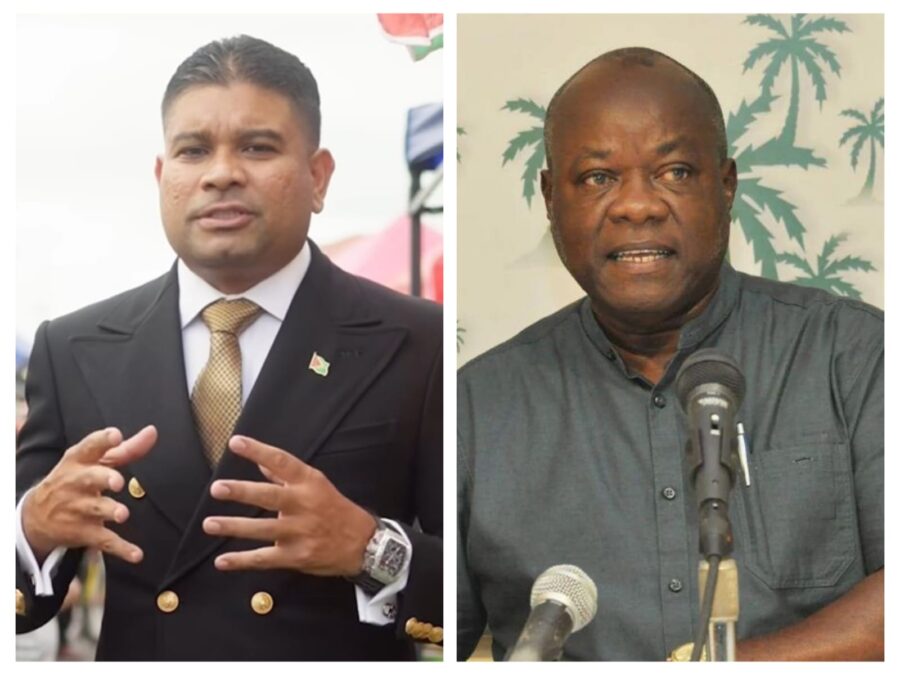
As the controversy deepens over the removal of Acting Chancellor Justice Yonette Cummings-Edwards and the President’s latest move to appoint Justice Roxane George-Wiltshire as Chancellor and Justice Navindra Singh as Chief Justice, a constitutional question has emerged: Who — Aubrey Norton or Azruddin Mohamed — holds the authority to consult with President Irfaan Ali on the appointments of Guyana’s two top judicial officers?
President Ali’s letter to outgoing Opposition Leader Aubrey Norton, expressing readiness to confirm George-Wiltshire and Singh, has ignited debate among legal scholars, political observers, and constitutional commentators. At the centre of the issue is whether Norton, whose tenure effectively ends with the 12th Parliament, retains the constitutional standing to represent the Opposition in this pivotal process — or whether that role should now fall to Azzruddin Mohamed, the likely incoming Leader of the Opposition when the 13th Parliament convenes on November 3.
Background: An Unsettled Judiciary
The development follows months of tension surrounding Justice Cummings-Edwards’ tenure. When she returned to duty on October 15, Acting Chief Justice Roxane George-Wiltshire sought to revert to her substantive role. However, Justice Navindra Singh, who had been acting as Chief Justice while George-Wiltshire acted as Chancellor during Cummings-Edwards’ leave, reportedly refused to vacate his position — a move widely viewed as having the consent of the People’s Progressive Party (PPP) administration.
This sequence of events has been interpreted by many, including the Guyana Trades Union Congress (GTUC), as a deliberate attempt to sideline Justice Cummings-Edwards and hasten new appointments without meaningful adherence to Article 127 of the Constitution, on her resumption of duty after proceeding on leave.
The Constitutional Question
Article 127(2) of the Constitution stipulates until someone is officially appointed and assumes the duties of the office, or until the current officeholder resumes their duties, those responsibilities shall be carried out by another judge designated by the President, following meaningful consultation with the Leader of the Opposition.
Article 127(1) states that the Chancellor and Chief Justice shall be appointed by the President after obtaining the agreement of the Leader of the Opposition; it also stated on This makes the Opposition Leader’s participation not only necessary but constitutionally binding.
However, senior lecture at the University of Guyana, Attorney-At-Law Neville Bissember argues that Norton, having been elected to the post of Leader of the Opposition “from among the members” of the 12th Parliament, ceases to have standing to act in that capacity once Parliament is dissolved.
Citing Article 156(1)(f), Bissember explains that a member vacates their seat “whenever Parliament is dissolved,” and, by extension, Norton cannot constitutionally perform the functions of Leader of the Opposition after the dissolution.
“In keeping with the provisions of Articles 60, 61 and 160 of the Constitution, Mr. Norton was elected to the post of LOO in 2020 after elections held under said articles. … As Mr. Norton is elected ‘from among… members’ of the Assembly, it follows that he is a ‘member of the National Assembly,’” Bissember wrote in a letter to the media. He concluded that once Parliament stands dissolved, Norton no longer holds the authority to engage the President on such constitutional matters.
A Caretaker or a Consultant?
Yet, there is an opposing view that while Norton may technically be outgoing, he remains in a caretaker capacity until a new Leader of the Opposition is formally elected in the 13th Parliament. Under this interpretation, Norton retains the formal locus standi to engage the President in consultation until the position is officially filled — even if his political influence is waning.
Supporters of this view argue that the Constitution makes no explicit provision for an “acting” or “transitional” Leader of the Opposition. Therefore, until Parliament reconvenes and a new Opposition Leader is elected from among the non-governmental members, Norton remains the de jure interlocutor under Article 127(1).
This position is echoed in the President’s latest correspondence, which continues to address Norton as the constitutional Leader of the Opposition.
GHK Lall: “Norton Should Not Be the Man”
Political columnist GHK Lall, in an op-ed published in Village Voice News, argues that Norton should not be the person engaging in the constitutional consultation.
“Mr. Aubrey Norton has a week to decide. Parliament reopens next Monday, Nov 3rd. Aubrey Norton is the man of the moment. He is also the man of the future… involved are the substantive senior appointments of Chancellor of the Judiciary and Chief Justice, after years of stalemate,” Lall wrote.
He went further to assert that Norton’s participation in the process, given his outgoing status, “would be a travesty of justice, the rankest of injustices, whether he says yea or nay.” According to Lall, the political choreography between the President and Norton was already predetermined — with the outcome, not the process, being the true focus.
“The [People’s National Congress] PNC lost, but still won. [We Invest In Nationhood] WIN’s Mohamed won, but somehow, he lost out. The biggest winner in this season of winning is the PPP government,” Lall observed, describing the situation as a “political sorcery” designed to deliver the administration’s preferred judicial appointments.
Who Should Consult?
In legal terms, the President must consult with whoever is formally recognised as the Leader of the Opposition. As of now, that remains Aubrey Norton — unless and until the new Parliament elects Azruddin Mohamed to the post. However, the issue underscores the tension between constitutional formality and political legitimacy.
If President Ali proceeds with Norton, the decision could invite legal challenge or political backlash from those who view Norton’s mandate as expired. Conversely, waiting until the 13th Parliament installs Mohamed could delay the appointments further, prolonging the 20-year deadlock over confirming Guyana’s top judicial officers.
Implications for the Judiciary
The President’s refusal to confirm Cummings-Edwards and George-Wiltshire in 2022, combined with Singh’s refusal to vacate his acting position in October 2025, has left the judiciary in an extended limbo, affecting public confidence in its independence. Supporters of both female justices argue that confirming their appointments would have cemented their legacy and brought stability to Guyana’s judiciary.
Whether President Ali proceeds with consultation under Norton or waits for Mohamed, the situation highlights the delicate intersection of constitutional mandates, political timing, and judicial independence. The decision will test the country’s commitment to both the letter and spirit of the Constitution.