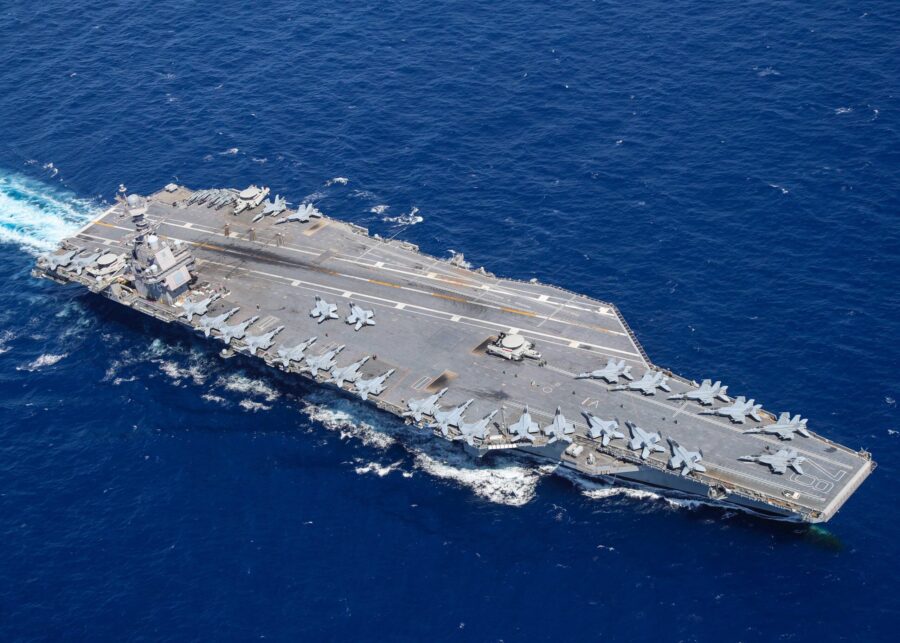
By Mark DaCosta-The United States has ramped up its military presence in the Caribbean with the deployment of the USS Gerald Ford aircraft carrier, which is a significant move that raises several questions about its implications for security and peace in our region. This escalated show of force is a part of a broader military strategy by the Trump administration aimed at countering the perceived threats of drug trafficking and instability, notably linked to the government of Venezuela.
The USS Gerald Ford, the largest aircraft carrier in the world, is currently en route to Latin America, which includes an array of military assets such as eight additional warships, a nuclear submarine, and advanced F-35 aircraft. This sizeable deployment marks an unprecedented escalation not only in terms of counter-narcotics initiatives but also in the geopolitical dynamics of the Caribbean and South America. While the Pentagon asserts that this enhanced military presence is aimed at protecting U.S. national interests, many are left to ponder its potential ramifications.
Heightened tensions with Venezuela underpin these military movements. The U.S. government has long accused Venezuelan President Nicolas Maduro’s administration of harbouring drug traffickers and eroding democratic institutions. In light of this, Washington has intensified its rhetoric and actions against Maduro, with U.S. President Donald Trump recently doubling the reward for information leading to Maduro’s arrest to a staggering $50 million. Such provocations only serve to exacerbate the already fraught relations within the region.
The Pentagon has indicated that the deployment will bolster the U.S. capacity to combat illicit activities that threaten both the safety of the American homeland and the stability of the Western Hemisphere. Pentagon spokesperson Sean Parnell stated, “These forces will enhance and augment existing capabilities to disrupt narcotics trafficking and degrade and dismantle transnational criminal organisations.” While the stated aim is to address drug trafficking, it is crucial to consider how this military posturing could provoke further instability in an already volatile region.
The USS Gerald Ford’s advanced capabilities play a significant role in this military strategy. Commissioned in 2017, it can accommodate over 75 military aircraft and is equipped with an arsenal of missiles including advanced surface-to-air systems. Its supporting vessels, which include guided missile cruisers and destroyers, enhance its ability to perform a range of military operations. Furthermore, the Ford is outfitted with sophisticated radar systems to effectively control air traffic and provide early warning against potential threats.
As our nation looks on, the silence from the current government in Guyana regarding these developments is particularly alarming. The lack of a strong response or articulated stance raises concerns about our government’s priorities and its commitment to safeguarding national interests. The PPP administration’s inaction could be interpreted as tacit approval of increased foreign military activities in our vicinity, yet it seems unwilling to express discontent or take a definitive stand against such intimidating military developments.
Moreover, as the region grapples with U.S. military manoeuvres, the diplomatic altercations between the U.S. and Colombia add another layer of complexity. Trump’s recent derogatory remarks about Colombian President Gustavo Petro have only served to escalate tensions, making it clear that the U.S. is not only targeting Venezuelan interests but also directly confronting its allies in the region. The ramifications of this could be wide-reaching, affecting trade, security, and regional cooperation efforts.
As we reflect on these developments, it is imperative that we, as a nation, stay vigilant and advocate for a diplomatic resolution to these tensions. The increased military presence in the Caribbean can threaten regional peace and stability, and our government must not remain complacent while foreign nations reshape the security architecture of our neighbourhood. Our sovereignty and security should be paramount, and the silence from those in power is, at best, disconcerting. We must demand that the PPP government actively engage in discussions regarding these developments, prioritising our nation’s interests above all else.