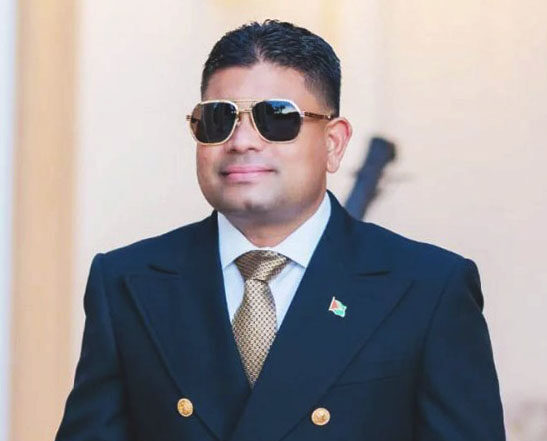
Guyana’s long-standing common-law principle that a person is innocent until proven guilty is coming under renewed scrutiny as state agencies continue to take actions against Opposition Leader Azruddin Mohamed while he fights extradition proceedings in the Guyanese courts.
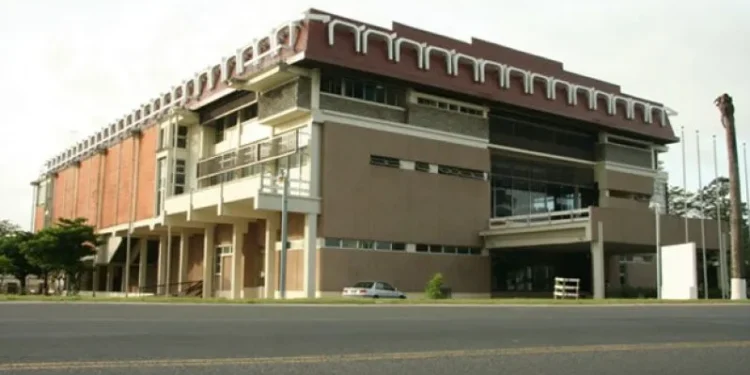
The latest controversy involves the Maritime Administration Department (MARAD), which has declined to renew Mohamed’s captain’s licence, citing his status as a person sanctioned by the United States.
The decision is now being viewed by Mohamed and others as another instance of state action that restricts the rights of an Opposition Leader who has not been convicted of a criminal offence in Guyana.
Mohamed and Opposition MP Odessa Primus visited MARAD on Thursday September 10 to follow up on his application, which he said was submitted on August 28 to MARAD head Stephen Thomas.
Mohamed said he had held a captain’s licence since 2012 and submitted all the required documents, including an affidavit concerning his lost licence, TIN certificate, birth certificate, medical report, vision and hearing assessments, a recommendation from another captain, identification and passport photographs.
“Everything was above board. My vision is intact. I can hear well.”
Mohamed said other captains who submitted their applications on August 28, and even some who applied days later, had already received their licences. He said the normal processing time was three to four days.
But MARAD has now made clear that Mohamed’s application is being treated differently because of his U.S. sanctions status.
The agency said:
“Any responsible public authority dealing with a sanctioned person must, therefore, carefully consider the legal, financial, banking, contractual and compliance consequences of any proposed transaction.”
MARAD went further, saying it would be “extraordinarily reckless” for the national maritime regulator to issue a licence to someone of “such sanctioned character.”
The agency also argued that maritime licensing standards must apply equally, regardless of wealth or political influence.
“The wider issue, however, is bigger than one man and one boat. Maritime safety standards cannot be tightened for ordinary Guyanese but relaxed when a politically powerful individual wants a licence. That would be reckless.”
But the controversy raises a fundamental legal and constitutional question: does being sanctioned by a foreign government, or facing extradition proceedings, amount to guilt under Guyanese law? It does not.
Guyana’s Constitution protects the presumption of innocence, providing that a person charged with a criminal offence is presumed innocent until proved or has pleaded guilty. Mohamed is currently fighting extradition to the United States and has not been convicted of the U.S. allegations in a Guyanese court.
The extradition proceedings themselves are not a finding of guilt. Yet the continuing actions involving Mohamed by different state institutions are increasingly being viewed as an attack on his rights and as evidence that the presumption of innocence is being undermined in practice.
That concern is particularly significant because Mohamed is now Leader of the Opposition and has become one of the PPP/C administration’s most aggressive critics. He has repeatedly challenged the accumulation of wealth and assets by senior government figures, including President Irfaan Ali, members of his government, their families and associates, demanding explanations about the sources of that wealth.
His political confrontation with the administration has unfolded alongside police investigations, court proceedings, U.S. sanctions and now the MARAD licence dispute.
Mohamed said the treatment was making him feel like a second-class citizen in his own country.
“Under this wicked and deceitful and treacherous administration, we are living like prisoners and third-class citizens in our own country.”
He said he had submitted everything required and questioned how he could function if government agencies could prevent him from obtaining ordinary licences.
“It looks like when my driver’s license is expired, they won’t renew my driver’s license. So how can we operate like this in the country?”
According to Mohamed, Thomas did not personally engage him during the visit. Instead, he said a secretary communicated that there was no update on his application.
“Mr. Thomas said he’s going to let us know. He’s going to contact us for updates. He currently said he has no updates for us at this time.”
Mohamed maintains that his status as a Guyanese citizen entitles him to equal treatment.
“As a citizen of this country, as a Guyanese born, I am entitled to these things.”
The MARAD dispute therefore goes beyond a captain’s licence. It has become another test of whether Mohamed’s legal rights and the presumption of innocence are being respected while the state pursues actions against him.
And with successive state agencies becoming involved in matters concerning the Opposition Leader, the question increasingly being asked is whether Mohamed is being subjected to legitimate regulatory and law-enforcement scrutiny—or whether the machinery of the state is being used in ways that effectively punish him before guilt has been established.