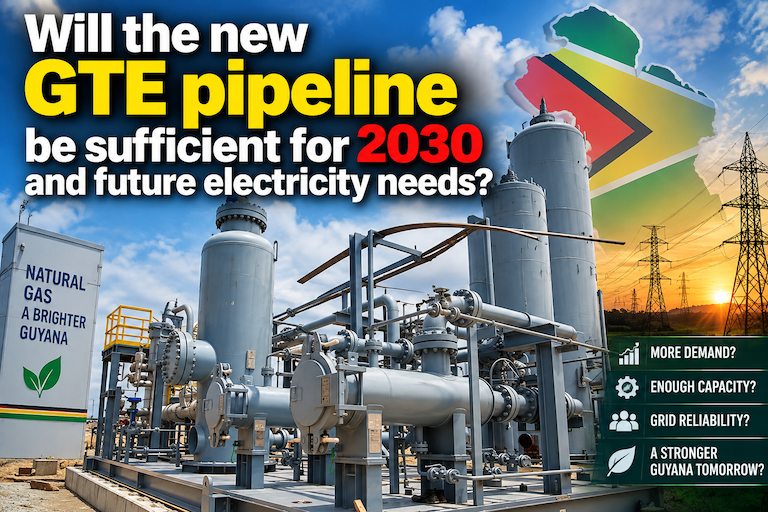
After another massive blackout, government must tell the nation what Guyana’s electricity demand will be in 2030, how much dependable generating capacity it intends to maintain, and whether the grid being built today can support the economy of tomorrow
Another major blackout left large sections of Guyana without electricity for hours on Saturday, once again raising questions that go considerably deeper than the immediate cause of a power outage. Guyana is in the middle of an unprecedented oil-driven economic expansion, thousands of new homes are being built, businesses are expanding, air-conditioning use is rising and government is encouraging industrialisation. Yet the country’s electricity system appears to be operating with an extraordinarily narrow margin between available generation and peak demand.
Guyana Power and Light recently disclosed that peak demand had climbed to approximately 257 megawatts, compared with 221 MW in 2025. At the same time, GPL reported approximately 265.6 MW of available generating capacity, with another 5 MW expected to be added. That means demand has been operating within roughly nine megawatts of available generation. GPL officials have also acknowledged that the system lacks sufficient “spinning reserve”, the generation kept immediately available to respond when a generator, transformer or other major component suddenly trips.
These admissions raise serious questions about how Guyana’s electricity system has been planned and, more importantly, how it is being planned for the future.
What caused Saturday’s blackout?
At the time of publication, Village Voice News could not independently identify a detailed technical explanation from GPL establishing the cause of Saturday’s prolonged outage. GPL should provide one.
This is particularly important because the company has already disclosed serious vulnerabilities in the interconnected system. During another recent major outage, a transformer fault at the Kingston substation triggered protection systems and generators shut themselves down. Restoration was subsequently complicated when generation at Garden of Eden repeatedly tripped. In another disturbance, GPL reported a large current spike on the submarine cable between Kingston and Vreed-en-Hoop, resulting in transformers at both ends tripping.
GPL officials have acknowledged another fundamental weakness. Much of the existing network is radial, meaning electricity does not always have an alternative route when an important line, transformer or substation fails. Government only this week announced that redundancy is now being incorporated into new infrastructure so that another transformer or transmission route can carry electricity when equipment is taken out of service.
That raises an obvious question: Why, after years of rapid economic growth and billions of dollars in electricity expenditure, can a single significant fault still potentially cascade through large portions of Guyana’s power system?
A modern electricity system is not planned merely to generate enough electricity when everything is working properly. It must be capable of surviving equipment failures. Generators require maintenance. Transformers fail. Transmission lines trip. Cables develop faults. A properly planned system therefore requires reserve generation, transmission redundancy and sufficient capacity to withstand predictable contingencies without plunging large sections of the country into darkness.
The numbers deserve scrutiny
The growth in electricity demand has been dramatic.
GPL says peak demand increased from approximately 221 MW in 2025 to 257 MW in September 2026, an increase of roughly 16 percent in about one year. The utility’s customer base has also increased from around 201,000 in 2020 to approximately 250,000 today.
These numbers should fundamentally change the national discussion about the 300 MW Wales Gas-to-Energy power plant.
The question cannot simply be whether Wales will produce 300 MW. The relevant question is: 300 MW in addition to what?
Will the existing generating fleet continue operating? Which generators will be retired? Which will remain available as emergency or spinning reserve? How much existing capacity does GPL consider dependable? What reserve margin is government targeting? And what will Guyana’s peak electricity demand be when the entire 300 MW Wales plant is finally commissioned?
If demand were to continue growing anywhere near its recent rate, today’s 257 MW peak would quickly become 300 MW, then 350 MW and beyond. No responsible national electricity plan for one of the world’s fastest-growing oil economies can be based solely upon satisfying today’s demand.
Where are the projections?
Government should therefore publish its electricity demand forecasts for 2027, 2030, 2035 and 2040.
Those projections should account for new housing developments, commercial construction, hotels, hospitals, schools, industrial estates, agro-processing facilities, mining expansion, data centres, increased air-conditioning, electric vehicles and other demands likely to accompany economic development.
There is also a phenomenon planners cannot ignore: providing cheaper and more reliable electricity can itself increase electricity consumption. Businesses that cannot presently operate energy-intensive facilities may invest once dependable power becomes available. Families may purchase more air conditioners and appliances. Manufacturing and processing operations that were previously uneconomical may become viable.
In other words, successful development creates additional electricity demand.
The government’s decision to pursue a second 300 MW phase at Wales suggests that policymakers themselves recognise that the first 300 MW plant will not be sufficient for Guyana’s medium-term needs. But citizens should not have to piece together announcements to determine the country’s electricity strategy. There should be a published, transparent national generation and grid expansion plan.
Generation is only half the problem
GPL has recently insisted that it possesses sufficient generation and that much of the present problem lies within transmission and distribution. Officials say feeders are overloaded, transformers are being taxed beyond their intended loads and portions of the network have reached thermal limits.
That explanation raises another serious planning question.
What benefit is hundreds of megawatts of new generation at Wales if the transmission and distribution system cannot reliably move that electricity to Georgetown, Berbice, Essequibo and expanding communities?
GPL says major upgrades are underway, including new high-voltage transmission infrastructure, new substations, hundreds of kilometres of transmission and distribution lines and a National Control Centre. These investments are important. But government should demonstrate, with numbers and timelines, that the grid expansion is being designed around the country’s projected demand rather than continuously attempting to catch up with it.
Questions GPL and the Government should answer
Village Voice News therefore calls on GPL, the Ministry of Public Utilities and Aviation and the Government of Guyana to publish clear answers to the following questions:
1. What precisely caused the prolonged September 12 blackout, where did the initiating fault occur, and what sequence of events caused the outage to spread?
2. How many megawatts of generation were online immediately before the disturbance, what was system demand at that moment, and how much spinning reserve was available?
3. How many generating units tripped during the event, at which plants, and why?
4. Why did restoration take several hours? Were there failed restart attempts, transmission constraints or additional generator trips during restoration?
5. What is GPL’s current installed generating capacity, dependable capacity, available capacity and spinning reserve? These are different measurements and should be reported separately.
6. What reserve margin does GPL consider necessary for a reliable Guyanese electricity system, and what reserve margin does it currently have during peak demand?
7. What are government’s projected peak electricity demands for 2027, 2030, 2035 and 2040?
8. What assumptions underpin those forecasts regarding population, housing, industrialisation, commercial construction, air-conditioning, electric vehicles, mining and other major new loads?
9. When the first 300 MW Wales plant is fully operational, which existing generating plants will continue operating, which will be placed in reserve and which will be retired?
10. What will Guyana’s total dependable generating capacity actually be after Wales Phase I is commissioned?
11. When is the proposed additional 300 MW Wales Phase II expected to become operational, and what projected electricity demand justifies that investment?
12. Can the transmission and distribution network currently accommodate 300 MW from Wales, and if not, precisely when will all infrastructure required to move that electricity reliably across the interconnected system be completed?
13. What redundancy standard is GPL designing into the new network? Can the system withstand the loss of its largest generator, transformer, transmission line or substation without a widespread blackout?
14. How much has been spent since 2020 on generation, transmission and distribution separately, and what measurable improvements in reliability has that expenditure produced?