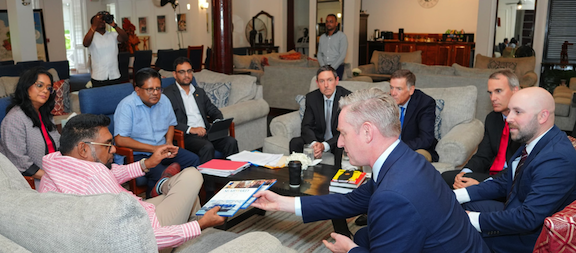
Georgetown, Guyana – In a high-level meeting at State House today, His Excellency President Dr. Irfaan Ali and senior government officials met with executives of the National Milling Company of Guyana (NAMILCO) to discuss new investment plans, a move that has sparked pointed commentary about the nation’s long-abandoned pursuit of agricultural self-sufficiency.
The meeting, attended by Senior Finance Minister Dr. Ashni Singh and Minister of Public Service Zulfikar Ally, centered on NAMILCO’s “vision for future expansion.” However, the engagement stands in stark contrast to a national vision articulated over four decades ago by then-President Forbes Burnham, who championed the use of locally grown cassava and other root crops to produce flour and break dependence on foreign wheat imports.
The irony is not lost on observers of Guyana’s political and agricultural history. In the 1980s, the Burnham-era government invested significant political capital in promoting alternative flours, aiming to shield Guyana from volatile international grain prices and to stimulate local agriculture. The vision was one of self-reliance, built on the backbone of the Guyanese farmer.
Today, that vision appears to have been supplanted. NAMILCO, a company with significant foreign ownership, is now being positioned as the architect of the next phase in Guyana’s food production, despite the existence of local potential that has gone largely untapped for generations.
“This is a classic case of history being forgotten, or perhaps intentionally ignored,” said a veteran agricultural expert who wished to remain anonymous due to the political sensitivity of the topic. “For forty years, we have spoken about the potential of cassava, eddoe, and sweet potato to create a viable local flour and starch industry. Our farmers can grow these crops in abundance. Instead of a massive, government-led push to finally realize this, we are once again placing our food security in the hands of a foreign entity’s boardroom decisions.”
The high-level nature of the meeting, with both the President and the Finance Minister in attendance, signals the administration’s full backing of NAMILCO’s corporate expansion strategy. Critics argue that this level of political will and financial incentive could have been directed towards creating a decentralized, locally-owned industry based on indigenous crops.
“What we are witnessing is the consolidation of food production under a foreign-dominated corporate model,” the expert added. “Burnham’s vision may have been ideologically driven and flawed in its execution, but its core principle, that a nation should strive to feed itself from its own soil, was sound. Today, we are outsourcing that sovereignty.”
The government and NAMILCO have yet to release specific details of the proposed investment. However, the meeting marks a decisive pivot, confirming that the PPP/C government is betting on international corporate investment to shape the nation’s food future, leaving a four-decade-old vision for local alternative flours firmly in the past.