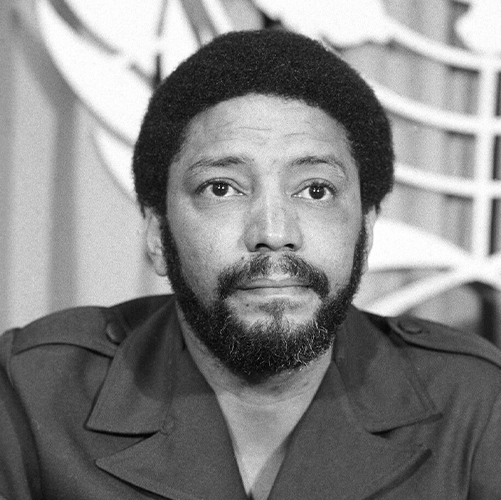
October 19, 1983 stands as one of the darkest moments in Caribbean post-colonial history — the day Grenada’s revolutionary leader Maurice Bishop was executed by his own comrades, and the day a dream of regional self-determination fractured under the weight of Cold War geopolitics.
Bishop, the charismatic head of the New Jewel Movement (NJM), had led a popular uprising in 1979 that overthrew Eric Gairy’s government and established the People’s Revolutionary Government (PRG). His revolution promised social reform, literacy, and independence from Western dominance. But by 1983, ideological rifts split the NJM leadership. Deputy Prime Minister Bernard Coard and Marxist elements accused Bishop of betraying the revolution’s principles and demanded shared power.
That internal conflict erupted fatally. On October 13, Bishop was placed under house arrest by his own security forces. Six days later, crowds of supporters freed him and marched triumphantly to Fort Rupert- now For George- in St. George’s. But the celebration was short-lived. Soldiers loyal to Coard and General Hudson Austin stormed the fort. Bishop, along with Cabinet ministers Jacqueline Creft, Unison Whiteman, and others, were lined up against a wall and executed by firing squad. Their bodies were never recovered.
Despite extensive searches and multiple inquiries, Bishop’s body was never recovered. The mystery of his remains continues to haunt Grenada, symbolising the unresolved wounds of the revolution and the silence that followed its violent collapse.
Regional Shockwaves: A Caribbean Revolution Turns on Itself
The killings sent shockwaves across the Caribbean. Regional leaders, some already uneasy with Grenada’s close ties to Cuba and the Soviet Union, viewed the internal coup as both tragic and destabilising.
Leaders such as Mary Eugenia Charles of Dominica and Tom Adams of Barbados — both members of the Organisation of Eastern Caribbean States (OECS) — convened emergency meetings and appealed for external intervention, fearing that Grenada’s revolution had descended into anarchy. Jamaica’s Edward Seaga went further, calling Bishop’s murder “a betrayal of Caribbean ideals” and supporting a multinational military response.
But others warned of dangerous precedents. George Chambers of Trinidad and Tobago, and Forbes Burnham of Guyana opposed any U.S.-led action. Burnham condemned the governments that supported intervention as “satellites and puppets” of Washington and warned that the Caribbean was witnessing “the return of gunboat diplomacy under the guise of liberation.”
The U.S. Response: ‘Operation Urgent Fury’
The United States, which had long expressed alarm over Grenada’s growing ties to Cuba and the construction of the Point Salines airstrip, seized upon Bishop’s death as justification for military action. Six days after his execution, on October 25, the U.S. launched Operation Urgent Fury — a full-scale invasion supported by the OECS and Caribbean allies.
Washington claimed the move was to “restore democracy” and protect hundreds of U.S. medical students on the island. But critics argued it was a Cold War manoeuvre to reassert American influence in the Caribbean following what President Reagan had called “a Soviet-Cuban colony being built in our backyard.”
Within days, the Coard-Austin regime collapsed. Scores were killed, and the U.S. installed an interim government under Governor-General Sir Paul Scoone. The PRG’s revolutionary institutions were dismantled, and Grenada’s socialist experiment abruptly ended.
Forbes Burnham and the Politics of Resistance
Guyana’s President Forbes Burnham became one of the most vocal regional critics of the invasion. In statements from Georgetown, he denounced the U.S. military action as “imperialist aggression” and accused Caribbean governments that endorsed it of betraying regional independence. Burnham declared that Guyana would not “bend to any superpower,” adding that the invasion marked “a black day for Caribbean sovereignty.”
His defiance, however, placed a strain on Guyana diplomatically within CARICOM, exposing the ideological split between the region’s socialist-aligned and Western-aligned states — a division that still echoes in Caribbean foreign policy debates.
Aftermath and Legacy
The executions at Fort Rupert destroyed the moral foundation of Grenada’s revolution and set in motion a chain of events that permanently reshaped the region’s politics. The U.S. intervention reinforced American strategic dominance in the Caribbean but also left a lingering sense of betrayal among regional nationalists who viewed it as an assault on self-determination.
For Grenada, the tragedy of October 19 remains unresolved — not least because Bishop’s remains have never been found. For the Caribbean, it remains a cautionary tale: how ideological positioning, external interference, and regional disunity can conspire to crush a people’s revolution from within.
As historian Brian Meeks later observed, “The execution of Maurice Bishop was not just the death of a leader; it was the death of an idea — that small Caribbean nations could chart an independent socialist path in a bipolar world.” (University of the West Indies, Caribbean Quarterly, 1993.)