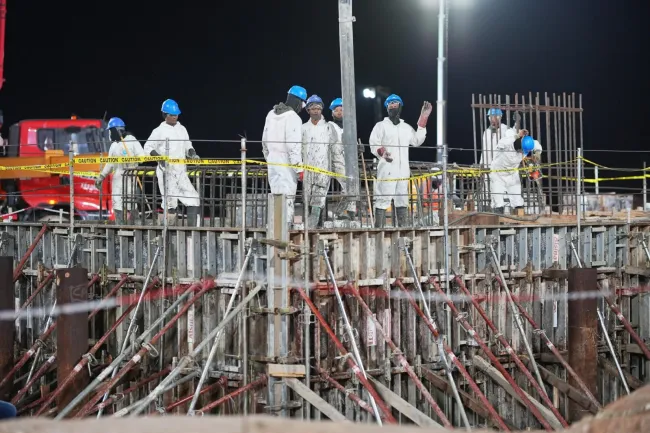
The government’s flagship Wales Gas-to-Energy project has entered a new phase of accelerated construction, with 24-hour work shifts now in full effect, according to President Irfaan Ali during a site visit on Friday night.
The visit coincided with the completion of the final concrete pour for the foundation of the fourth gas turbine, marking a key milestone in the development of the US$1.9 billion project aimed at revolutionizing Guyana’s energy sector.
“Work is picking up pace,” Ali said, noting that the project team, contractor (CH4/Lindsayca), and engineering consultant (Engineers India Limited) have all transitioned to round-the-clock operations. He added that manpower and man-hours will more than double in the coming weeks to ensure timelines are met.
Describing the construction activity as “tremendous,” the President said the site is undergoing complex engineering as it moves toward laying all four gas turbines by December 2025. By January 2026, most of the major equipment is expected to be on-site, he noted.
A major facilitator of this progress, according to Ali, has been the new Demerara River Bridge, which allows uninterrupted, full-capacity transportation of equipment and materials. He credited the bridge with significantly improving logistics and cutting down on construction delays.
Before its opening, transport vehicles had to wait until late hours to cross the older bridge due to load restrictions. Now, Ali explained, “full-weight transport can come through any time, speeding up construction.”
Project updates provided by contractors and consultants revealed that nearly 400 workers are already deployed on-site, with that number expected to rise substantially under the new 24/7 schedule. Engineering consultant EIL reported that of the 665 concrete piles needed for turbine and plant areas, only 40 remain, and piling work across the site—over 9,300 piles in total—will be completed in a matter of days.
This will pave the way for the next phase, including substation construction, additional concrete pouring, and rebar placement. The site will require about 25,000 cubic metres of concrete for foundational work across the power plant, substation, and other critical facilities.
Once completed, the power plant will supply up to 300 megawatts of low-cost electricity, a game-changer for Guyana’s domestic and industrial energy needs. It will anchor the Wales Development Zone, a 1,400-acre site on the West Bank of Demerara, envisioned as a future hub for industry and manufacturing, with planned facilities including agro-processing plants, data centres, and light manufacturing.
President Ali emphasised that the Gas-to-Energy project is more than an energy solution—it is a catalyst for economic transformation. “This project is not only about reliable and cheaper energy,” he said. “It’s about unlocking new opportunities for industrialisation, agro-processing, and manufacturing, making Guyana’s economy more competitive and resilient.”
The project remains on track for completion in 2026.