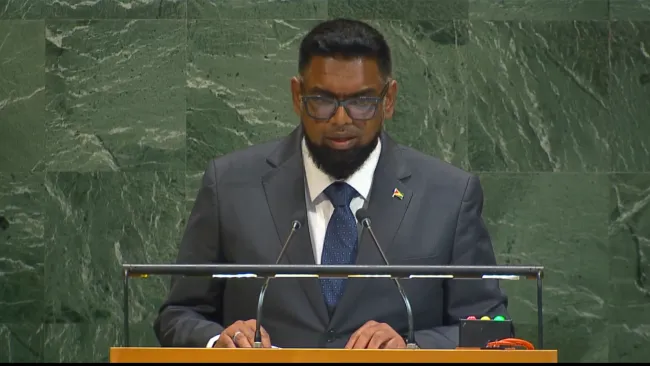
While President Mohamed Irfaan Ali projects a message of justice and peace on the international stage, his governance at home in Guyana tells a far different story, one marked by exclusion, centralization, and political favouritism.
Yesterday, addressing the 80th Session of the United Nations (UN) General Assembly in New York, President Ali urged global leaders to “ensure that power must never be allowed to triumph over principle” and called for urgent action to end the devastating conflicts in Ukraine and Gaza. He condemned the “mass extermination, a systematic slaughter and displacement” in Gaza and stressed the need for a two-state solution to the Israeli-Palestinian conflict.
“The United Nations’ noble mission to maintain international peace and security will ring hollow if it allows power to triumph over principle and might to override right,” Ali said, underscoring Guyana’s firm stance on human rights and peace.
Yet, within Guyana’s borders, this commitment to principle is conspicuously absent.
There is widespread view President Ali’s administration operates with an iron fist, systematically excluding civil society leaders and opposition supporters from meaningful participation in decision-making processes.
Communities perceived as unsupportive of the People’s Progressive Party/Civic (PPP/C) administration are routinely bypassed when it comes to development initiatives, deepening political divides and eroding democratic ideals.
Union leader Lincoln Lewis recently criticised the government’s approach, highlighting how local democracy is undermined. “The President’s salary comes from the pockets of all citizens, and with it comes an undeniable obligation to act in their best interest,” Lewis said. He stressed that development that disregards constitutional rights is “overreaching” and “contempt.”
Political analysts warn that while Guyana enjoys a growing international profile—bolstered by its active role on the UN Security Council—domestically, the administration risks alienating large segments of the population through centralised control and exclusionary governance.
Observers argue that President Ali’s lofty international rhetoric must be matched by an equally principled approach to governance at home. Power must not be allowed to suppress participation and silence dissent if Guyana is to truly embody the democratic ideals it champions abroad.
The contradiction between President Ali’s international rhetoric and his domestic actions exposes a troubling hypocrisy. If Guyana is to move forward, it must break free from the cycle of exclusion and authoritarian control. True leadership demands more than speeches at the UN; it requires dismantling the barriers that silence opposition and denying no community their rightful place in the nation’s progress. Anything less is a betrayal of the democratic principles Guyana claims to uphold.