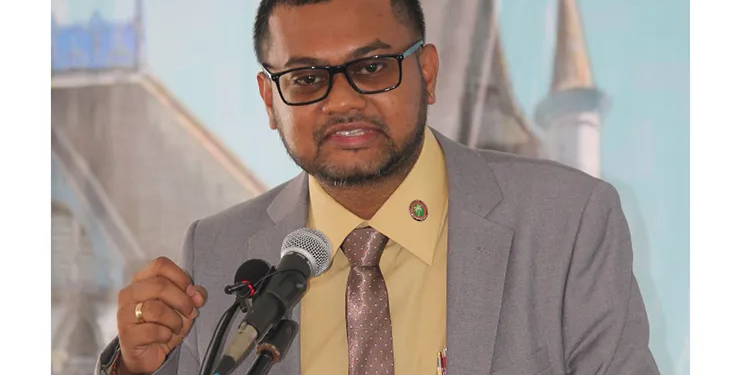
Former Minister of Finance, Winston Jordan, who served under the A Partnership for National Unity and Alliance For Change (APNU+AFC) coalition government, has unleashed a blistering critique of the current administration’s stewardship of Guyana’s natural resources. He accuses the People’s Progressive Party/Civic (PPP/C) government of recklessly “giving away” the country’s gold and oil wealth with little consideration for long-term national development.
Appearing on “The Countdown” with Andrew Weekes, last Sunday, Jordan warned that Guyana is on a dangerous path, rapidly depleting its most valuable assets without building sustainable mechanisms to benefit future generations.
“Wouldn’t it have been better if you had owned that gold mine and invited foreign ownership on a fifty-fifty or sixty-forty basis? Instead, you just give it away. And what are we left with? Scraps in royalties!” he declared.
Jordan’s comments come amid reports that five Canadian mining companies now control an estimated 15.5 million ounces of gold across Guyana’s mining regions. These projects are advancing through exploration, feasibility studies, and permitting stages, while companies publicly praise Guyana’s “mining-friendly” policies.
Jordan sharply criticised the PPP/C for what he called “shortsightedness” in handing out massive gold concessions at a time when the country is already earning substantial oil revenues. “We’re not satisfied with the extraction of the oil that we have got. We have gone on giving away these gold mines, these massive gold mines, for next to nothing,” he said.
He argued that this approach leaves the country with little more than low-wage jobs and minimal royalties, while foreign companies extract and export the real value. “There’s no smelter…the gold is then going to be dug out, and then you give them permission to build airstrips. They are going to fly out the gold from the airstrip, and it’s going to be added value for somewhere else, but not in Guyana.”
With gold prices high and the country projected to benefit from oil production for decades, Jordan believes the timing could not be worse. “Look, there’s enough oil there to last another 30, 40 years, even at the existing extraction rate…that’s huge money coming to a country in terms of population,” he said. “In 10 years’ time with good investment, all of us should be — not super rich — but have a decent standard of living.”
Instead, he warned, Guyana is simply extracting and exporting raw resources, with no meaningful plans to develop in-country value chains. He pointed to the missed opportunity to build gold smelting capacity, especially with the promise of cheap electricity from associated natural gas on the horizon.
“I believe quite honestly that we are being fooled, and we are doing nothing about it,” Jordan stated.
His warning comes as Guyana continues to attract intense interest from multinational corporations, particularly in mining and petroleum. But Jordan’s concern is that without a clear national strategy, these sectors could become pipelines of wealth flowing out of the country — leaving Guyanese citizens with little to show for their natural endowments.
The former Finance Minister’s critique underscores mounting concern over the lack of long-term vision in how Guyana’s natural resources are being managed. With billions in potential wealth on the table, he argues that the current approach risks repeating the age-old pattern of extraction without development — where foreign companies walk away enriched, while the country is left behind. His call is not just for better deals, but for a national strategy that secures lasting benefits for citizens through value-added industries, infrastructure, and generational planning.
————————–
Winston Jordan is an economist. He served in the Cabinet from 2015 to 2020 under the A Partnership for National Unity + Alliance For Change (APNU+AFC) coalition government, led by President David Granger. Prior to his ministerial role, Jordan held several key positions in Guyana’s public financial sector, including Director of the State Planning Secretariat and Budget Director at the Ministry of Finance. He is known for his extensive experience in economic planning, fiscal policy, and public administration. Jordan holds a Master’s degree in Economics from the University of Warwick in the UK.