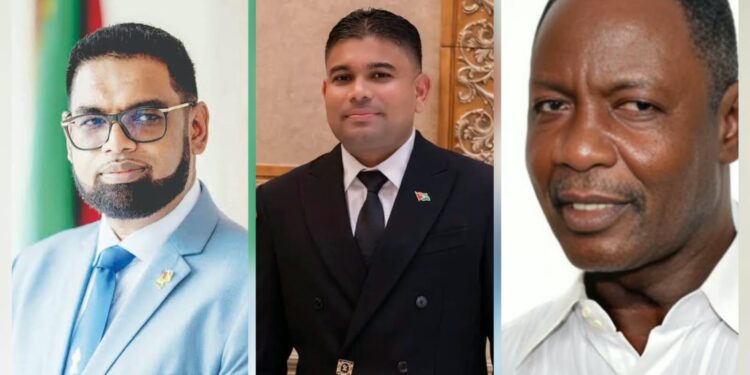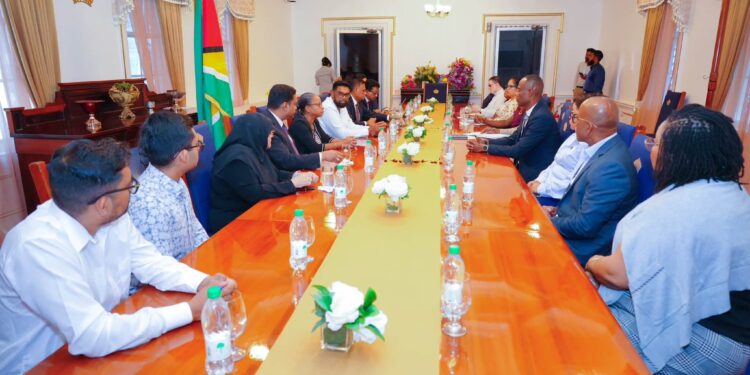
Every corner of Guyana today bears the stamp of President Irfaan Ali. His face gazes down from towering billboards on highways, intersections, city, town, and village streets. Party colours drape towns and villages, even in opposition strongholds. Oil drums have been painted and converted into oversized cups bearing party colours and insignia while lampposts across the nation are strung with partisan banners. This is a brazenness Guyana has never before witnessed in its post-independence politics.
But the billboards and flags are only the surface. At the heart of Ali’s project is the all-consuming slogan ‘One Guyana.’ Once introduced as a message of unity, it has since been imposed on nearly every facet of national life. The words now sit emblazoned on the very passports Guyanese citizens carry, symbolically tying the identity of the state to the president’s political mantra.
Major institutions have been swept into this branding exercise. The Guyana Telephone and Telegraph Company long known by that identity was pressed into rebranding itself as ‘One Communication.’ ExxonMobil, in what appeared to be a gesture of compliance, christened one of its Floating Production Storage and Offloading vessels ‘One Guyana.’ Religious and sporting events now echo the same slogan, blending faith, competition, and culture into the president’s chosen narrative.
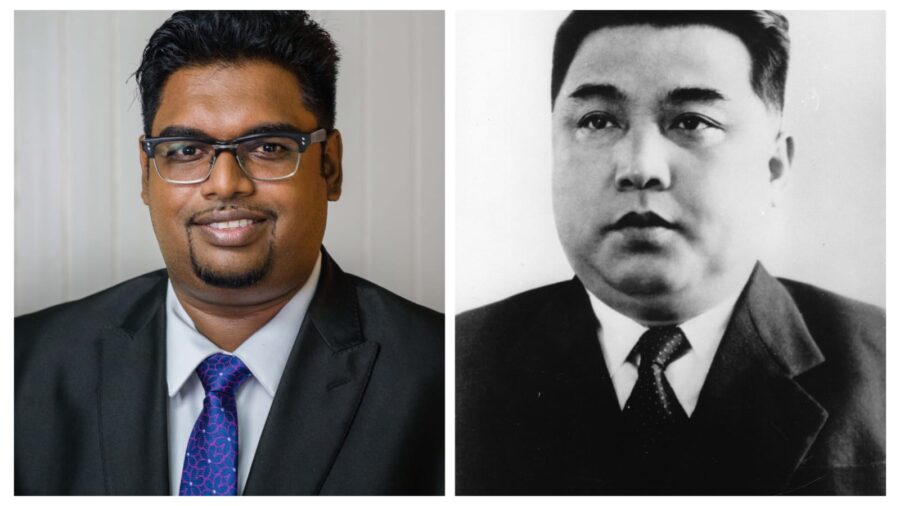
The cumulative effect is strikingly similar to what Kim Il Sung engineered in North Korea where the leader’s image and chosen phrases became inseparable from national life itself. There, the blending of state, party, and leader became absolute. In Guyana the trajectory is disturbingly close: Ali’s face on billboards, his party’s colours dominating public space, his slogan branded onto institutions that once stood independently.
From a psychological perspective this reflects patterns of narcissistic projection and control. Mental health professionals describe this as an attempt to conflate personal identity with national identity so that opposition to the leader feels like opposition to the nation. The compulsive drive to stamp a slogan across passports, businesses, and cultural events reveals not just a political tactic but an underlying desire for omnipresence where the leader cannot be separated from the state.
Ali’s defenders call it unity. But unity imposed through saturation propaganda is not harmony, it is submission. True unity arises when citizens freely embrace common values. Manufactured unity branded on passports and drilled into public life is closer to indoctrination.
The brazenness of this strategy converting oil drums into party props, commandeering lampposts, imposing slogans on private and state entities exposes a deeper anxiety: the fear of being ordinary, the dread of being forgotten. Leaders who build cults of personality mistake exposure for legitimacy. History from Pyongyang to countless other capitals has shown that this path corrodes democracy replacing governance with spectacle and people’s welfare with one man’s ego.
The question now before Guyanese is urgent. Is ‘One Guyana’ truly about unity or has it become the machinery of a personality cult designed to place Irfaan Ali’s name, face, and slogan above the nation itself?