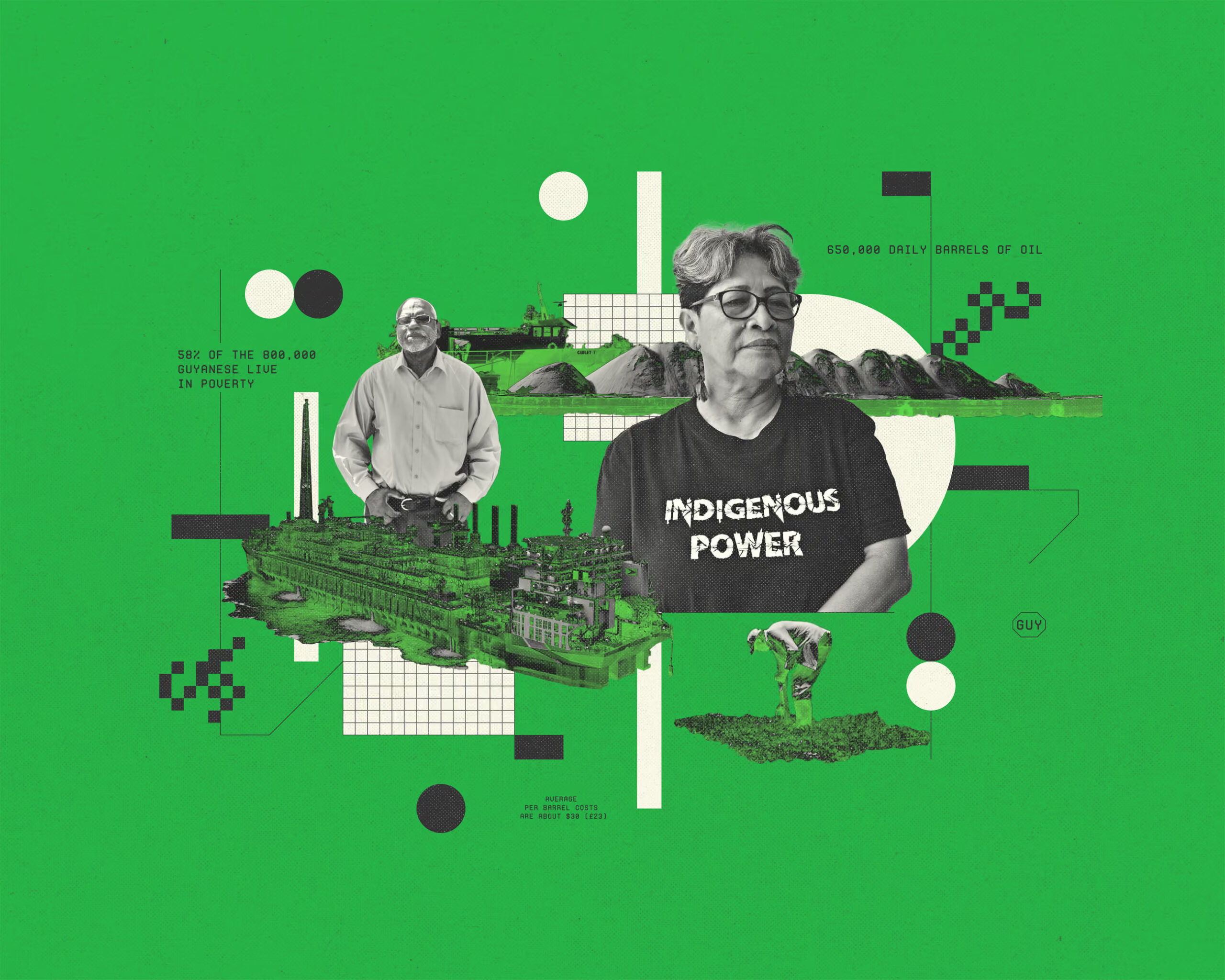
On 18 July, the International Chamber of Commerce approved the attempt by the US energy multinational Chevron to replace Hess Oil as a stakeholder in one of the world’s largest offshore oilfields, Guyana’s Stabroek, as part of its $55bn (£41bn) acquisition of the smaller company.
Yet, as Chevron executives celebrated joining Exxon and China National Offshore Oil Corporation (CNOOC) as in producing Guyana’s daily oil output of 650,000 barrels, the response from the Guyanese government, opposition leaders and environmentalists was muted.
In the capital, Georgetown, as the world’s leading fossil fuel companies compete for local oil, many residents see few benefits for ordinary Guyanese people. Ten years after Stabroek’s discovery, and six years after production began, Guyana feels ambivalent about oil, as the wealth generated by fossil fuels remains concentrated among a few.
The 2016 production and revenue-sharing agreements allow the oil companies to use 75% of revenue from exploration to cover their costs in full. The remaining 25% is split in half, leaving 12.5% of revenues for Guyana, with the government also receiving 2% royalties on all production.
Such “one-sided” deals make Guyana highly attractive to energy multinationals, industry experts say. Costs average about $30 (£23) a barrel, making it one of the cheapest and most profitable countries to drill for oil in the world.
Guyana has revised fiscal arrangements for new contracts over the past year, introducing better terms for the country, including a new 10% corporate tax rate not included in the 2016 agreement.
However, by taking over Hess and its stake in Stabroek, Chevron has avoided the need to bid independently for its offshore blocks under the new, less favourable terms.
“They will obviously benefit from buying into the block, as Guyana has to abide by the existing agreement,” says David Patterson, the parliamentary opposition’s spokesman on energy.
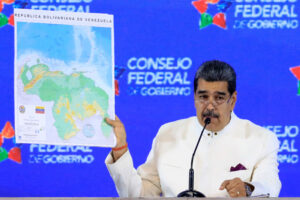
Patterson sees the only potential benefit for Guyana being geopolitical – if the company succeeds in enhancing the Guyanese government’s relationship with neighbouring Venezuela.
Since the discovery of oil in 2015, President Nicolas Maduro has stepped up his government’s hostility towards Guyana, with threats to annex and invade its smaller English-speaking neighbour (which only has about 4,000 military personnel compared with Venezuela’s 300,000-strong security forces).
The border demarcation dispute is now before the international court of justice for a final settlement, with a ruling anticipated next year.
“Chevron may bring some benefit as they are now in Guyana and Venezuela, where there is a border controversy,” Patterson says. “Chevron might well be able to ease the situation and enable exploration in a larger part of the basin without aggravating Venezuela.”
Still, any potential geopolitical gains have not inspired much enthusiasm in Georgetown. At cabinet level, the government has made little comment on Chevron’s entry. Prior to his re-election on 1 September, President Irfaan Ali simply told the local newspaper Stabroek News: “We welcome Chevron.”
Bharrat Jagdeo, a former president and now oil minister, believes Chevron’s arrival will benefit Guyana by keeping Exxon in check, amid government allegations of cost inflation.

“Chevron is one of the shareholders now in Guyana. Having acquired Hess’s shares, and Exxon on the other side being another major shareholder, that tension between the two could serve our country better,” Jagdeo said recently.
However, environmentalists fear the government may be too weak to regulate and enforce restrictions effectively on the two leading global fossil fuel companies.
Elizabeth Deane-Hughes, a lawyer and environmentalist, says: “We are simply going to get clobbered on the head more and more with two giant companies running the oil sector in Guyana.
“My activism is not against Chevron,” she says, “but we have difficult days ahead. Chevron is answerable to its shareholders, not to us.”
Aside from environmental concerns, many Guyanese complain that the benefits promised from the country’s transformation into a petrostate with a high GDP per capita are not reaching marginalised groups.
Recent data from the Inter-American Development Bank shows that 58% of the 800,000 Guyanese live in poverty, earning less than $6.85 a day, and 32% in extreme poverty, earning under $3.65.
Rajesh Singh, a 46-year-old painter and maintenance worker, says the benefits of the country’s oil bounty are not reaching the average Guyanese.
“The government has built roads and improved the infrastructure, but it needs to do much more,” says Singh. “I have a heart condition and can’t do heavy work, so more money should come to help people like me.
“People must live comfortably now that we have big oil money but it is clearly not happening yet. The big boys are looking after themselves too much.”
Byron Pedro, 18, a mechanic and welder, says the government must act swiftly to ensure benefits reach young people. “The government has to provide greater opportunities for youths so they will stop the killing and violence many are involved in,” he says. “Youths need to be elevated with all this oil money flowing.”

Data from the oil consortium suggests there are 11bn barrels of recoverable oil, or nearly 50 years at the current rate of output.
The 650,000 barrels produced daily originate from three oilfields, while permits for four more have already been granted or are at an advanced stage. Exxon says that by 2027, Guyana could be producing nearly 1.3m barrels daily, making it one of the world’s highest per capita producers.
Exxon has said it welcomes Chevron to the joint venture and “looks forward to continued industry-leading performance and value creation in Guyana for all parties”, while Chevron’s chief executive, Mike Wirth, said: “The combination enhances and extends our growth profile well into the next decade.”
ExxonMobil and Chevron recently highlighted their commitment to the existing commercial terms governing the Stabroek block, though contested by local public opinion.
Until 2015, when oil and gas were discovered, Guyana’s primary exports were gold, bauxite, sugar, rice, timber and seafood. These now pale in significance compared with oil and gas as the country becomes a petro-economy.