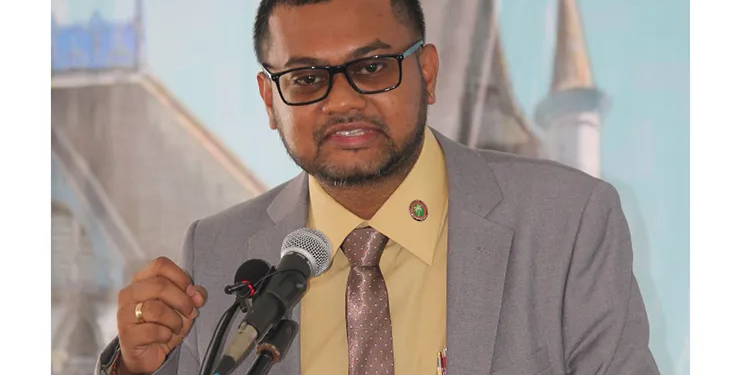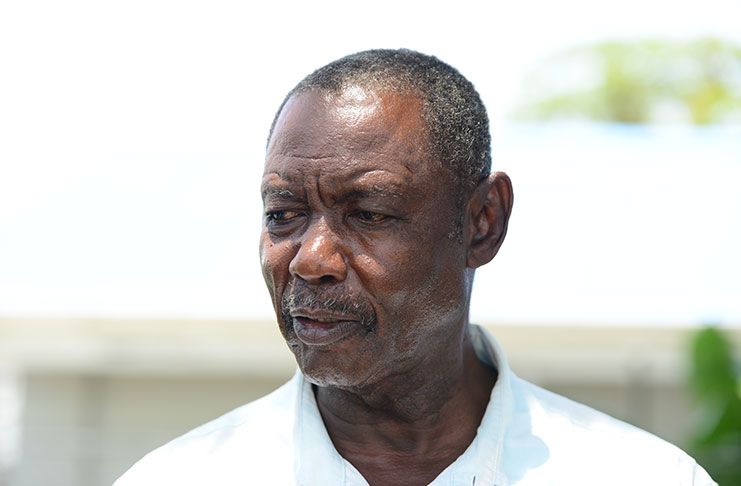
By Mark DaCosta- In a fiery response to the recent disparaging comments made by Attorney General Anil Nandlall, Lincoln Lewis, General Secretary of the Guyana Trades Union Congress, has struck a resounding chord that resonates deeply within our nation. Lewis‘s remarks are centred around a profound respect for the rights of all citizens to political association; however, he vehemently condemns Nandlall’s comments as disgraceful and disrespectful to the legacy of Cuffy, a symbol of resistance and dignity for African Guyanese and indeed, all of our nation.
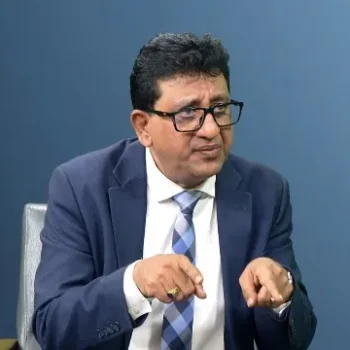
In a bid that many are calling an affront to the sensibilities of African Guyanese, Nandlall referred to Cuffy, our national hero, as a “proud house slave,” dismissing the profound historical significance of his struggle.
Lewis has taken exception to this insensitivity, stating that such comments not only distort the historical narrative surrounding the African experience, but also perpetuate a pattern of marginalisation that the People’s Progressive Party (PPP) has inflicted upon African Guyanese.
Cuffy, far from being any form of “house slave,” is celebrated as a valiant freedom fighter who led the charge against oppression during the Berbice Revolution in 1763, a pivotal moment in our nation’s history that predates other well-known uprisings, including the Haitian Revolution.
Lincoln Lewis’s declaration reinforces that Cuffy was “no proud house slave,” but a proud African, who survived the agonies of slavery while possessing an indomitable spirit that led to his revolutionary actions. He was captured and subjected to the brutal reality of the Middle Passage, and emerged as a beacon of hope during one of the darkest chapters in our history. Cuffy’s bravery in leading the fight for freedom demonstrates an unwavering commitment to justice and dignity, which should not be trivialised by flippant remarks from those in power.
Taking a firm stand, Lewis openly challenged Nandlall to identify anyone in the PPP with an equivalent record of sacrifice and courage, asserting, “Show us!” He implored that the legacy of Cuffy should not be rewritten by those who seek to sully the rich tapestry of our cultural heritage. The Attorney General’s apology has been dismissed by Lewis as insincere, framing it as part of a broader pattern of disrespect faced by African Guyanese under the present PPP administration.
Addressing a wider audience, Lewis reiterated that the PPP’s policies have been detrimental to the Afro-Guyanese community, outlining the systematic neglect facing this demographic. From incidents of extrajudicial killings to the dismantling of the Bauxite Workers Pension Plan worth over $2.5 billion, he branded the PPP’s policies as a form of “Economic Genocide.” Furthermore, he highlighted the attempts to appropriate lands historically owned by freed Africans, lands purchased with the blood, sweat, and tears of their ancestors, particularly pointing to his own family’s ownership which has stood the test of time since 1851.

Moreover, Lewis pointed to the failure of Nandlall to uphold the legal rights of workers’ unions, including the Guyana Teachers Union and his own organisation. The Attorney General has reportedly ignored a court directive on union dues which form the backbone of support for these organisations, the majority of whose constituents are African Guyanese. Lewis condemned this as a direct attack on the livelihoods and rights of these workers.
The larger context of Nandlall’s comments, argues Lewis, points to a coordinated effort by the PPP to marginalise African Guyanese and belittle their historical significance in our nation’s narrative. He urges the populace to view these comments as part of a more disturbing trend: an ongoing campaign that seeks to undermine and devalue the contributions of African Guyanese to the rich history of our country. Such actions constitute not merely attacks on individuals or communities but on the very foundations of our shared values.
“Our nation must rally together to confront these injustices,” Lewis implored. He insists that respect for all citizens must be non-negotiable. Asserting that Cuffy’s legacy belongs to everyone, he calls for a unified stand against those who dare attempt to distort our shared history. Ultimately, he vows that no one, not even a sitting Attorney General, will be permitted to erode the memory of our heroes or the fundamental rights of our people.
In this critical moment, we are reminded that we must stand resolutely against any efforts to rewrite the narrative of our rich history — Cuffy’s fight, “was not in vain.” His legacy is a testament to courage, resistance, and an unwavering pursuit of justice that should be acknowledged and respected by all.