The Guyana Lands and Surveys Commission (GLSC) and the Food and Agriculture Organization of the United Nations (FAO), in collaboration with the National Agricultural Research and Extension Institute (NAREI), have launched a targeted pilot to introduce commercial dragon fruit cultivation to small-scale farmers in Regions 4 and 10. The initiative – financed by the Guyana REDD+ Investment Fund (GRIF) under the Mainstreaming Sustainable Land Development and Management (SLDM) project – couples practical training with starter inputs so farmers can move from learning to production as part of a sustainable land management initiative.
The idea stemmed from a learning journey last year to Brazil’s Agricultural Research Corporation (EMBRAPA), where a group of Guyanese experts learnt about agroforestry, soil conservation, and mined-out land reclamation — including the cultivation of dragon fruit, which thrives in nutrient-poor soils. Inspired by this experience, the team initiated a pilot project in Regions 4 and 10 to repurpose mined out lands and areas of limited land capability through dragon fruit farming.
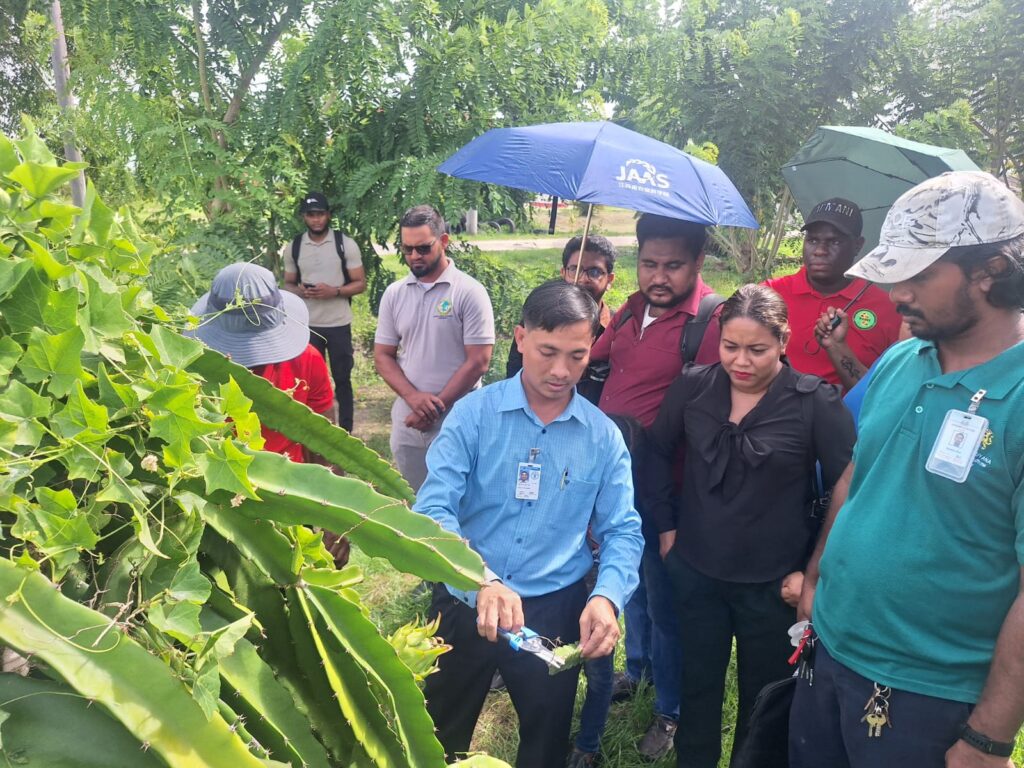
“This high-value crop is new to Guyana. With both wet and dry conditions suitable for its cultivation, and with the training, farmers can easily produce dragon fruit. It will increase income and move Guyana from importing to producing — and even exporting,” said Kevin Paul of NAREI.
The pilot began with a Training of Trainers (ToT) session on 12 August 2025 at NAREI’s Mangrove Hall, Mon Repos, followed by farmer training on 14 August 2025 at NAREI’s Kairuni Station. The ToT brought together 32 participants, including officials from NAREI, the University of Guyana’s Faculty of Agriculture and Forestry, the Guyana School of Agriculture, and GLSC. Additionally, 37 farmers from the Linden–Soesdyke Highway benefited from the second session.
The sessions covered ecological requirements for cultivation, best farming practices, fertiliser management, trellising systems, pest and disease control, and post-harvest handling. Farmers also gained hands-on experience in NAREI’s dragon fruit orchard, guided by FAO’s international experts, Mr Nguyen Van Son and Mr Md Fazlay Arafat.
Farmer Muhammad Haron praised the training, saying, “I enjoyed the way the information was presented. The interaction with the experts was great, and I am looking forward to planting dragon fruit on our farm. I believe it will be successful.”
SLDM Project Manager, Mr Ahmed Jan, emphasised that crop diversification is key to stronger food systems and better farmer incomes. NAREI’s Chief Scientist, Mr David Fredericks, shared similar views. By pairing training with the right starter package, farmers can establish orchards quickly and begin tapping into high-value markets. While GLSC Project Officer, Mr Asib Mohammed, stressed the importance of collaboration to promote dragon fruit as a viable cash crop.
To further support this initiative, each participating farmer will receive 200 dragon fruit saplings, 50 prefabricated trellises to support proper canopy development and productive growth, as well as on-farm technical backstopping from NAREI’s extension team. Beneficiaries will also be provided with guidance on quality standards, post-harvest handling, training manuals, and market linkages to strengthen their capacity. The initiative is expected to generate higher and more stable farm incomes from a premium, fast-maturing fruit with consistent market demand. In the short term, it will support import substitution, with strong potential for exports over time. By introducing a drought-tolerant crop, the programme also enhances climate resilience and farm diversification, while creating new value-chain opportunities in nurseries, trellis fabrication, aggregation, and agro-processing.