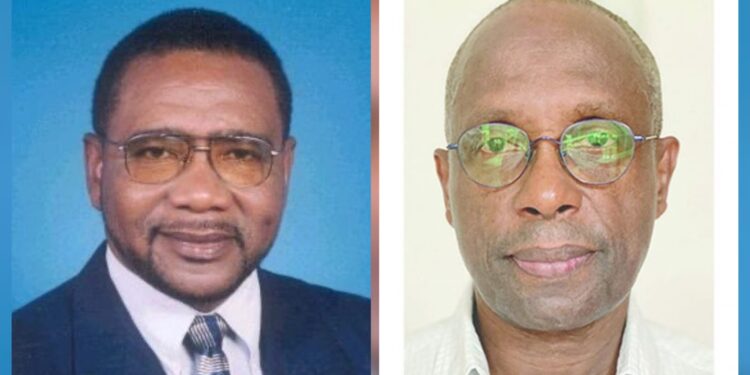
A few weeks ago, as he and a few of his redshirted People’s Progressive Party (PPP) colleagues were campaigning in Beterverwagting, I had a fleeting encounter with Mr. James Bond. We shook hands on his move, but he looked back, smiled and said, ‘I am following in your footsteps.’ For a moment I thought that James must have ‘lost it’ but then came to the realisation that many people neglect to properly locate their context.
After all, I became politically associated with the PPP in the late 1980s, when Soviet Marxism having disintegrated made Guyana and the PPP geopolitically irrelevant and it appeared that, the ethnic strife that took many lives in the 1960s forgotten, there was a more than good chance of the country, given its natural and human resources becoming a prosperous, inclusive society i.e., a la PPP ‘a return to democracy.’
Unfortunately, the PPP government Mr. Bond has became associated with in 2025 is assessed by the world’s most respected index on government transparency as having captured and using the state for it own ends. Also, this year, the PPP government has been designated an elected autocracy – i.e. a dictatorship – by V-Dem, the world’s most comprehensive democratic index.’
But of far greater significance is Mr. Lincoln Lewis’ attempt to save Guyana from the dictatorship it already is, largely because in my view he is a great believer in the existing Constitution. If Bond did not properly contextualise the historic eras he juxtaposed, Mr. Lewis failed to do so with the de facto political structures of governance. If that was not so, he would come to realise that, maybe as an unintended consequence, the Constitution of Guyana facilitates ‘one man’ rule. And that, particularly in the context of fortuitous large-scale national resource management, this is most unfortunate.
Having drawn attention to the PPP general secretary’s request that the electorate give his party a 2/3 majority for it to be able to make constitutional reforms, Lincoln concluded ‘No political party must ever be allowed to gain a two-thirds majority in Guyana’s National Assembly. That kind of power would be the beginning of the end for democracy, the rule of law, and every right and freedom the Guyanese people have fought for over generations. It would legalise the illegal, legitimise the abuse of power, and turn oppression into policy’ (KN: 04/08/2025).
All he said is true, but it has already occurred, largely because even where governments are produced by free and fair elections, they may be inefficient, corrupt, shortsighted, irresponsible, dominated by special interests and incapable of adopting policies demanded by the public good. ‘These qualities make such governments undesirable, but they do not make them undemocratic.’ To reverse the current dictatorship and prevent a future Guyanese government from ‘legitimising the abuse of power and turning oppression into policy’ one needs to urgently properly contextualise, constitutionalise and implement some fundamental liberal precepts.
What I am saying here is that the major problem in Guyana is not the Guyana/Venezuela border controversy, not the obvious waste of national resources focused on buying votes rather than upon generational thinking and therefore consensus building, not the 2016 lopsided oil contract about which neither the government nor opposition is willing to confront Exxon, not the humongous level of corruption, not the blatant maldistribution of wealth that discriminates against Africans and Amerindians, etc.
I may have missed it, but even if so it is useful to emphasise that apart from broad commitment to constitutional reform, I have seen nothing in the various parties’ manifestos that give a clear indication of the nature of the reforms that are required. Priority must be given to reforms to prevent the leader of the ruling party’s almost unhindered political decision making. He selects the president and parliamentarians from a closed list of electors.
If monstrosities such as democratic centralism are in play, even the oligarchy in the party of which he is a member is largely at his disposal. The constituency that voted for the party at national and regional elections has little voice and will largely adhere to his beck and call because, even in opposition, there is substantial patronage to share. Supporters are fed various ideological concoctions, laced with socialist, racial and regional bias to help solidify the party and the leaders grip on the leadership.
The separation of powers is one of the cornerstones of democratic government, yet for decades to enable the PPP to control the judiciary, the top judicial officers have been in acting positions. Effective measures, such as term limits after which acting positions become permanent, or even sortition i.e., lottery, must be urgently put in place. Only minority ethnic groups at present exist in Guyana and if, as in Suriname, the president and possibly the national budget had to acquire super-majorities to get legislative approval, the dictatorial behaviour will be seriously constrained.
Among other things, no president could have refused to speak to the opposition leader as the PPP did; no president could have refused to carry out an ethnic disparity analysis as Irfaan Ali did; no president could have for decades avoided collective bargaining that punishes the constituency of the other side as the PPP had done. In Lewis’s parlance, no president would have been able to ‘legalise the illegal, legitimise the abuse of power, and turn oppression into policy.’
Furthermore, as in Suriname, the vital budgeting process follows international best practices, is very inclusive and lasts for 3 months rather than the 22 days of largely meaningless parliamentary discourse as in Guyana. Independent Members of Parliament selected, elected by, responsible to and recallable by their local constituencies should be established. Local governments are so suppressed in Guyana one could hardly hold a substantial private party without having to get permission from the central government. The principle of ‘subsidiarity’ should limit the scope of central government.
The Natural Resource Charter presents a comprehensive and interrelated picture of what is necessary if a country it to make the best of its resources. ‘Because the extraction process can last many generations, decisions made in the present must be robust to the cycles of governments. This calls for building understanding and consensus from a critical mass of informed citizens. Actors outside the executive, including legislators, journalists, and civil society groups are guardians of the strategy, playing a scrutinizing role by holding decision-makers to account’ (https://resourcegovernance. org/approach/ natural-resource-charter).
Reforms that seek to establish the democratic process by preventing the continuation of ‘one man’ rule are urgently required. But it is as if there exists a silent prayer for the country to be lucky enough to elect ‘good’ people to manage its affairs. The evidence suggests, however, that is it not sensible to put your hopes in there being ‘good politicians’ for they are very thin on the ground.