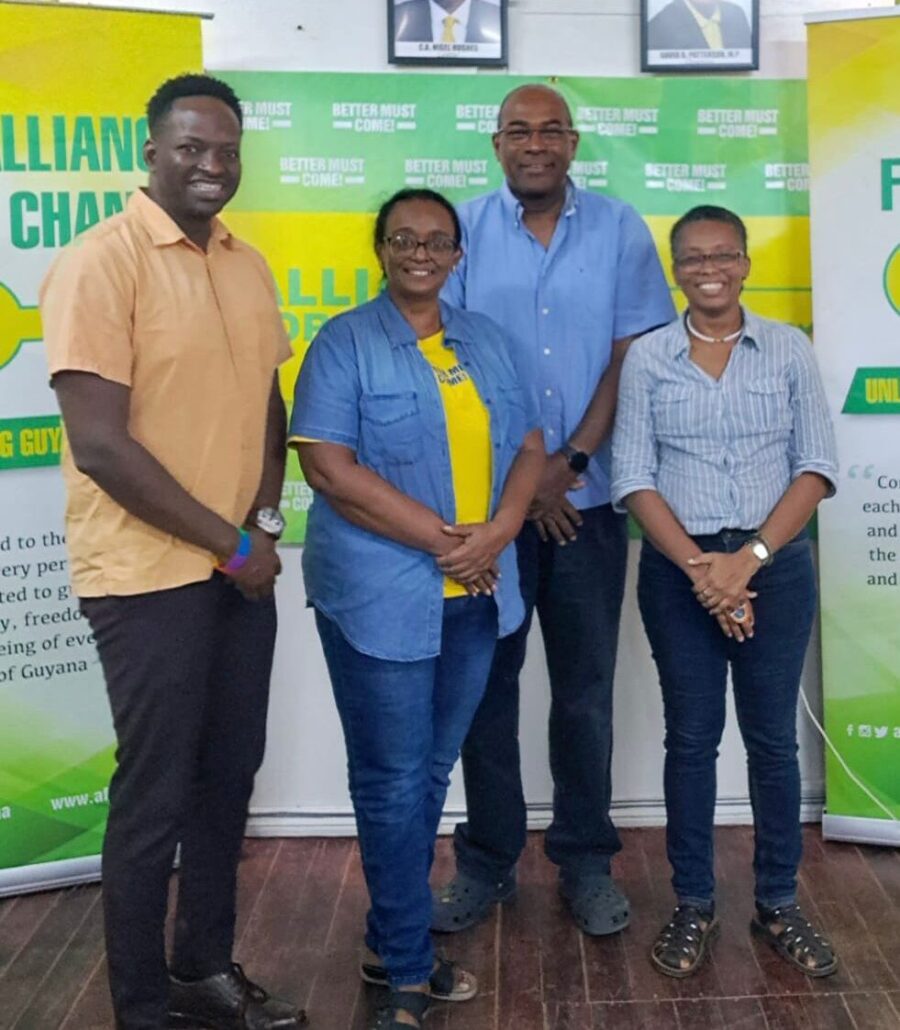
By Mark DaCosta- The Alliance For Change (AFC) and the Society Against Sexual Orientation Discrimination (SASOD) met in late July 2025 for a frank exchange on discrimination, bullying and legal protections for LGBTQ people; the AFC delegation was led by party leader Nigel Hughes alongside deputy general secretary Beverley Alert, while SASOD was represented by managing director Joel Simpson and member Natasha Yhap.
In a discussion held in July, the two organisations examined education, victimisation tied to gender identity, gaps in law and ongoing research into discrimination — and agreed to a collaborative relationship intended to prevent the party from adopting positions or policies that would marginalise people on the basis of gender or sexuality. The meeting signals a rare public rapprochement between a national party and an advocacy group that has long pressed for reform of colonial-era statutes and greater protection for sexual minorities in our country.
For observers of Guyanese politics the event is notable. SASOD, formally known as the Society Against Sexual Orientation Discrimination, has for years been one of the most visible civil-society voices pushing for legal and social change on behalf of lesbian, gay, bisexual, transgender and queer people. The organisation combines public education campaigns with legal advocacy, research and community outreach: it documents incidents of harassment, runs sensitisation workshops, supports strategic litigation and engages regional and international human-rights mechanisms to challenge laws and practices that stigmatise sexual minorities.
In a nation where conservative social attitudes remain strong and remnants of British colonial law continue to criminalise same-sex intimacy, SASOD’s work has been and catalytic — it has helped place issues of equality and non-discrimination on the national agenda.
The meeting with the AFC comes against this backdrop. According to participants, conversations ranged from the need for more comprehensive public education on all forms of discrimination to specific concerns about how people are victimised because of their gender identity, as well as the prevalence of bullying in schools and workplaces. Both sides reportedly discussed legislative options to prohibit discrimination on grounds of sexual orientation and gender identity, and the role that evidence-based research — much of which has been produced by or in partnership with SASOD — can play in shaping policy. The two groups arrived at a mutual commitment to collaborate with an express aim: ensuring that the AFC’s platform and policy proposals do not endorse or enable discriminatory practices.
Political analysts in Georgetown noted the practical ambitions of such an arrangement, but also urged scrutiny. A promise to avoid discriminatory policies is meaningful only if translated into concrete steps: a timetable for policy review, public disclosure of any changes to party manifestos, and follow-up meetings with affected communities. Civil-society engagement with political parties can produce progressive outcomes, yet it can also be cosmetic unless mechanisms for accountability are agreed and made public.
SASOD’s participation in these talks also reflects a broader strategy by rights groups to engage the political mainstream rather than remain solely in adversarial roles. Over the past decade the organisation has alternated between campaigning in the courts, lobbying parliamentarians and conducting grassroots education in an effort to change hearts and minds as well as laws.
That hybrid approach has yielded incremental gains: greater visibility of LGBTQ concerns, international support, and a slow but perceptible shift in public debate. Nevertheless, the day-to-day realities for many queer Guyanese — from schoolchildren facing bullying to adults excluded from employment or healthcare — underscore the distance between dialogue and durable legal protections.
As the AFC and SASOD move from a single meeting toward a working relationship, the key questions for citizens of our nation will be whether promises are operationalised, and whether the voices of marginalised people remain central to policy development. For advocacy to become change, the public should expect a clear roadmap: what specific reforms will be proposed, how consultations will be conducted, and how progress will be monitored. Without those elements, well-intentioned meetings risk becoming yet another statement with little follow-through.