Political commentator GHK Lall is raising urgent questions about fairness, consistency, and institutional integrity in Guyana amid mounting controversy over the treatment of individuals sanctioned by the United States (U.S) government.
In a recent column titled “Sanctioned, unsanctioned, banks, other considerations,” Lall lays out what he calls three telling cases that reflect the contradictions in how Guyana treats both sanctioned and unsanctioned individuals—especially in matters of politics, banking, and justice.
“Guyana is either the mother of all backward countries, or the best relative to its sublime law-abiding character,” Lall writes, inviting citizens to examine three real-world examples and then “examine themselves in the mirror to determine whether they resemble Freddy Krueger or Sir Thomas More.”
Sanctioned Mohamed Cleared, Team Rejected
Lall first turned his focus to the Guyana Elections Commission (GECOM), describing it as the national agency “standing close guard on the bridge of Guyana’s elections.” He zeroed in on GECOM’s handling of Azruddin Mohamed, the leader of the We Invest In Nationhood (WIN) party, who is currently under U.S. sanctions. Despite this, Lall notes, Mohamed was given the all-clear by GECOM to contest elections.
“Apparently, GECOM’s only objection to the sanctioned Azruddin Mohamed of WIN fame was whether his jaguar was a local lion, or an alley cat,” Lall wrote. “He was already walking around with the weight of US sanctions on his head when he ventured near the elections bridge. GECOM afforded free and full passage after the feline festivities were settled.”
However, the same acceptance was not extended to members of Mohamed’s team, who, despite being unsanctioned, were reportedly denied banking services by Demerara Bank and later GBTI. According to Lall, “unsanctioned members of his team, full citizens with, I take the leap, the fullest compliance with this country’s laws, fall afoul of two banks. No bank accounts, no job.”
Citizens Bank and NBS have since denied similar services to WIN candidates.
Lall added pointedly: “GECOM, an arm of the State, has approved a US-sanctioned Guyanese for elections activities… But unsanctioned comrades are censored and slammed.”
The Case of Mae Thomas and Himnauth Sawh
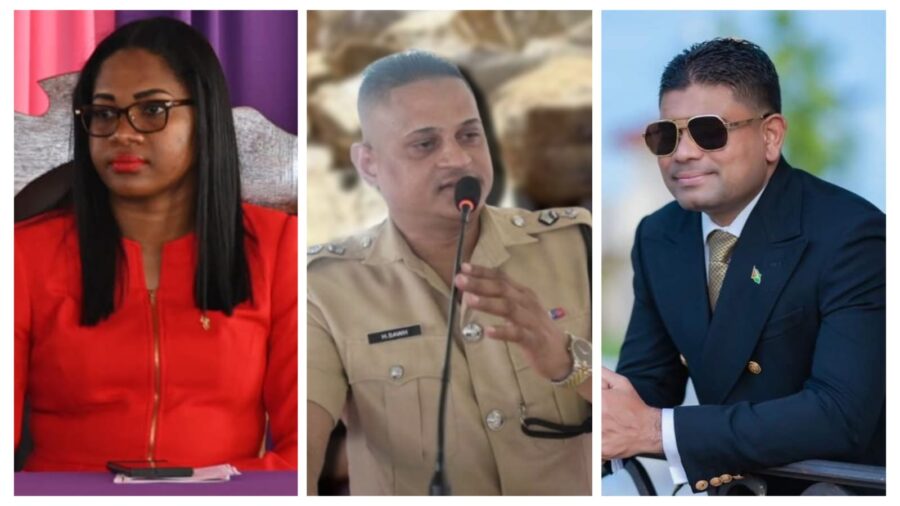
In his second example, Lall highlighted the case of former Permanent Secretary Mae Toussaint Jr. Thomas—who is also under U.S. sanctions, and reportedly has since resigned from the Central Executive of the People’s Progressive Party (PPP).
But his concern didn’t stop there. Lall drew attention to a third sanctioned Guyanese: Senior Superintendent Himnauth Sawh of the Guyana Police Force. Sawh has been sent on leave and is currently subject to due process. Lall acknowledges that Sawh is “entitled” to all the protections afforded under Guyanese law, including police service regulations.
However, the question of his banking status remains relevant.
“Even if the senior superintendent is paid by cheque he still has to utilise some financial institution,” Lall noted. “I pass no judgment on the standards and practices that the banks may have employed… But if they are in a relationship with him, like maybe Ms. Thomas, what message does that convey?”
He challenged Guyanese to serve as “referees,” urging them to weigh in on whether such decisions are being applied consistently and fairly.
“Guilt by Association” and Risk Aversion
Lall acknowledged that local commercial banks may feel constrained by the risks of engaging with sanctioned individuals. Guyana’s private sector and other umbrella bodies have echoed similar concerns. But he warns that due process and constitutional rights must not be casualties of fear-driven policy.
“What about that old wisdom of better sparing a thousand guilty than one innocent sent to the gallows?” he asked. “Or there is recollection, but it doesn’t apply to some in some circumstances?”
He went further: “Child molesters and rapists, serial killers and other mad dogs, are all given the widest coverage of the best defense that is constitutionally permissible… but unsanctioned Guyanese have their feet roasted by fire.”
Lall referenced even Nazi war criminals, noting that individuals like Werner Von Braun were ultimately embraced by the U.S. government, yet today, in Guyana, “guilt by association is seemingly what is at work.”
Elections, Fear, and the Future
Quoting Franklin D. Roosevelt’s famous line—“the only thing we have to fear… is fear itself”—Lall called for greater national introspection.
He urged Guyanese, including “my well-wishers and admirers in the PPP,” to “dive deeply, then to expound sensibly, fairly, and publicly on what really is at work in relation to the approximately 20 up to recent Demerara Bank account holders. Don’t forget that one fired GBTI employee. For exercising their sacred right to choose their political company.”
In a final, sobering question, Lall asked: “Is Guyana a country rising, or a society decaying?”
He didn’t answer. “I take the easy way out. No position,” he wrote. But the implications are clear—and they demand serious public discussion.