


How a Prime Minister’s non-response to an Interpol controversy exposed more than it concealed
PORT-OF-SPAIN, Trinidad and Tobago (WiredJA) – There’s an old saying in Caribbean politics: when you’re explaining, you’re losing. Prime Minister Kamla Persad-Bissessar seems to have taken this advice so literally that she’s opted out of explaining altogether—and somehow managed to lose anyway.
Her response to former Prime Minister Keith Rowley’s explosive revelation about being placed on an Interpol watch list reads like a masterclass in political deflection. Rather than address the substantive questions about how a former head of government ended up flagged by international law enforcement, Persad-Bissessar chose to attack the messenger while studiously avoiding the message.
The Art of Non-Response
When pressed by the Trinidad Express about Rowley’s claims, the Prime Minister delivered what can only be described as a greatest hits compilation of political evasion tactics. She called his actions “reckless,” demanded an apology, and accused him of “conspiracy theories”—everything except explaining how his name allegedly got on that list in the first place.
This is particularly striking given that Rowley’s account was methodical, specific, and delivered by someone who spent a decade chairing Trinidad and Tobago’s National Security Council. His description of the “Antigua Long Bench” experience—being detained twice by immigration officials who explicitly told him he was on a watch list—came with the precision of someone intimately familiar with how these systems work.
Yet Persad-Bissessar’s response treated this detailed account as if it were the ramblings of some conspiracy theorist rather than the testimony of a man who, until recently, had access to the very security apparatus now allegedly targeting him.
The Credibility Gap
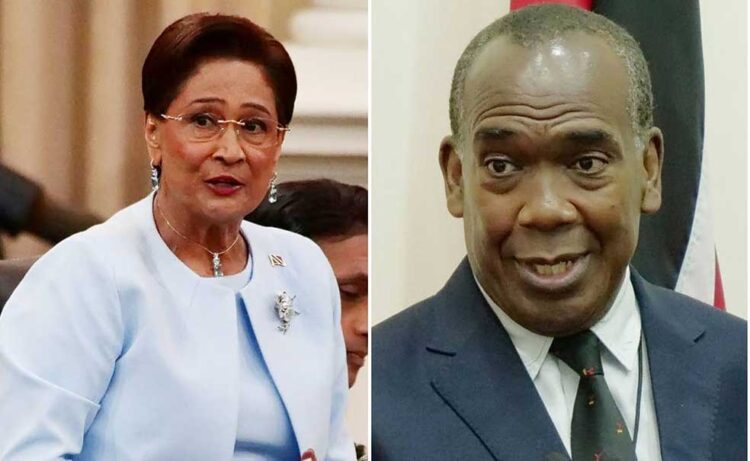
At Left, Prime Minister Kamla Persad Bissessar while at right is Attorney General John Jeremie referenced by Rowley over his “shocking” speech in Parliament where he allegedly threatened Opposition members.
The most glaring contradiction in the Prime Minister’s response lies in her criticism of Rowley for not “first seeking answers from the police.” This suggestion reveals either a stunning misunderstanding of how Interpol listings work or a deliberate attempt to mislead the public.Interpol watch list entries don’t originate from casual police inquiries—they stem from formal requests by national authorities alleging criminal activity. For Persad-Bissessar to suggest that Rowley should have simply called the local police station to clear this up demonstrates either breathtaking naivety about international law enforcement procedures or calculated disingenuousness.
More damning still is the timing of her comments. The Trinidad and Tobago Police Service (TTPS) issued a statement shortly after Rowley’s press conference claiming he was not on any Interpol list—yet this apparent contradiction didn’t prompt the Prime Minister to question why immigration officials in Antigua would repeatedly detain someone based on non-existent intelligence.
The Security Expert’s Advantage
What makes Persad-Bissessar’s dismissive tone particularly tone-deaf is the identity of her accuser. Rowley didn’t stumble into the Prime Minister’s office from some political wilderness—he spent nearly a decade as the country’s chief executive and chairman of its National Security Council. His familiarity with how Trinidad and Tobago’s security apparatus interfaces with international partners isn’t theoretical; it’s institutional.
When someone with Rowley’s security credentials describes being told by foreign immigration officials that his name triggered Interpol alerts, it demands investigation, not insults. His methodical recounting of events—complete with specific dates, locations, and the exact language used by officials—bore the hallmarks of someone who understands the gravity of such allegations.
But Rowley didn’t stop at merely reporting what happened in Antigua. Drawing on a decade of relationships built while leading Trinidad and Tobago’s security apparatus, he launched what he called “necessary investigations” through CARICOM contacts and colleagues. The results were unambiguous: confirmation that he was indeed on Interpol’s watch list, with Antigua’s actions being a direct response to international law enforcement interest in him.
This isn’t some opposition politician making wild accusations—this is a former National Security Council chairman using the very networks and contacts he cultivated over ten years in power to verify facts. When someone with Rowley’s institutional access conducts his own investigation and confirms the allegations, dismissing him as reckless becomes an exercise in willful blindness.
Compare this methodical, evidence-gathering approach to Persad-Bissessar’s response, which read like talking points crafted by someone who hoped volume could substitute for substance.
Questions That Demand Answers
The Prime Minister’s evasions have only amplified the very questions Rowley raised. If his name wasn’t actually on any Interpol list, why did Antiguan authorities repeatedly flag him? If there was indeed some “mistaken identity” as officials there suggested, what specific steps have Trinidad and Tobago’s authorities taken to clarify this with international partners?
Most critically, if the TTPS truly found no record of any Interpol listing, doesn’t this suggest either a breakdown in communication between Trinidad and Tobago’s police and their international counterparts, or worse—that someone is lying?
Persad-Bissessar’s strategy of attacking Rowley’s decision to go public rather than addressing these substantive questions has backfired spectacularly. Her demand that he apologize to the nation rings hollow when she hasn’t explained what, exactly, he should apologize for—being detained by foreign authorities based on intelligence allegedly originating from Trinidad and Tobago?
The Precedent Problem
Perhaps most troubling is what Persad-Bissessar’s response reveals about her administration’s approach to accountability. Rather than treat this as a serious matter requiring transparent investigation, she’s chosen to frame it as a public relations problem to be managed through spin rather than substance.
This approach sends a chilling message to other potential critics: speak out against this government, and expect personal attacks rather than answers. It’s the kind of response one might expect from an administration more concerned with protecting its image than protecting democratic norms.
Rowley’s warning—”Today is my day, your day will come”—takes on added significance in this context. If a former Prime Minister can be dismissed and attacked for raising legitimate questions about potential abuse of state power, what hope do ordinary citizens have for accountability?
The Credibility Crisis
Ultimately, Persad-Bissessar’s response has achieved the opposite of its apparent intention. Rather than discrediting Rowley’s claims, her evasions have lent them credibility. Her failure to provide substantive answers to substantive questions has transformed what might have been a one-day story into an ongoing credibility crisis for her administration.
The Prime Minister’s demand for an apology might be better directed inward. Trinidad and Tobago deserves better than non-answers masquerading as responses, and the Caribbean’s democratic tradition deserves better than leaders who treat legitimate questions as personal attacks.
In politics, when you’re not explaining, you’re definitely losing. Persad-Bissessar’s response proves that sometimes, the silence speaks louder than the words.







![The 11th national congress of returned overseas Chinese and their relatives concluded in Beijing on Sept 3, 2023. [Photo/Xinhua]](https://villagevoicenews.com/wp-content/uploads/2023/09/cogress-120x86.jpeg)
